What reputation management skills should every communications professional develop?
Quick answer
Every communications professional should build six baseline skills: entity-optimization basics, AI literacy, Wikipedia policy fluency, the ability to read a search-result page critically, structured-data fundamentals, and integrated measurement across earned, owned, Wikipedia, and AI channels.
Reputation now forms in channels that messaging skill alone does not reach. Six disciplines that used to belong to specialists have become part of the baseline for communications professionals. None requires deep technical expertise; what matters is knowing enough to act correctly and to brief a specialist well.
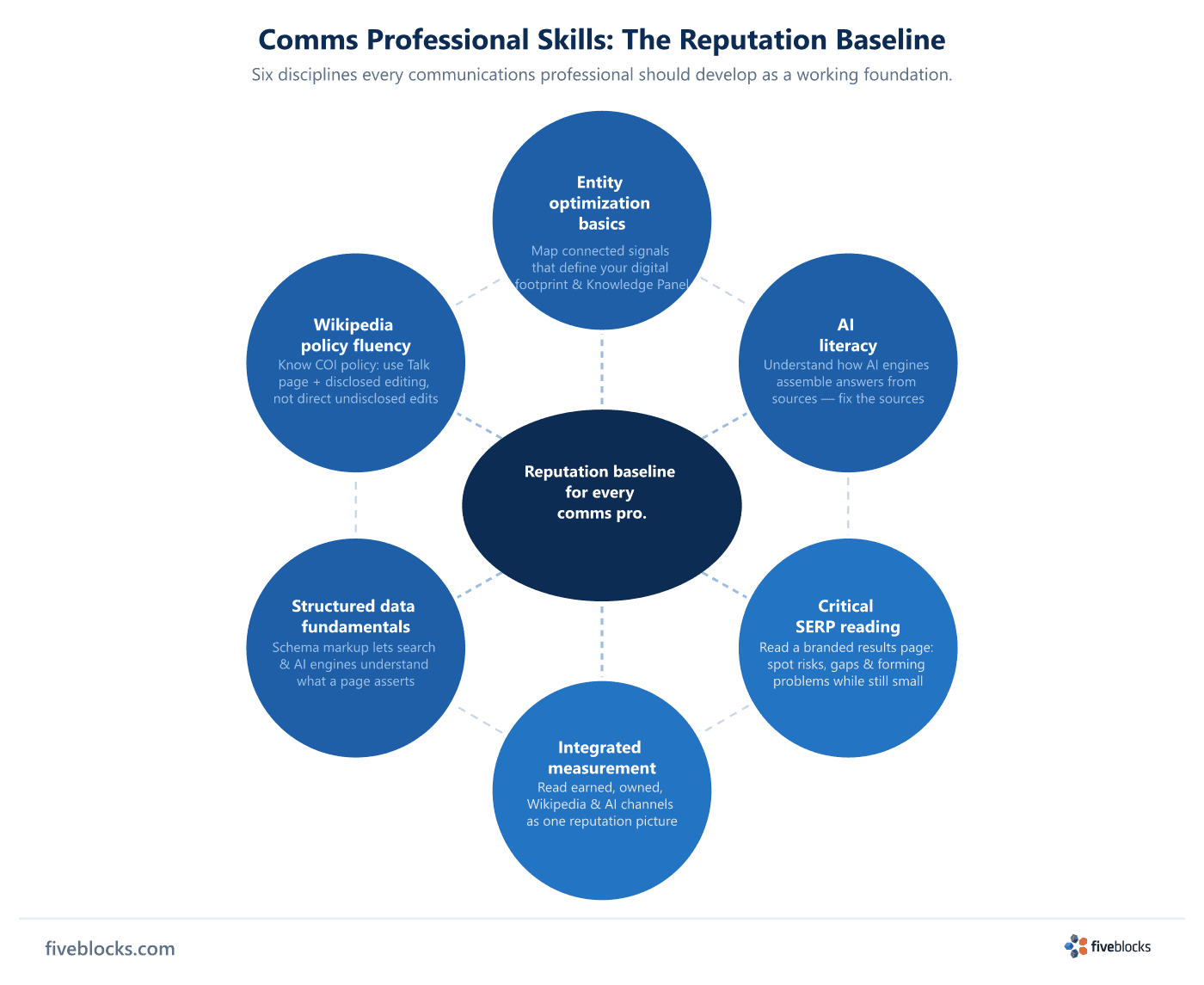
- Entity-optimization basics
- Understanding how the connected signals that identify an organization (directories, structured data, authoritative third-party references) drive the Knowledge Panel and the wider digital footprint. Entity signals are the substrate everything else rests on. Accurate ones make other communications work land; thin or wrong ones quietly work against it.
- AI literacy
- Knowing how AI engines assemble answers from the sources available about a company, so the instinct is to improve and anchor those sources rather than to try to edit a model’s output, which no one can do. The AI narrative sits downstream of the source layer. Change the sources and the answer changes.
- Wikipedia policy fluency
- Enough policy knowledge to recognize that direct, undisclosed editing backfires. It violates Wikipedia’s terms of use, the editing community actively detects it, and it usually leaves the article in worse shape than before. The right path is the Talk page and the disclosed conflict-of-interest process, where the editor declares the relationship to the subject and argues proposed changes on their merits.
- Critical SERP reading
- The ability to look at a branded search-result page and see what occupies it and why: which assets rank, what they say, where the risks and gaps sit. Someone who reads a SERP closely can catch a forming problem while it is still small.
- Structured-data fundamentals
- Knowing why schema markup and machine-readability decide whether well-produced content actually reaches search and AI engines. Structured data is how those systems understand what a page asserts and attach it to the right entity. Without it, content can be live and still invisible to the machines that now shape the first answers stakeholders receive.
- Integrated measurement
- Reading earned media, owned content, Wikipedia, and AI narratives together as one reputation picture instead of four separate reports. The channels feed each other: earned coverage shapes Wikipedia, Wikipedia feeds the AI engines, and the AI engines shape what stakeholders find. Measurement that treats them in isolation misses the interactions that decide the outcome.
Last reviewed: 20/05/2026
