How should crisis communications plans incorporate digital reputation management?
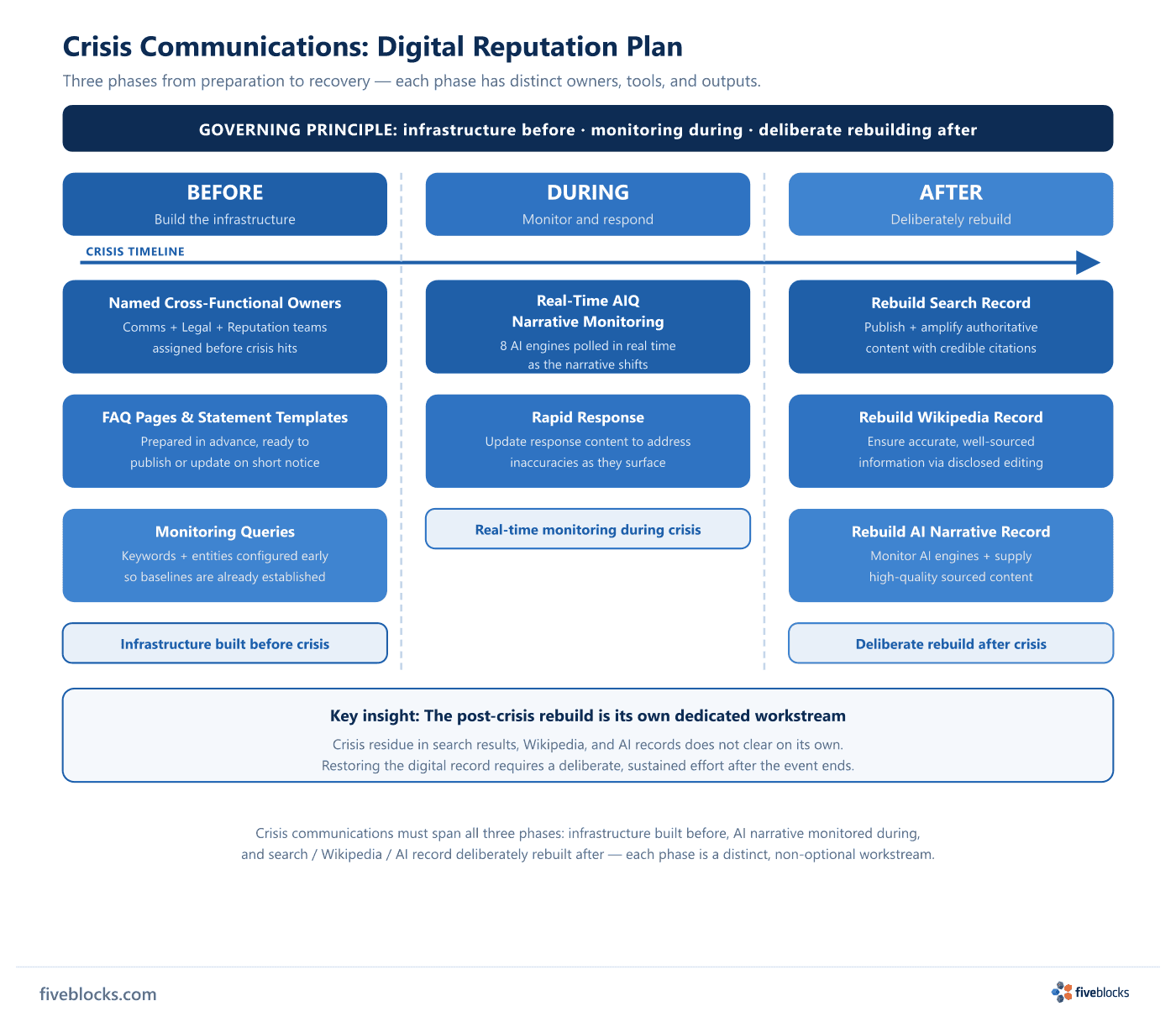
A crisis communications plan has to cover digital reputation in three phases. Build the infrastructure before the crisis (FAQ pages, statement templates, cross-functional ownership, monitoring queries), monitor the AI narrative in real time during the event, and treat the post-crisis rebuild of the search, Wikipedia, and AI record as its own workstream. Infrastructure before, monitoring during, deliberate rebuilding after.
A crisis communications plan that ignores digital reputation is planning for the last era’s crisis. A story breaks and is immediately synthesized by search engines and AI answer engines, so the plan has to cover those channels before, during, and after the event.
Step 1, before: build the infrastructure
- Assign named cross-functional owners across communications, legal, and reputation, so nobody is working out who acts while the crisis is already running.
- Prepare FAQ pages and statement templates in advance, ready to publish or update on short notice.
- Set up monitoring queries on the relevant keywords and entities before you need them, so the baselines already exist.
Step 2, during: monitor the AI narrative in real time
AI answer engines get asked about the crisis almost as soon as it becomes public. Your communications team needs to know what those engines are saying while the narrative is still shifting, not hours later. This is what AIQ is for: it polls eight major AI engines in real time. Track how the crisis narrative is being represented, and update your response content to correct inaccuracies as they surface.
Step 3, after: rebuild the digital record deliberately
A crisis leaves a residue in search results, Wikipedia, and the AI narrative record, and it does not clear on its own. Restoring the digital record is its own workstream, not a by-product of the crisis ending. The rebuild should address:
- Search results, publishing and amplifying authoritative positive content that credible, independent outlets can reference, since search and AI engines weight sources by credibility and independent citation.
- Wikipedia, bringing the article in line with accurate, well-sourced information through disclosed conflict-of-interest editing where appropriate, because the Wikipedia record feeds knowledge panels and AI engine training data.
- AI narrative, watching how AI engines represent the post-crisis story and continuing to supply the well-sourced content that shifts their outputs over time.
Last reviewed: 20/05/2026
