What pre-built digital assets should you have ready before a crisis?
The six asset types that matter most before a crisis: scenario-tagged statement templates with counsel-approved language, FAQ pages on sensitive topics, current leadership bios and quotes, fact pages on common stakeholder questions, owned-property content covering broader operations, and monitoring queries pre-saved in IMPACT and AIQ. Five Blocks helps clients build and refresh this library on a twice-yearly maintenance cadence.
A pre-built asset library is what lets you deploy in the first hour of a crisis instead of improvising. Without it, communications teams spend the opening hours building what should already exist: drafting statements under time pressure, hunting for approved quotes, configuring monitoring from scratch. With it, the response is a deployment rather than a build.
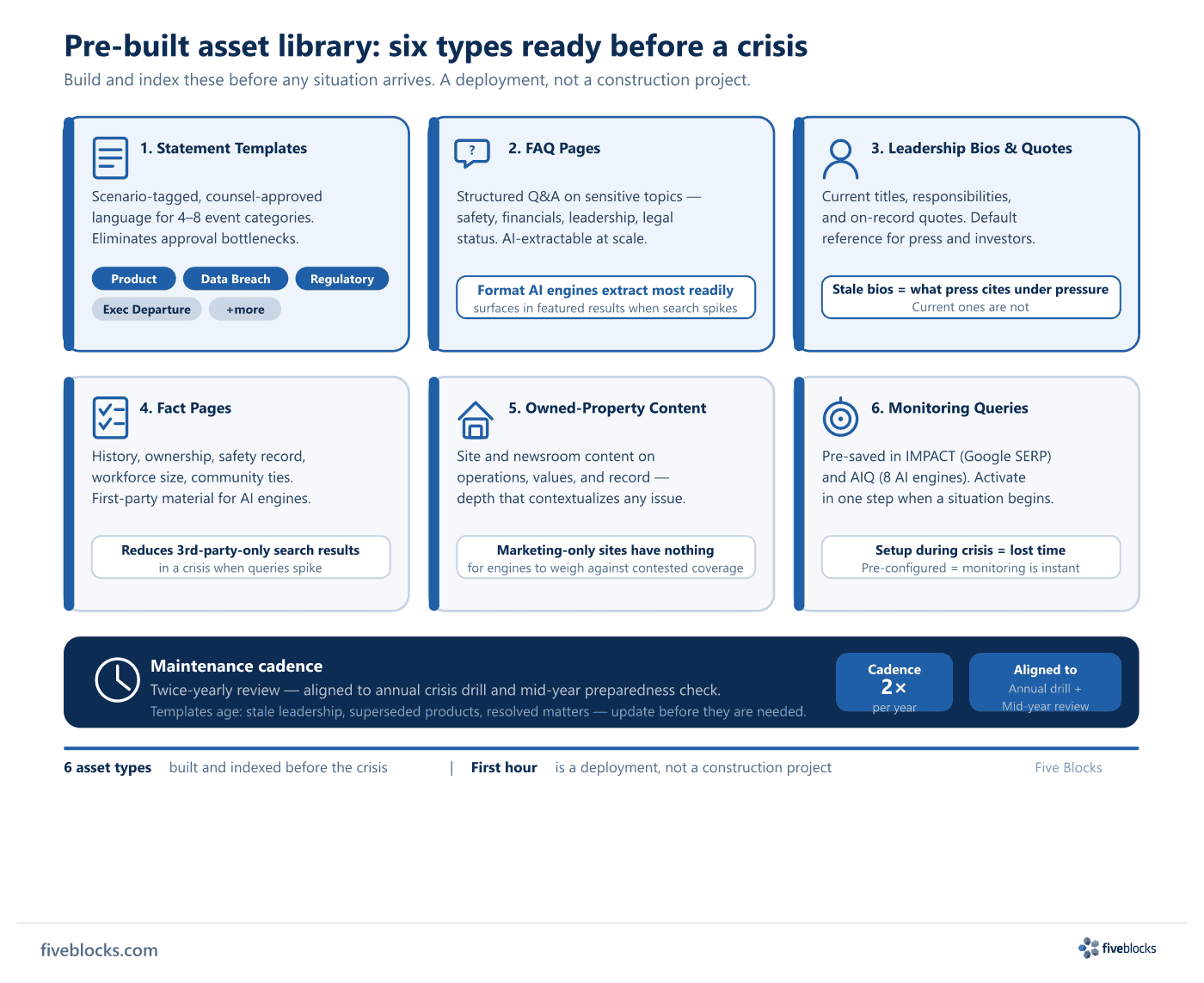
- 1. Scenario-tagged statement templates
- Counsel-approved language for the four to eight categories of event the company is most likely to face. Each template is tagged to a scenario type (product incident, executive departure, regulatory action, data breach) so the right version is reached immediately. Pre-approved language removes the approval bottleneck that turns a one-hour turnaround into a twelve-hour one.
- 2. FAQ pages on sensitive topics
- Structured question-and-answer pages covering the topics most likely to draw searcher attention during a crisis: product safety, financial stability, leadership, regulatory status. AI engines extract FAQ structure most readily, so pages built and indexed before the crisis can surface in AI answers and featured results the moment search interest spikes.
- 3. Current leadership bios and quotes
- Up-to-date executive and leadership pages with accurate titles, responsibilities, and on-record quotes. These become the default reference for journalists, investors, and the AI engines the moment a crisis prompts stakeholders to look. The press cites stale or thin bios under pressure; it cites current ones when they exist.
- 4. Fact pages on common stakeholder questions
- Standalone pages covering the factual questions stakeholders reliably ask in difficult moments: company history, ownership structure, product track record, safety record, workforce size, community commitments. These give the AI engines first-party authoritative material to surface and reduce the risk that a crisis search returns only third-party interpretations.
- 5. Owned-property content covering broader operations
- Substantive content on the corporate site and newsroom covering the company’s wider operations and commitments, at enough depth to put any single contested topic in context. A company whose owned properties offer only product marketing has nothing for the engines to weigh against contested coverage. A company whose properties document its operations, leadership, values, and record does.
- 6. Monitoring queries pre-saved in IMPACT and AIQ
- Topic queries and search-monitoring configurations loaded in IMPACT and AIQ before the crisis, ready to activate in one step. IMPACT tracks search-result shifts across priority keywords; AIQ tracks how the eight AI engines are framing the company across daily prompts. Setting these up during a live crisis costs setup time when speed matters most, so pre-configure them and monitoring runs from the moment the situation begins.
Maintenance cadence
The library needs active maintenance to stay useful. A statement template drafted eighteen months ago may reference outdated leadership, superseded products, or resolved regulatory matters. Five Blocks helps clients build the library and review it twice a year, usually aligned to the annual crisis drill and the mid-year preparedness review. The cost is small next to the day-one impact when a real situation arrives.
Last reviewed: 19/05/2026
