How do you prepare owned digital properties to absorb a crisis?
An owned property absorbs a crisis only if five layers are already in place before the incident: accumulated domain authority, schema-marked entity data, structured FAQ content that covers likely search queries, recent publishing activity that signals freshness to search and AI engines, and the operational ability to push factual updates in minutes rather than through a multi-week CMS approval queue. The last layer, publishing speed, is where most organizations fail in the first hour.
Owned properties absorb a crisis only if they are ready before the crisis arrives. Organizations that treat the corporate site and newsroom as static brochures find out under pressure that those properties cannot rank, cannot surface in AI answers, and cannot be updated fast enough to matter. Fixing that means building five layers ahead of time.
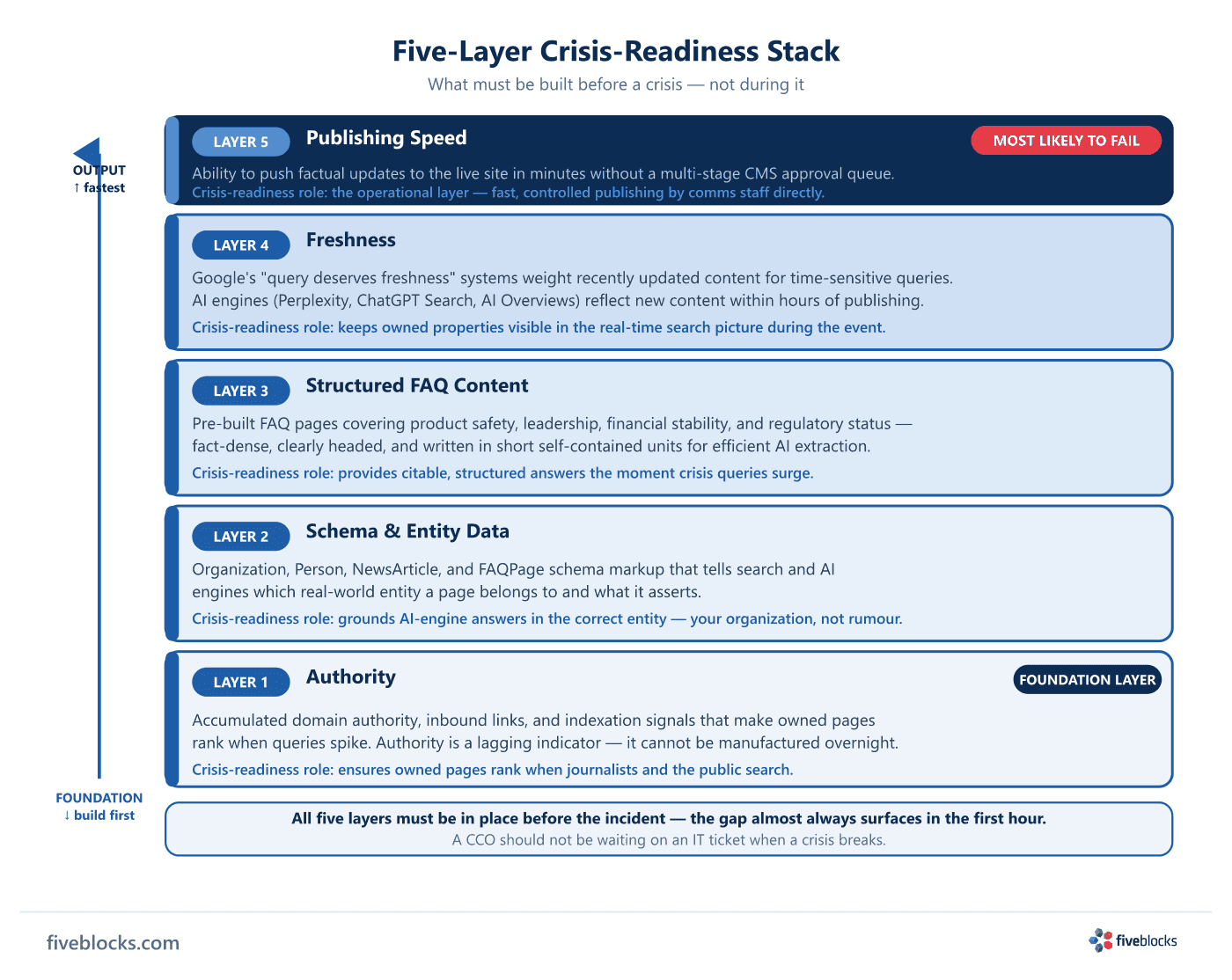
- Layer 1, Authority
- The corporate site, newsroom, and executive bio pages need accumulated indexation, inbound links, and engagement signals so they rank when they need to. Authority builds slowly and cannot be manufactured overnight. Google’s ranking guidance is clear that authority signals accumulate over time through consistent investment in credible, well-linked content.
- Layer 2, Schema and entity data
- Schema markup (Organization, Person, NewsArticle, FAQPage) tells search and AI engines what a page asserts and which real-world entity it belongs to. Google Search Central documents that structured data is how engines classify page content and decide when to surface it. As of May 2026, Google retired FAQ rich results in the SERP, so FAQPage markup no longer produces an accordion snippet, but the underlying structured data still helps engines understand the entity and ground AI answers.
- Layer 3, Structured FAQ content
- Pre-built FAQ pages covering the questions most likely to spike during a crisis, product safety, leadership, financial stability, regulatory status, give search and AI engines citable, structured answers the moment queries surge. Retrieval-driven AI engines extract answers more efficiently from content that is fact-dense, clearly headed, and written in short self-contained units than from long-form prose where the answer is buried.
- Layer 4, Freshness
- Dormant sites lose ranking authority over time. Google runs “query deserves freshness” systems that weight recently updated content for time-sensitive queries, which is what a crisis generates. Retrieval-driven AI engines (Perplexity, Google AI Overviews, ChatGPT Search) issue live web queries at the moment of each prompt, so recently published authoritative content can appear in AI answers within hours of going live.
- Layer 5, Publishing speed (the layer most likely to fail)
- The ability to push a factual statement, updated FAQ, or corrective press release to the live site within minutes, without going through a multi-stage CMS approval queue, is the layer that most often breaks down under crisis pressure. A CCO should not be waiting on an IT ticket during the first hour. The IT and content setup needs to let communications staff publish fast, under control, and directly.
We work with clients on all five layers as part of crisis preparedness. The readiness gap almost always surfaces in the first hour of a real situation, and by then it is too late to build what should have been in place already.
Last reviewed: 19/05/2026
