What are owned digital properties and why do they matter for reputation?
Owned digital properties (the corporate website, microsites, executive profile pages, investor relations hub, and press center) are the only assets a brand fully controls. That control lets you engineer each property for Google ranking and AI extraction, and it makes them the canonical reference that the entity layer (schema, sameAs links, Wikidata) points to.
Earned coverage and third-party platforms have value, but a brand cannot control them. It can control owned properties. The corporate website, executive leadership pages, topic microsites, investor relations content, and the press hub are the only assets where the brand decides what is said, how it is structured, what schema markup wraps the content, and when it is updated.
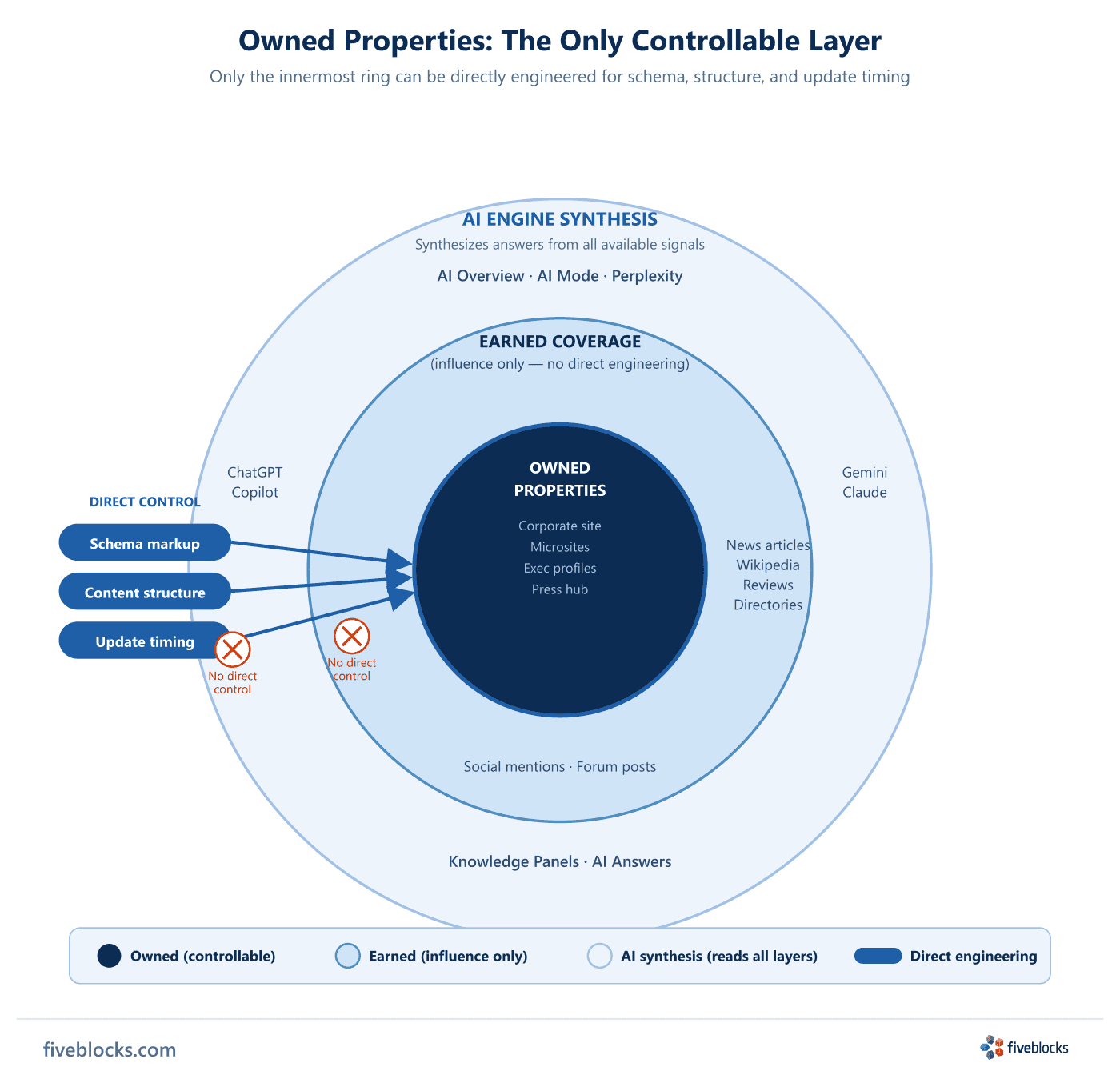
Why control matters
- You can engineer them for Google and AI extraction
- Owned content can be built for search ranking and AI engine ingestion: clean heading hierarchy, FAQ structure with FAQPage schema, Organization or Person schema with
sameAslinks, tight internal linking, and fast load times. These controls do not exist on rented platforms, where the brand owns neither the markup nor the update cadence. - They are the canonical entity reference
- The Wikidata entry, Knowledge Panel, and AI engine grounding all point outward to a canonical source, and that source should be the brand’s own domain. When owned properties carry well-formed
sameAslinks back to Wikidata, Wikipedia, and authoritative directories, the entity layer resolves cleanly. AI engines build answers about an entity from its digital footprint, and owned properties with strong schema are among the highest-weighted inputs.
Core owned properties
- Corporate website
- The primary canonical domain. It carries Organization schema with founding details, headquarters, industry, and
sameAslinks. About and leadership pages do the most work for branded query ranking and entity extraction. - Executive profile pages
- Dedicated owned bios with Person schema, current title, biographical anchors, and
sameAslinks to LinkedIn, Wikipedia (where notable), and Wikidata. Each page is the canonical identity reference for that leader and helps engines attribute statements and roles correctly. - Topic microsites
- Focused domains or subdomains built around a specific narrative: a product line, a market segment, a campaign. They widen the brand’s controllable footprint on queries the main domain cannot rank for alone.
- Investor relations hub
- Structured financial and governance content that engines and institutional audiences use to check the brand’s stated narrative against the public record.
- Press center
- A dated, structured archive of releases, media assets, and statement content. Engines index and cite press centers heavily when they construct brand narratives, so freshness and schema compliance matter.
A reputation program that under-invests in owned property infrastructure builds on rented ground, dependent on platforms and publishers that can change structure, policies, or ranking behavior at any time without notice.
Last reviewed: 19/05/2026
