How do you ensure owned properties are optimized for both Google and AI search?
The same disciplines that make a page readable to a search crawler also make it extractable by an AI model: clean HTML and schema markup at the technical layer, named expert authorship and authoritative external citations at the credibility layer, and clear question-and-answer structure at the extraction layer. Pages built to all three standards rank in Google and get cited by the AI engines.
Optimizing owned properties for both Google and the AI engines relies on overlapping disciplines: what makes content readable to a search crawler also makes it extractable by a model. The work divides into three layers.
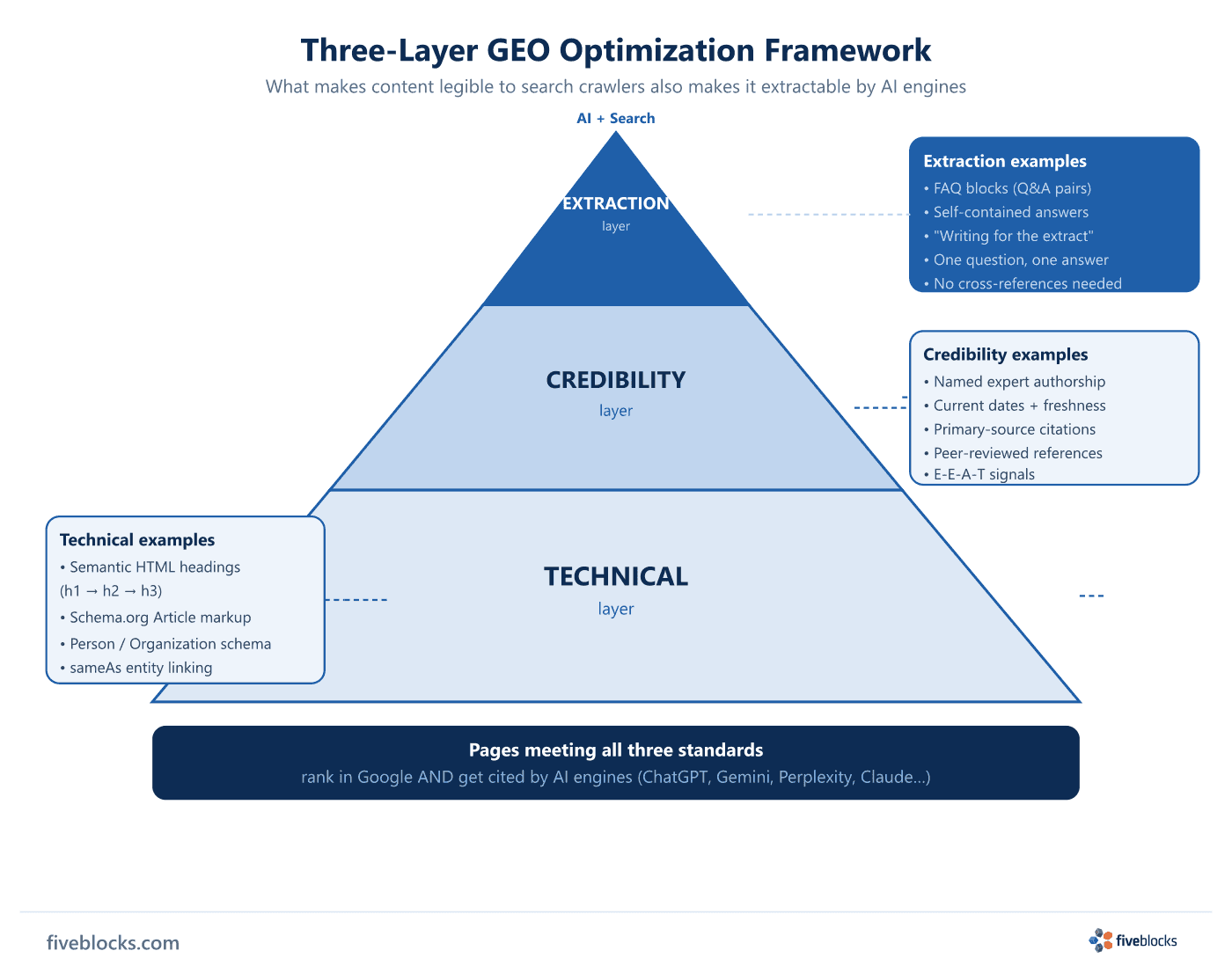
- Technical layer
- Clean HTML and schema markup let the systems parse the entities and content type on a page. Structured headings (
h1,h2,h3) make the document’s logic explicit. Schema.org markup, particularlyArticle,Person,Organization, andsameAsproperties, attaches the page to the correct entity in both Google’s Knowledge Graph and the retrieval indexes the AI engines draw on. Google Search Central describes structured data as “a standardized format for providing information about a page and classifying the page content.” - Credibility layer
- Named expert authorship rather than anonymous corporate prose signals the experience, expertise, authoritativeness, and trustworthiness (E-E-A-T) that Google’s quality raters assess and that the AI engines treat as a citation-worthiness signal. Current dates and freshness signals tell both systems that the content reflects a recent state of the world. Authoritative external citations, such as links to primary sources, official data, and peer-reviewed material, back up the claims and are among the factors the Princeton/ACM SIGKDD GEO research identifies as boosting source visibility in generative engine answers.
- Extraction layer
- FAQ blocks and clear question-and-answer structure are the format the AI engines pull from most readily. This is what we call writing for the extract: structuring content so a model can lift an accurate, self-contained answer directly from the page without paraphrasing or reconstructing meaning. Each answer should stand on its own, one question, one concise answer, no cross-reference required. The same structure helps with Google’s featured snippet selection. Note: as of May 2026, Google retired FAQ rich results (the accordion SERP feature), so FAQPage schema no longer produces a visual accordion in search results. Q&A structure remains the format AI engines extract from most reliably, so for GEO purposes the discipline is unchanged.
A page that meets all three standards ranks in Google and gets cited by the AI engines. We build owned properties to these standards and verify the result across both search and the AI engines with IMPACT™ and AIQ™.
Last reviewed: 20/05/2026
