How do you create content that both ranks in Google and gets cited by AI?
Content that earns both Google rankings and AI engine citations shares four requirements: fact-density with named entities and concrete claims; clear structure with logical headings and self-contained FAQ blocks; schema markup that makes entities and content type explicit; and freshness plus credibility signals, named expert authorship, current dates, and authoritative external citations. All four come down to writing for the extract: structuring content so a model can lift an accurate, standalone answer directly from the page.
Content that ranks in Google and content that gets cited by AI engines share most of the same requirements, so a single page built well serves both. The four requirements below apply to each system, and a page that meets all of them works for search and AI at once.
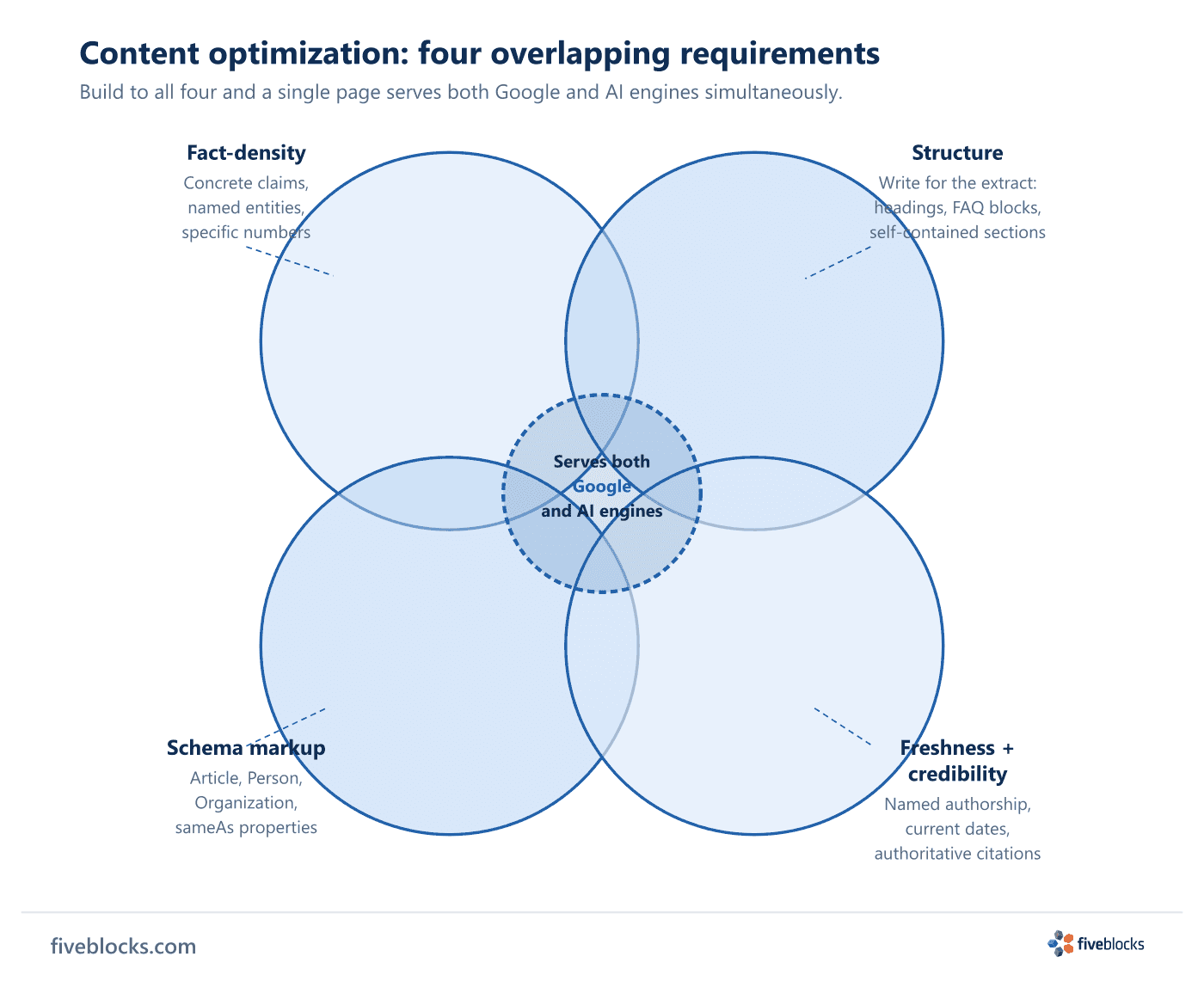
- Fact-density
- Google and the AI engines both favor content with concrete, verifiable claims, specific numbers, named entities, and dated events over content that is vague or promotional. The Princeton/ACM SIGKDD GEO research (2024) found that including citations, quotations from relevant sources, and statistics can significantly boost a source’s visibility in generative engine responses. Generic content neither ranks durably nor gets cited by a model looking for specific, extractable answers.
- Structure, writing for the extract
- This requirement serves AI engines most directly: structure the content so a model can lift an accurate, self-contained answer straight from the page without paraphrasing or reconstructing meaning. In practice that means logical headings (
h2,h3), short self-contained sections, and FAQ blocks where each question-answer pair works as a standalone unit. The structural clarity that gets a page picked for a Google featured snippet is the same clarity AI engines extract from most efficiently. Google Search Central notes that structured data helps it “understand the content of a page”, and the legibility that makes structured data useful also makes well-headed, FAQ-organized prose easier to parse. AI engines pull answers more efficiently from short, dense, well-organized content than from long pages where the answer is buried. - Schema markup
- Schema.org markup, particularly
Article,Person,Organization, andsameAsproperties, makes entities and relationships explicit to both Google’s Knowledge Graph and the retrieval indexes AI engines draw on. It is one of the few signals available to make entity relationships unambiguous for an AI (Search Engine Land, 2025). Google’s entity layer, Knowledge Graph, AI Overviews, and Wikidata-fed responses, reads schema markup directly as a signal about what a page is and how it relates to its entity context. Without it, even good content can be attributed to the wrong entity or overlooked. - Freshness and credibility
- Both systems weight recency. Google’s ranking systems include dedicated “query deserves freshness” signals that favor recently updated content for time-sensitive queries (Google Search Central). AI engines that retrieve live from the web prefer fresh pages over stale ones. Credibility signals then decide whether content is trusted as a citation source: named expert authorship rather than anonymous corporate prose, hosting on a domain with established authority, and authoritative external citations that ground the claims. These map to Google’s E-E-A-T framework (Experience, Expertise, Authoritativeness, Trustworthiness), and the AI engines apply similar logic when deciding whose content to quote.
We build owned properties to all four standards and check the result across both layers, search positions with IMPACT™ and AI engine citation and framing with AIQ™, rather than assume one fix carries everywhere. The same page, built right, serves both audiences.
Last reviewed: 20/05/2026