What website content is most likely to be cited by AI models?
The content AI engines cite shares a consistent profile: it is fact-dense (concrete numbers, dates, named entities), structured for extraction (clear headings with short self-contained answers, lists and tables), carries schema markup, has named expert authorship, is recently updated, and cites authoritative third-party sources within the text. Engines extract what they can quote with confidence.
The content the engines actually cite has a consistent profile. It is built to be quoted: dense with verifiable facts, organized so an answer can be lifted cleanly, machine-readable through schema, attributed to an identifiable expert, current, and anchored to authoritative sources of its own. We call this writing for the extract, the same discipline that earned featured snippets a decade ago, applied now to AI engine citation.
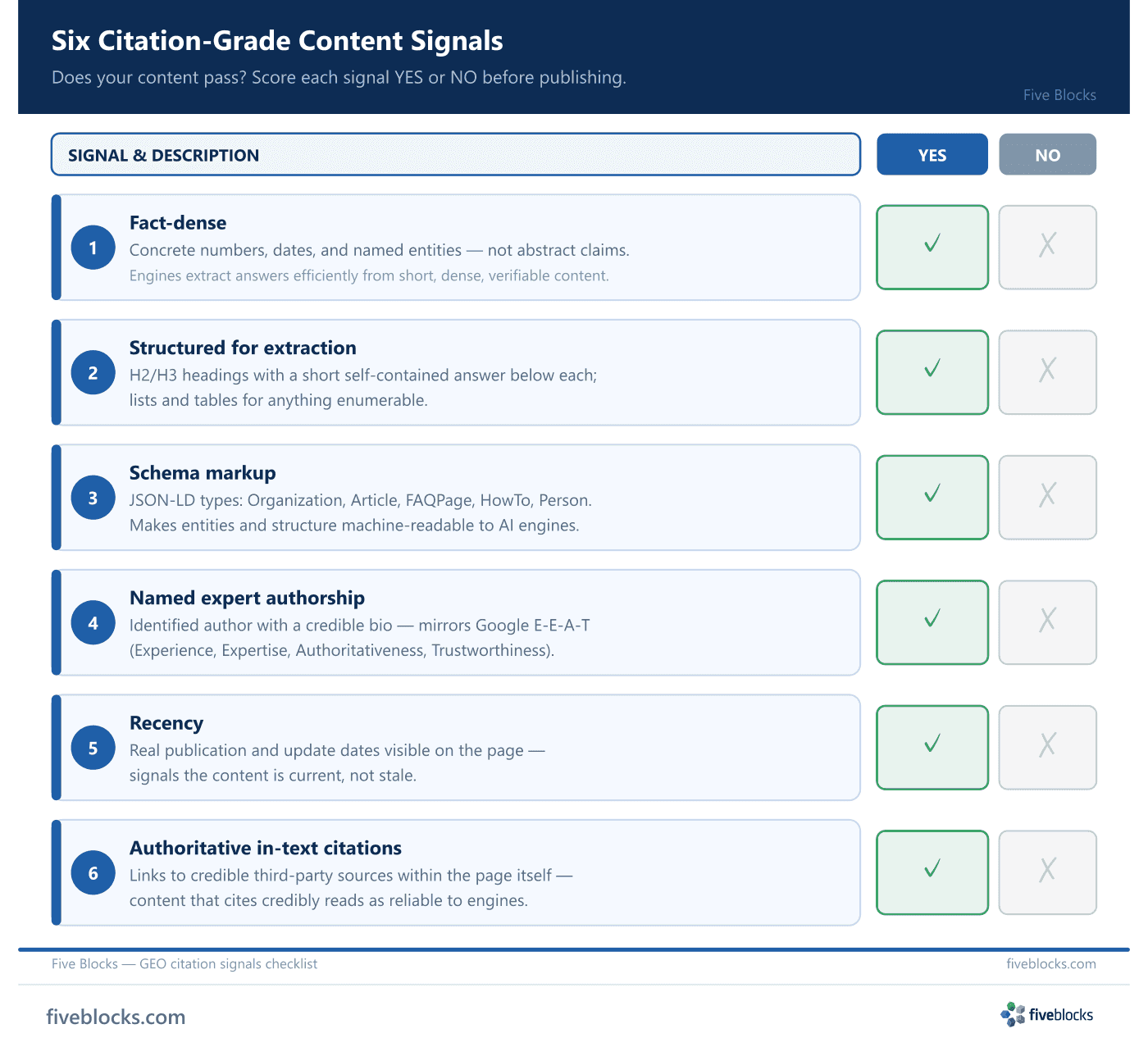
The six traits of citable content
- Fact-dense
- Concrete numbers, dates, and named entities rather than abstract claims. Engines pull answers more efficiently from short, dense, well-organized content than from long pages where the answer is buried.
- Structured for extraction
- Clear H2 and H3 headings, a short self-contained answer below each heading, and lists or tables for anything enumerable, so a model can find and quote a passage with high confidence.
- Schema markup
- Structured data (typically JSON-LD) such as Organization, Article, FAQPage, HowTo, and Person. It makes a page’s entities and structure machine-readable, which helps engines understand what the page asserts and attach it to the correct entity.
- Named expert authorship
- A clearly identified author with a credible bio. Engines weight content they can attribute to identifiable expertise, which mirrors Google’s E-E-A-T framework (Experience, Expertise, Authoritativeness, Trustworthiness).
- Recency
- Real publication and update dates that signal the content is current rather than stale.
- In-text authoritative citations
- Links to credible third-party sources within the page itself. Engines weight sources that themselves cite credibly, so content that carries its own citations reads as more reliable to the engine doing the synthesis.
Why “writing for the extract” works
Featured snippets and AI Overview or answer-engine results use closely related selection logic. Both favor clean, extractable answers backed by source authority, and the pages that earn featured snippets tend to overlap with the pages engines cite. Optimizing a page so a machine can quote it with confidence connects the snippet era to the citation era.
One caveat on FAQPage: the markup still helps AI engines find and extract question-and-answer pairs, but as of May 2026 Google no longer displays FAQ rich-result accordions in the search results, so FAQPage should be used for machine-readability rather than for a SERP feature.
Last reviewed: 19/05/2026
