How do you optimize a corporate website for AI crawlers?
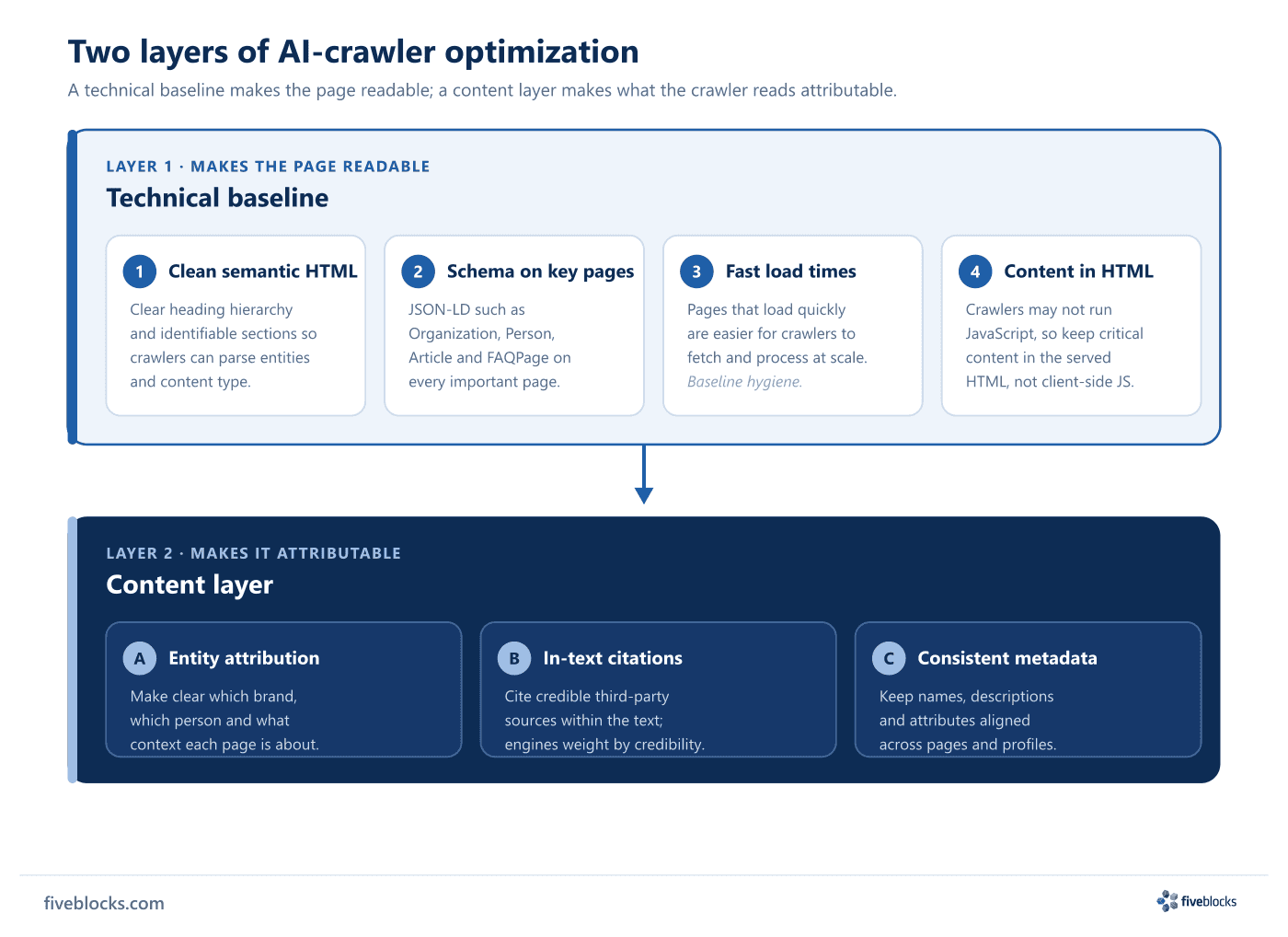
Optimize for AI crawlers on two layers. The technical baseline is clean, semantic HTML with a clear heading hierarchy, schema markup on every important page, fast load times, and critical content rendered in HTML rather than locked behind JavaScript that crawlers may not execute. The content layer is explicit entity attribution (which brand, which person, what context), authoritative citations within the text, and consistent metadata across pages. The work is mostly engineering and editorial discipline, not novel technique.
AI crawlers read the web differently from human readers, and content a crawler never reads is invisible to the engines regardless of how good it looks in a browser. Optimizing a corporate site for them works on two layers: a technical baseline that makes the page readable, and a content layer that makes what the crawler reads attributable.
Technical baseline
- Use clean, semantic HTML with a clear heading hierarchy. Identifiable sections and a logical heading structure let crawlers and AI systems parse a page’s entities and content type. Clean HTML and schema together let those systems understand what a page is and what it asserts.
- Add schema markup (JSON-LD) to every important page. Structured data types such as
Organization,Person,Article, andFAQPagegive AI engines and Google’s entity layer a direct signal about what a page is and how it relates to entity context. Models pull attributes more reliably from clean structured data than from ambiguous prose. - Ensure fast load times. Pages that load quickly are easier for crawlers to fetch and process at scale. (This is standard technical-SEO guidance rather than an AI-crawler-specific finding in our source library; treat it as baseline hygiene, not a citation-ranking lever.)
- Serve critical content in HTML, not behind JavaScript. AI crawlers may not reliably execute JavaScript, so anything important that is rendered only client-side can be missed. Keep critical content in the served HTML.
Content layer
- Make entity attribution explicit. State clearly which brand, which person, and what context each page is about. When entity infrastructure is weak, engines can confuse or conflate distinct entities that share a name; schema with
sameAslinks, clear disambiguation, and consistent descriptions help engines attach content to the correct entity. - Include in-text authoritative citations. Cite credible third-party sources within the body text. Engines weight sources by credibility, so a page that carries its own authoritative citations reads as more reliable to the engine doing the synthesis.
- Keep metadata consistent across pages. Align names, descriptions, and key attributes across all pages and profiles. When these signals are consistent, search and AI systems’ confidence rises; when they conflict, the systems hedge.
The work here is mostly engineering and editorial discipline rather than novel technique. In our experience most corporate sites fall short on more than one of these dimensions, and their AI engagement suffers as a result, though we present that as a field observation, not a measured statistic.
Last reviewed: 19/05/2026
