How do you develop a content strategy that works across Google and AI search simultaneously?
Build to the signals Google and the AI engines share: topical authority, named expert authorship, schema markup, freshness, and authoritative third-party citation, plus the AI-specific discipline of writing for the extract, which also helps Google snippets. One program serves both, but verify each engine separately since they draw on different sources.
A content strategy that works across Google and the AI engines at once is built on the recognition that the two systems reward heavily overlapping signals, so one well-built program serves both rather than splitting effort into parallel tracks. The shared requirements are listed below. The one discipline specific to the AI engines, writing for the extract, turns out to improve Google performance as well, because the same structural clarity that lets a model lift a self-contained answer is what powers featured-snippet selection.
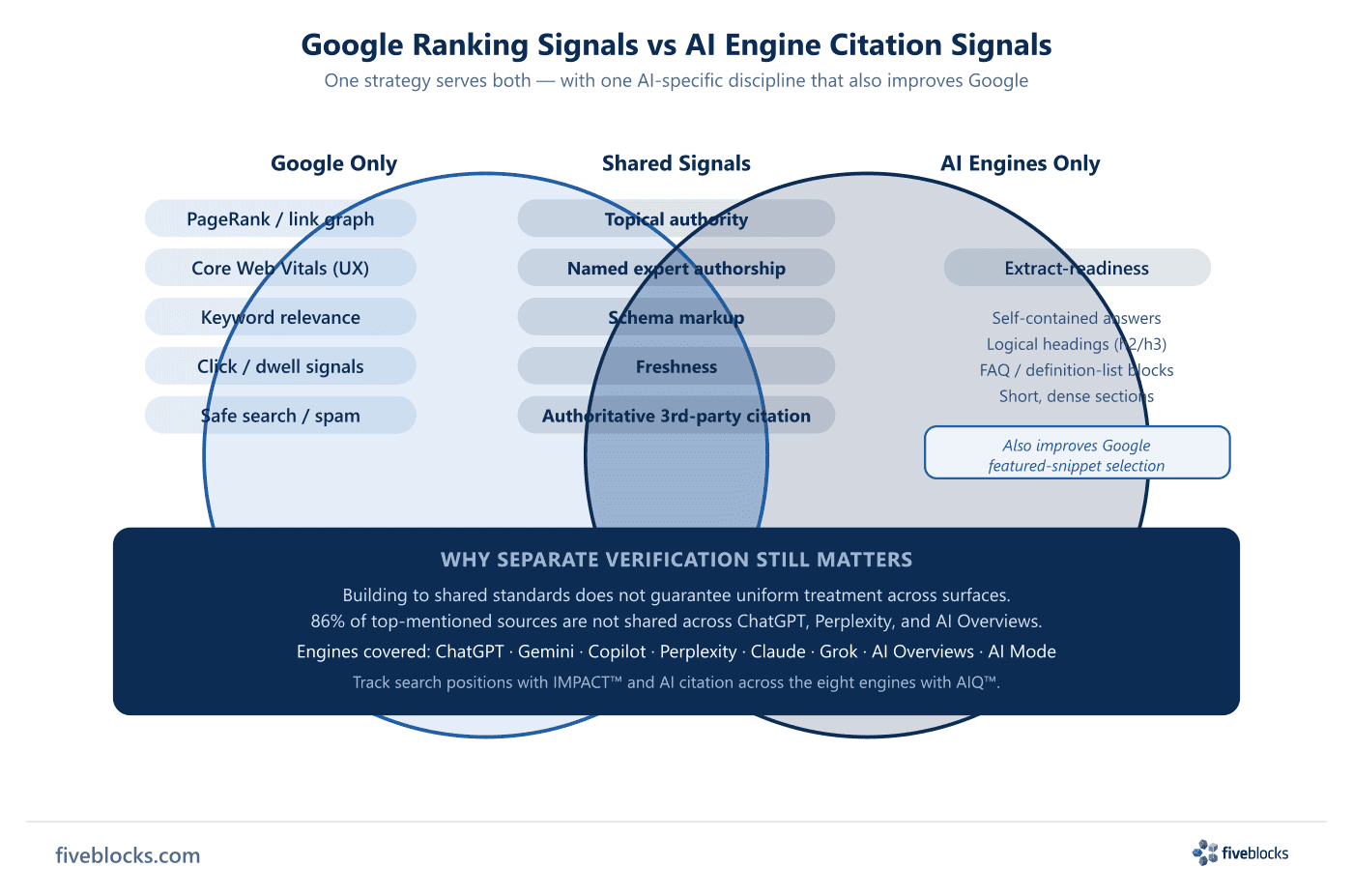
- Structured topical authority
- Both Google and the AI engines build a map of which entities are credible sources on which subjects. That map forms through co-occurrence, a name or brand consistently appearing near the same topic terms across credible publications, and through external citation, where independent authoritative outlets cite the entity as a source on the topic. A defined topical lane, sustained across owned and earned content over months, is how an entity moves from one the engines merely recognise to one they actively quote. Scattered coverage across unrelated subjects disperses the signal and builds little authority in any direction.
- Named expert authorship
- Google’s E-E-A-T framework (Experience, Expertise, Authoritativeness, Trustworthiness) and the AI engines apply similar logic: content attributed to an identifiable, credentialed author is weighted more heavily than anonymous corporate prose, because named authorship lets the systems attach expertise claims to a specific entity and verify that attribution across the broader web. In practice this means real bylines, author bio pages with schema markup, and consistency between the author’s name across the owned property and their presence on other credible platforms.
- Schema markup
- Schema.org markup, particularly
Article,Person,Organization, andsameAsproperties, makes entities and relationships explicit to Google’s Knowledge Graph and to the retrieval indexes the AI engines draw on. Google’s entity layer (Knowledge Graph, AI Overviews, Wikidata-fed responses) reads schema markup directly as a signal about what a page asserts and which entity it concerns. Without it, even high-quality content can be attributed to the wrong entity or overlooked entirely when the engines assemble a picture of the brand. - Freshness
- Both systems weight recency. Google’s ranking systems include dedicated freshness signals that favour recently updated content for time-sensitive queries. For retrieval-augmented AI engines (Perplexity, ChatGPT Search, Google AI Overviews) that fetch live from the web at query time, a stale page is at a structural disadvantage against a current one on the same topic. Keeping owned content updated on a maintenance cadence, refreshing statistics, dates, and cited sources, preserves both search positions and AI engine eligibility.
- Writing for the extract
- This is the discipline most specific to AI engines, and the one that makes a definition-list or FAQ structure strategically valuable rather than just a presentational choice. Writing for the extract means structuring content so a model can lift an accurate, self-contained answer directly from the page without needing to paraphrase or reconstruct meaning across paragraphs. Practically: logical headings (
h2,h3), short self-contained sections, and FAQ or definition-list blocks where each entry is complete as a standalone unit. The Princeton/ACM SIGKDD GEO research (2024) found that including citations, quotations from relevant sources, and statistics can significantly boost a source’s visibility in generative engine responses. AI engines extract answers more efficiently from short, dense, well-organised content with schema markup than from long pages where the answer is buried. The same structural logic applies in Google: pages that perform well for featured snippets are cited at higher rates across Perplexity and ChatGPT Search, because the snippet-selection and AI-extraction signals overlap closely. - Authoritative third-party citation
- The AI engines weight sources they treat as trustworthy: Wikipedia and its citations, mainstream news outlets, government and academic domains, and official owned properties with clean structured data. Third-party coverage in those outlets, earned by publishing substantive, fact-dense material that journalists and researchers cite, is how a brand becomes the source others reference rather than a downstream mention. Original research and proprietary data are among the strongest citation generators available, because they give credible outlets a reason to cite the brand as the primary source on a topic.
Why the results must still be verified separately
Building to the shared standards does not guarantee uniform treatment across surfaces. Research published in 2025 found that 86% of top-mentioned sources are not shared across ChatGPT, Perplexity, and AI Overviews, different engines draw on different source pools and can return materially different answers to the same query. Because ChatGPT, Gemini, Copilot, Perplexity, Claude, Grok, Google AI Overviews, and Google AI Mode each have their own retrieval and weighting logic, a content program built to the shared standards still needs to be verified separately on each surface. We track search positions with IMPACT™ and AI engine citation and framing with AIQ™, across the eight engines AIQ currently tracks, rather than assuming one fix propagates everywhere.
Last reviewed: 20/05/2026
