How do you develop a content calendar for reputation management?
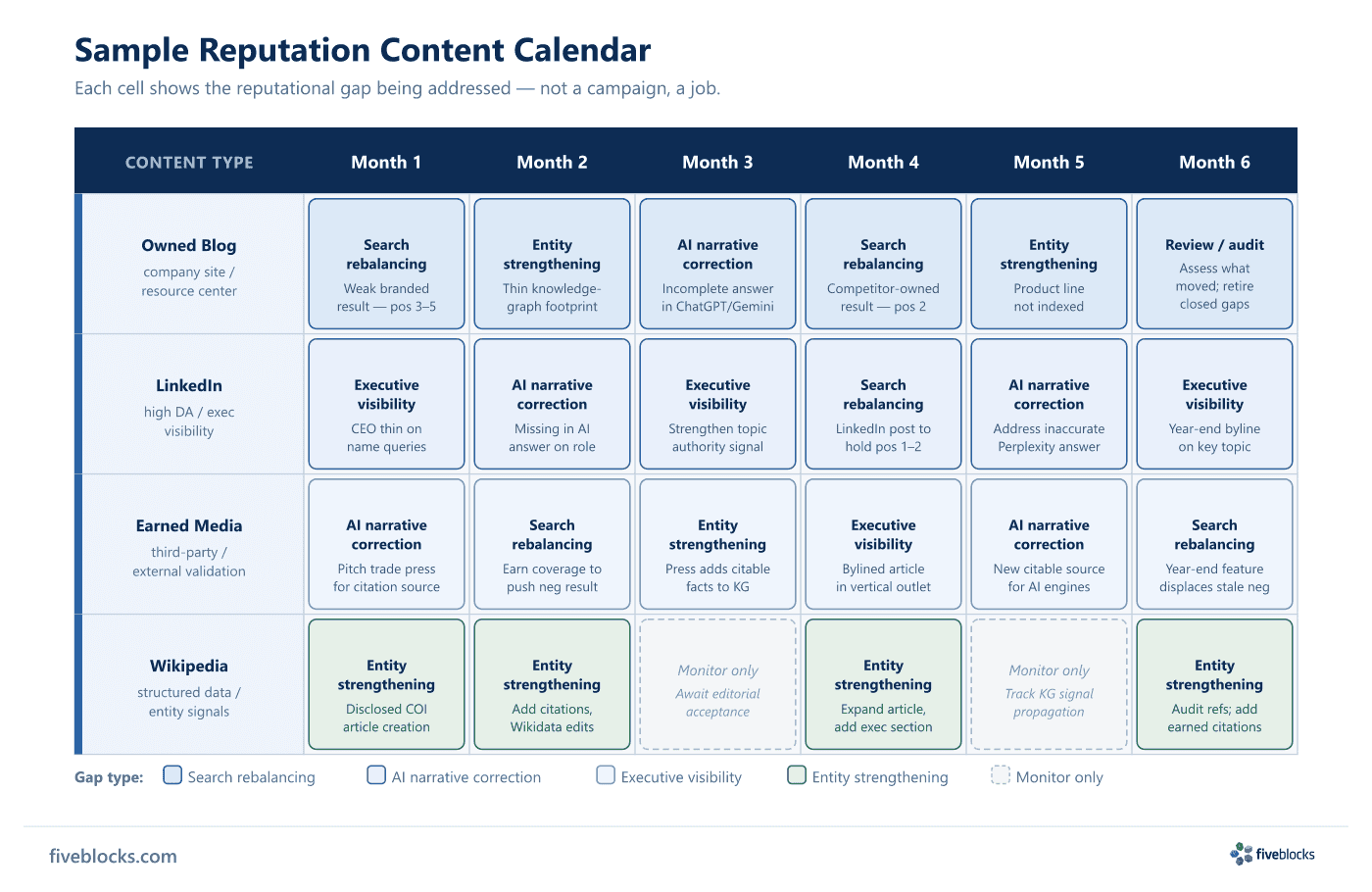
A reputation content calendar is built around gaps, not campaigns: each entry maps to a specific reputational job (rebalancing a weak branded result, addressing a recurring AI narrative, strengthening an entity signal, building executive visibility) and carries a publishing date, channel, author, and format. Content gets produced because it does reputational work, not because a slot needed filling.
A content calendar for reputation management is organized differently from a marketing calendar: around gaps and reputational jobs rather than campaigns and seasons. Build one in five steps.
Step 1: run the gap analysis first
The calendar is only as useful as the diagnosis behind it. Before any entry goes in, the gap analysis has to identify which branded results are weak or missing, which queries return incomplete answers from the AI engines, which topics need entity authority, and which executives have thin visibility. Every calendar entry traces back to one of these diagnosed gaps. Nothing is there to fill a slot.
Step 2: assign each entry a reputational job
Each planned piece gets a single primary objective, chosen from four categories of reputational work:
- Search rebalancing: content built to occupy a weak or missing branded result position.
- AI narrative correction: content written to address a recurring theme that the AI engines surface incompletely or inaccurately about the brand or executive.
- Entity strengthening: content that adds structured, citable facts to a thin knowledge-graph footprint.
- Executive visibility: bylined or attributed content that builds a named individual’s authority on a defined topic.
Step 3: set the channel and format for each entry
Each entry also carries the channel that best serves its job and the format suited to that channel:
- Owned site (company blog, resource center): the primary home for SEO-targeted and entity-building content, with full editorial control.
- LinkedIn: its domain authority is high enough that LinkedIn content ranks in the top positions on name and brand queries, which makes it effective for executive visibility and narrative work.
- Earned outlets: third-party placements supply the external validation that search and AI engines weight most heavily. Earned coverage is harder to plan but belongs on the same calendar.
- Wikipedia and structured reference sources: entity-strengthening edits and citations that feed knowledge-graph signals directly.
Step 4: attach the practicals to each row
Once job and channel are set, each calendar entry needs a publishing date (or target window), an assigned author or byline, a format (long-form article, short post, press release, structured FAQ, video), and the gap ID from the diagnosis it addresses. The author field matters: content tied to a credible, resolvable individual builds more entity authority than anonymous corporate prose.
Step 5: review the calendar against actual movement
The calendar is a plan, not a scorecard. Monthly, review it against actual movement in the search result set and the AI engine narratives. Entries that are not moving their target gap get reconsidered: the format may need to change, the channel may be wrong, or the gap may need earned coverage rather than owned content. We track this movement with IMPACT™ (for search positions) and AIQ™ (for AI engine narratives across eight major models) so the review runs on observed data rather than assumption.
The calendar is only as good as the discipline behind it. A reputation content calendar that drifts toward campaign content or volume-filling turns back into a marketing calendar: fine for brand-building, but not for closing the specific gaps that reputation management is hired to address. Every quarter, audit each entry against its original gap. If the gap closed, retire the entry type; if it did not, change the approach.
Last reviewed: 20/05/2026