How do you align content strategy across PR, marketing, and reputation management?
Align PR, marketing, and reputation management around a single canonical entity definition, one agreed description of the company, its leaders, and their attributes, then measure outcomes jointly using search and AI monitoring. When the three functions describe the entity differently, search engines and AI models get conflicting signals and grow less confident about resolving the entity correctly.
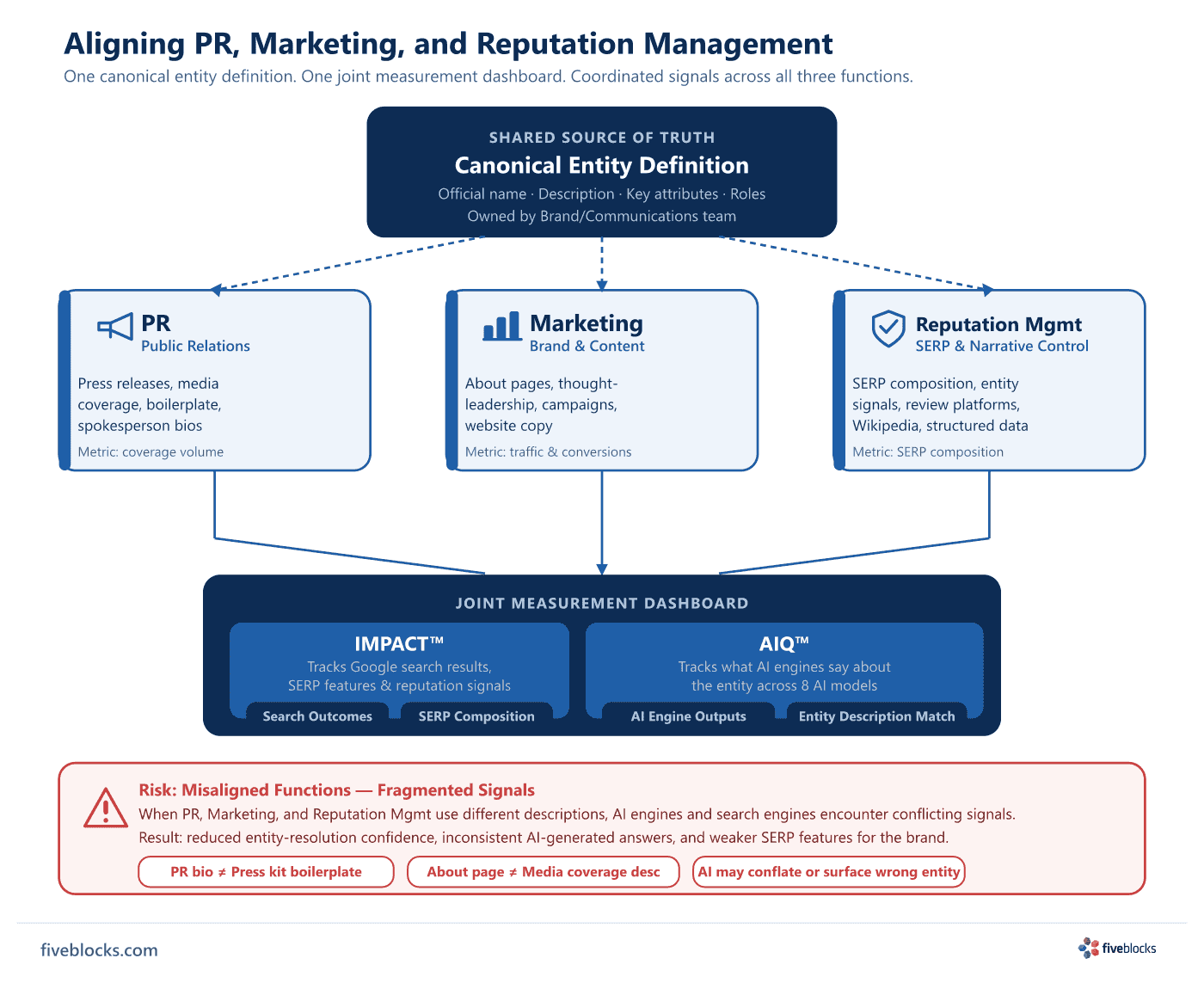
PR, marketing, and reputation management each produce content on their own, and when they describe the company differently, search engines and AI models receive conflicting signals about who the entity is. Alignment rests on three commitments: a shared canonical definition of the entity, coordinated publishing calendars, and joint measurement against search and AI outcomes.
Step 1: establish a canonical entity definition
The canonical entity definition is the single agreed description of the company (and its leaders) that all teams pull from. It covers the official name, a brief description, the main attributes, and the primary roles each person holds. Keep it in a shared document that all three teams treat as the source of truth for any bio, boilerplate, press-kit language, or website copy they produce.
- Who typically owns it: In practice, ownership usually falls to the communications or brand team, since that team controls press-kit assets and public-facing boilerplate. Where a dedicated brand-strategy function exists, it often holds the formal owner role, with PR and marketing as contributors.
- Conflict resolution: Disagreements between teams, for example marketing preferring a broader positioning phrase while PR uses a narrower sector description, should be settled at the definition level before content goes out, not after. The test is whether a search or AI engine reading both outputs would resolve them to the same entity and the same description.
- Why it matters to engines: Google and AI engines build entity understanding from structured signals across sources: Wikidata, schema markup, consistent descriptions, and authoritative backlinks. Inconsistencies in names, descriptions, or attributes make it harder for systems to resolve all those signals into a single, well-defined entity.
Step 2: coordinate publishing calendars
Content from the three functions should reinforce each other rather than duplicate or contradict. A shared editorial calendar prevents simultaneous releases that send competing messages, and it lets a press release, a thought-leadership article, and a reputation-oriented piece go out in a sequence that builds a coherent narrative in the index.
Step 3: measure jointly against search and AI outcomes
Left alone, each function optimizes its own metrics: PR measures coverage volume, marketing measures traffic and conversions, reputation management measures SERP composition. Put a shared measurement layer above those individual KPIs. That layer should track:
- Search outcomes, which pages and narratives hold which SERP positions for branded and issue-related queries, tracked via IMPACT™.
- AI engine outputs, what the major AI models say about the entity, whether descriptions match the canonical definition, and where discrepancies appear, tracked via AIQ™.
When all three teams see the same dashboard, they have less incentive to optimize local metrics at the expense of entity coherence, and course corrections become a shared responsibility.
The risk when alignment is absent
Without alignment, the entity fragments: marketing’s About-page description differs from PR’s press-kit boilerplate, which differs from the biography in media coverage. AI engines that encounter multiple conflicting descriptions may hedge, surface the wrong version, or, where entity infrastructure is weak, confuse the entity with another. The practical effect is lower confidence in AI-generated answers about the company and inconsistent SERP features.
Last reviewed: 20/05/2026
