How do you ensure content consistency across multiple authors and platforms?
Consistency across multiple authors and platforms takes four governance layers working together: a shared style guide, canonical entity descriptions with agreed facts and statistics, named-author bio schema, and an editorial review gate before publishing. Without these, the entity fragments, different bios, conflicting founding years, and varying employee counts reduce the confidence search and AI engines have in who the brand actually is.
When content is produced by multiple authors across multiple platforms, the entity is the thing at risk. Each piece may be individually accurate, but if the bios differ, the statistics appear in different forms, and the descriptions of the company shift in tone and fact, search and AI engines encounter a fragmented signal and lose confidence in who the brand and its people actually are. Governing consistency takes four interlocking mechanisms.
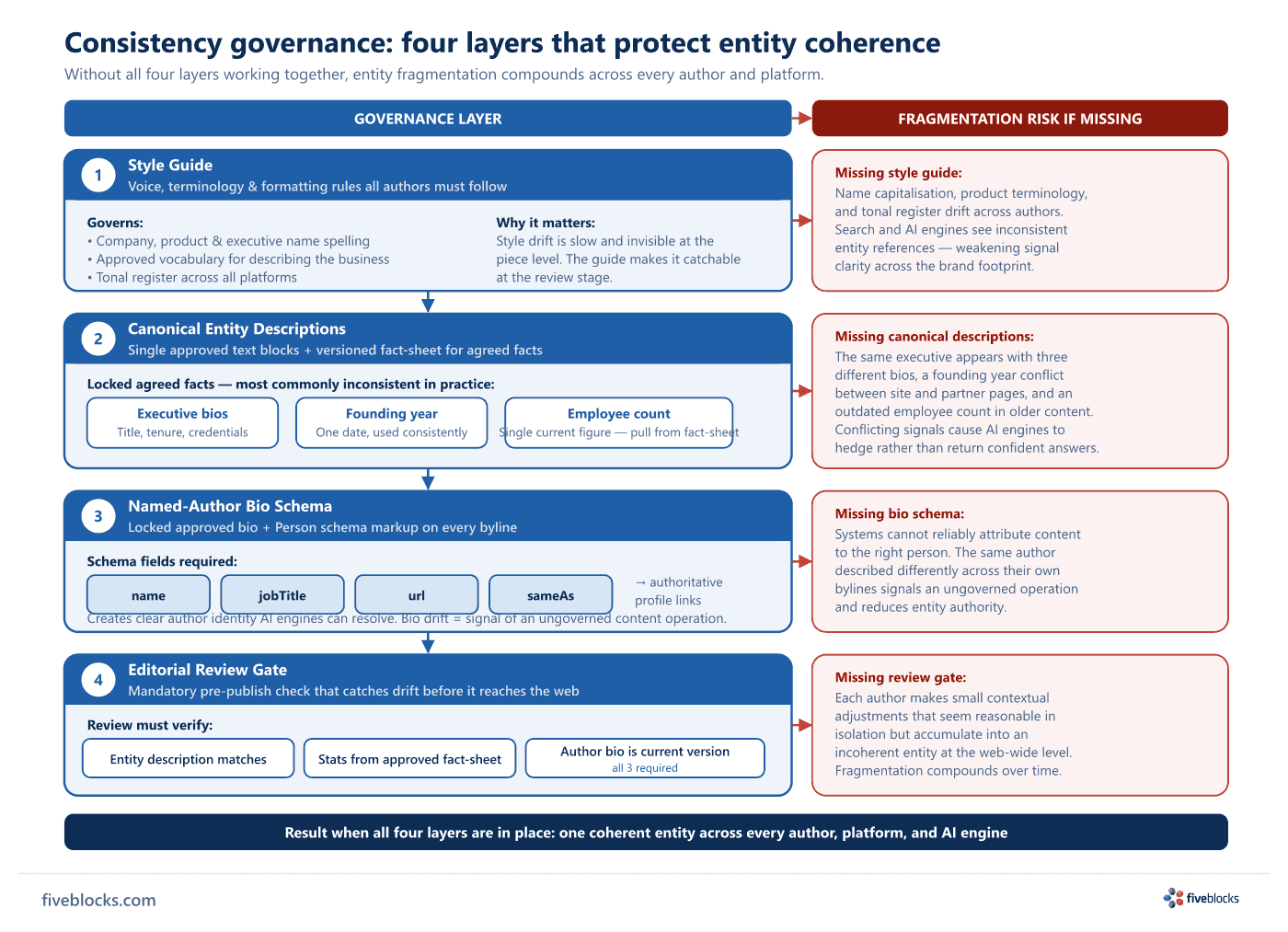
Step 1: Build a shared style guide
A style guide sets the non-negotiables of voice, terminology, and formatting that all authors must follow regardless of platform. For reputation purposes, the most important elements are how the company name, product names, and executive names are written (including capitalization and any trademarked suffixes), the approved vocabulary for describing what the company does, and the tonal register. Style drift is slow and hard to notice at the piece level; a style guide makes it catchable at the review stage.
Step 2: Lock canonical entity descriptions and agreed facts
The canonical entity description is the single approved text block that defines what the company is, when it was founded, where it operates, and what it does, in exactly the form that should appear across every property. Agreed facts and statistics must be versioned and circulated whenever they change. The entity attributes most commonly inconsistent across multi-author content programs in practice are:
- Executive bio descriptions. Short bios for the same executive often differ in length, title, credential emphasis, and even the years of tenure, sometimes substantially, across the corporate site, press boilerplate, conference listings, and social profiles.
- Founding year. A company founded in one year is sometimes described as having been founded in a different year on secondary or partner properties, either through error or because an earlier predecessor entity date is used inconsistently.
- Employee or team count. Headcount is frequently cited in content and often appears in multiple forms, an outdated figure in older content, a rounded figure in one press release, and a precise current figure elsewhere, creating contradictory signals across the entity’s footprint.
Maintaining a single locked fact-sheet and requiring authors to pull from it, rather than recalling from memory, is the operational control that eliminates most of these discrepancies before they reach the web.
Step 3: Implement named-author bios with bio schema
Named authorship matters for two reasons: it gives each piece a clear author identity the AI engines can resolve, and it creates accountability for consistency. Each author’s bio should be locked in a single approved version with schema markup (Person schema with name, jobTitle, url, and sameAs pointing to the author’s authoritative profiles). When schema is inconsistent or absent across a multi-author site, the systems cannot reliably attribute content to the right person. Bio drift, where the same person is described differently across their own bylines, is one of the clearest signals of a content operation without governance.
Step 4: Require editorial review before publishing
An editorial review gate is the mechanism that catches drift before it reaches the web. The review should check three things: that the entity description matches the canonical version, that any statistics or dated facts have been pulled from the approved fact-sheet, and that the author bio is the current approved version. Without this gate, fragmentation compounds over time, each author makes small contextual adjustments that seem reasonable in isolation but accumulate into an incoherent entity at the web-wide level.
What fragmentation looks like in practice
The failure mode at scale is not that any single piece is wrong; it is that the entity slowly loses coherence. A press release says the company was founded in one year; the Wikipedia article says another; the corporate About page says a third (because a rebranding date was used instead). Three bios exist for the same executive, written in three different registers, emphasizing different credentials. The employee count has not been updated since a major hiring push two years ago. Search and the AI engines draw on all of these surfaces, and when they conflict, the systems hedge or return less authoritative framing rather than the company-aligned picture. We establish the canonical definitions, review disciplines, and schema implementation that keep multi-author content reinforcing one identity, and verify the result by tracking how consistently the systems resolve the entity with IMPACT™ and AIQ™.
Last reviewed: 20/05/2026
