How do you prepare for negative press that you know is coming?
When negative coverage is known in advance, use the lead time to publish authoritative owned content on the topic, refresh leadership bios and quotes, build FAQ explainers, draft and approve statement templates with counsel, and pre-load monitoring queries in IMPACT and AIQ. Allow at least two to four weeks to get the digital infrastructure in place before the story drops.
Some negative coverage is known in advance: an upcoming long-form investigation, a scheduled regulatory filing, a former-employee book, a research-report drop. These are among the few crisis categories where the company has lead time, and using that lead time well changes how the story lands. Plan on two to four weeks to get the digital infrastructure in place. You can compress that, but it costs more and leaves gaps.
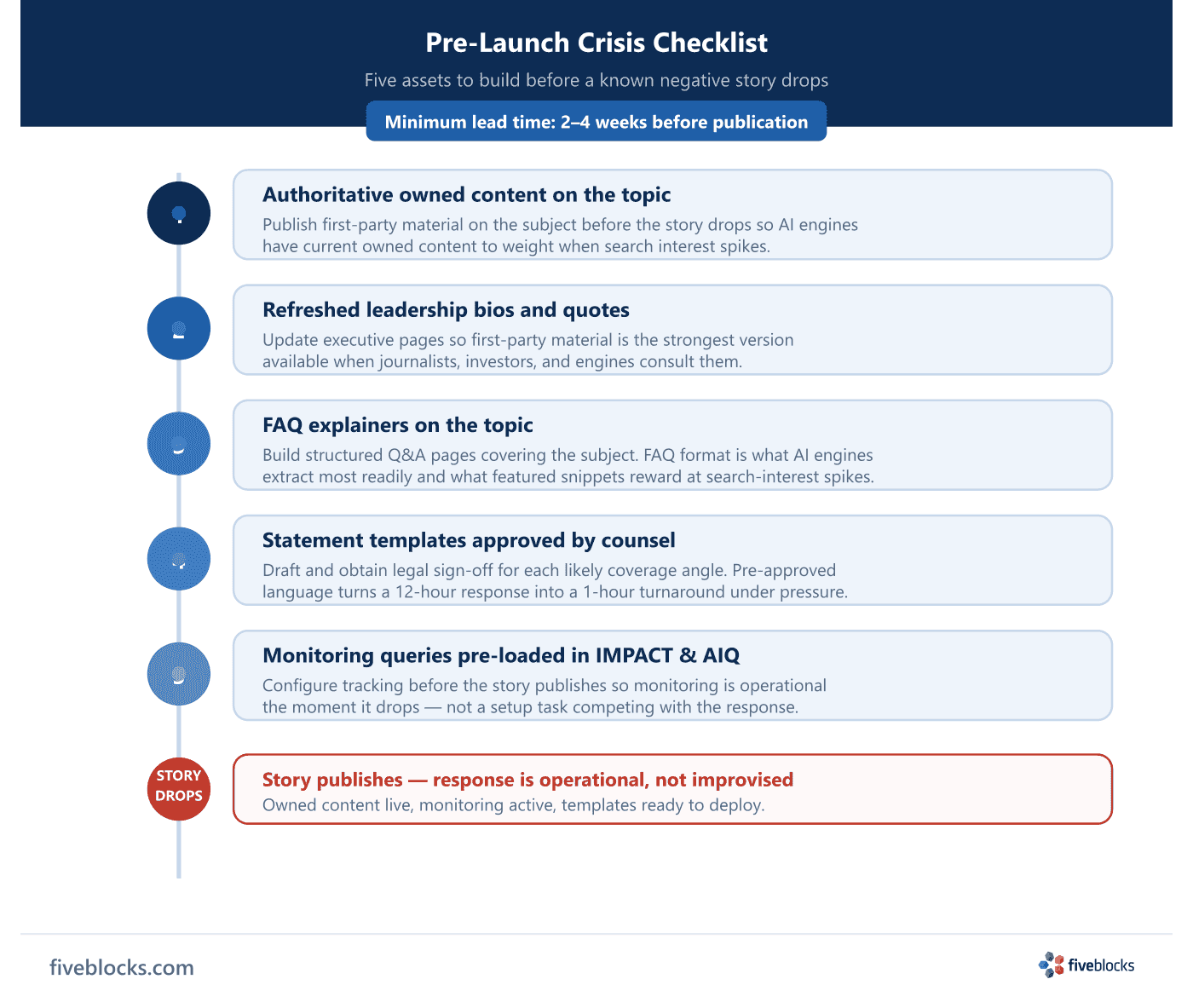
Five assets to build before the story drops
- Authoritative owned content on the relevant topic. Publish content on the subject the coverage will address on your own properties before publication, so the AI engines have current first-party material to draw on when the story breaks and search interest spikes.
- Refreshed leadership bios and quotes. Update executive and leadership pages so the company’s own material is the strongest version available when journalists, investors, and the engines consult it. Stale or thin bios become the default reference under pressure.
- FAQ explainers on the topic. Build question-and-answer pages covering the topic the coverage will address. FAQ format is what the AI engines pull from most readily and what featured snippets reward. Published in advance, these pages can rank for related queries the moment search interest rises.
- Statement templates approved by counsel. Draft templates for each likely angle of coverage and get counsel sign-off ahead of time. Under pressure in an active situation, pre-approved language is the difference between a one-hour turnaround and a twelve-hour one.
- Monitoring queries pre-loaded in IMPACT and AIQ. Configure the tracking queries in IMPACT and AIQ before the story publishes, so monitoring is already running the moment it drops rather than something you set up under pressure. IMPACT catches search-result shifts within hours; AIQ shows how the eight AI engines pick up and frame the coverage.
What changes when the story drops
When the story publishes, you execute instead of scramble. The owned content is already live and indexed, monitoring is already active, and the statement templates are ready to deploy. Clients who use their lead time this way have usually run the play before and know the difference between a prepared and an unprepared first 48 hours.
Last reviewed: 19/05/2026
