How does negative press affect Google search results long-term?
Negative press can hold page one for years if it is authoritative and unaddressed. Google has no built-in time-decay, so durable displacement requires sustained authoritative competing content plus source-level work on the underlying narrative.
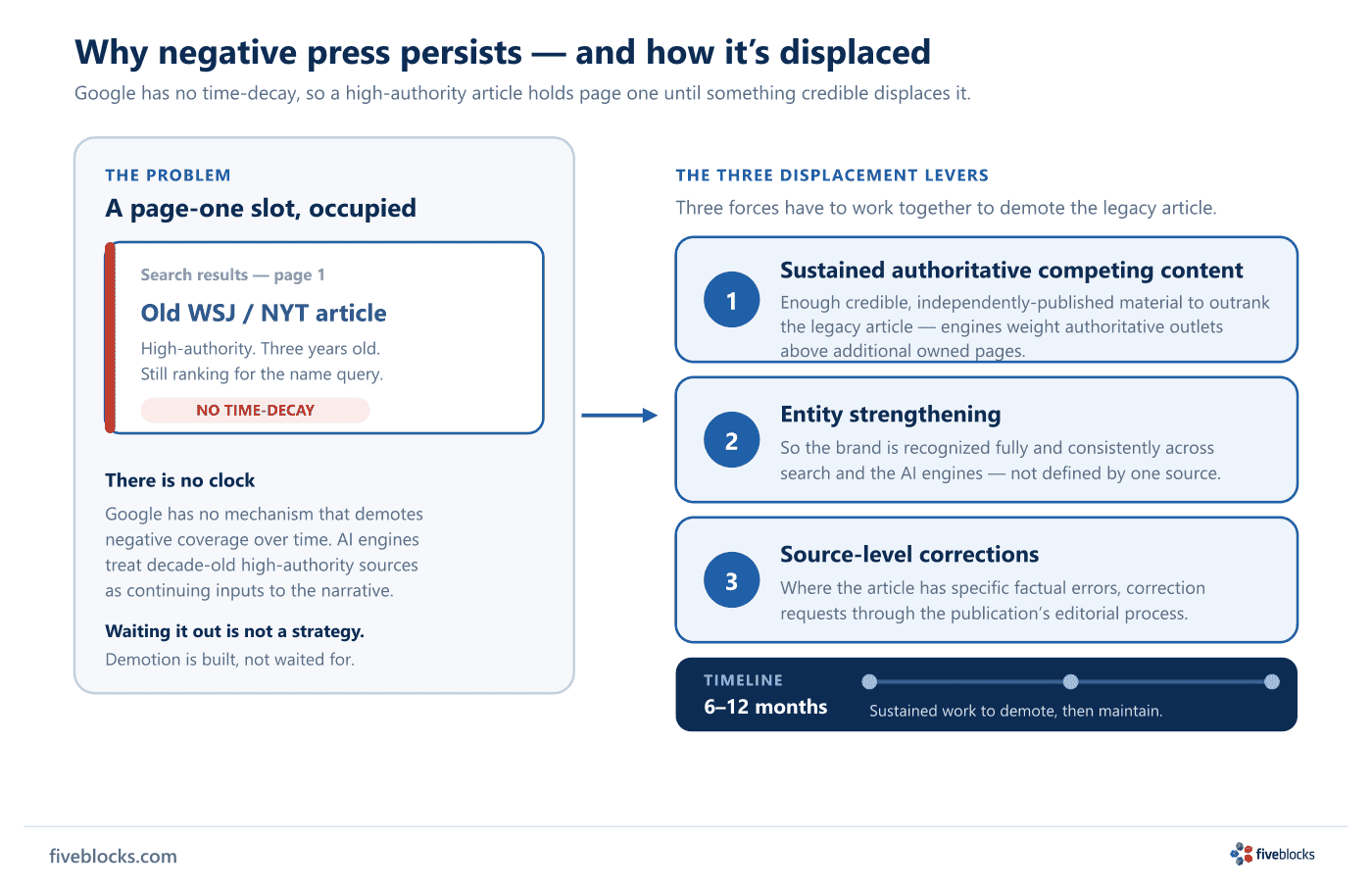
An old Wall Street Journal or New York Times article can rank indefinitely for a name query unless something credible displaces it. Google has no mechanism that demotes negative coverage over time, and AI engines treat decade-old high-authority sources as continuing inputs to their narrative.
Why the legacy article does not fade on its own
There is no clock. A high-authority piece holds its page-one slot for as long as the engines keep weighting the domain that published it, and stakeholder attention concentrates almost entirely on that first page. Waiting it out does not work.
The three displacement levers
You build demotion; you do not wait for it. Three things have to work together:
- Sustained authoritative competing content: enough credible, independently-published material to outrank the legacy article, because the engines weight authoritative outlets above additional owned pages.
- Entity strengthening, so the brand is recognized fully and consistently across search and the AI engines rather than being defined by the single contested source.
- Source-level corrections: where the article contains specific factual errors, correction requests through the publication’s own editorial process.
A realistic timeline
None of this is fast. A three-year-old NYT piece typically takes six to twelve months of sustained work to demote materially, and the work has to continue afterward to prevent resurfacing. Firms that pretend otherwise are the ones that push clients into pay-per-page contracts that fail.
Last reviewed: 19/05/2026
