How do you handle a negative article that ranks on page one?
Once a negative article reaches page one, removal is usually off the table, so the work is suppression and contextualization: build authoritative competing content, engage the publication where a corrections or updates process applies, strengthen the entity layer (Wikidata, schema, Knowledge Panel), and monitor with IMPACT as Google re-ranks. The article rarely leaves page two, but page-one composition can be rebalanced within months.
Once a negative article has reached page one, removal is usually not an option. The article is published, the URL is stable, and the outlet will not unpublish it without compelling cause. The work is suppression and contextualization, run as four tracks at the same time.
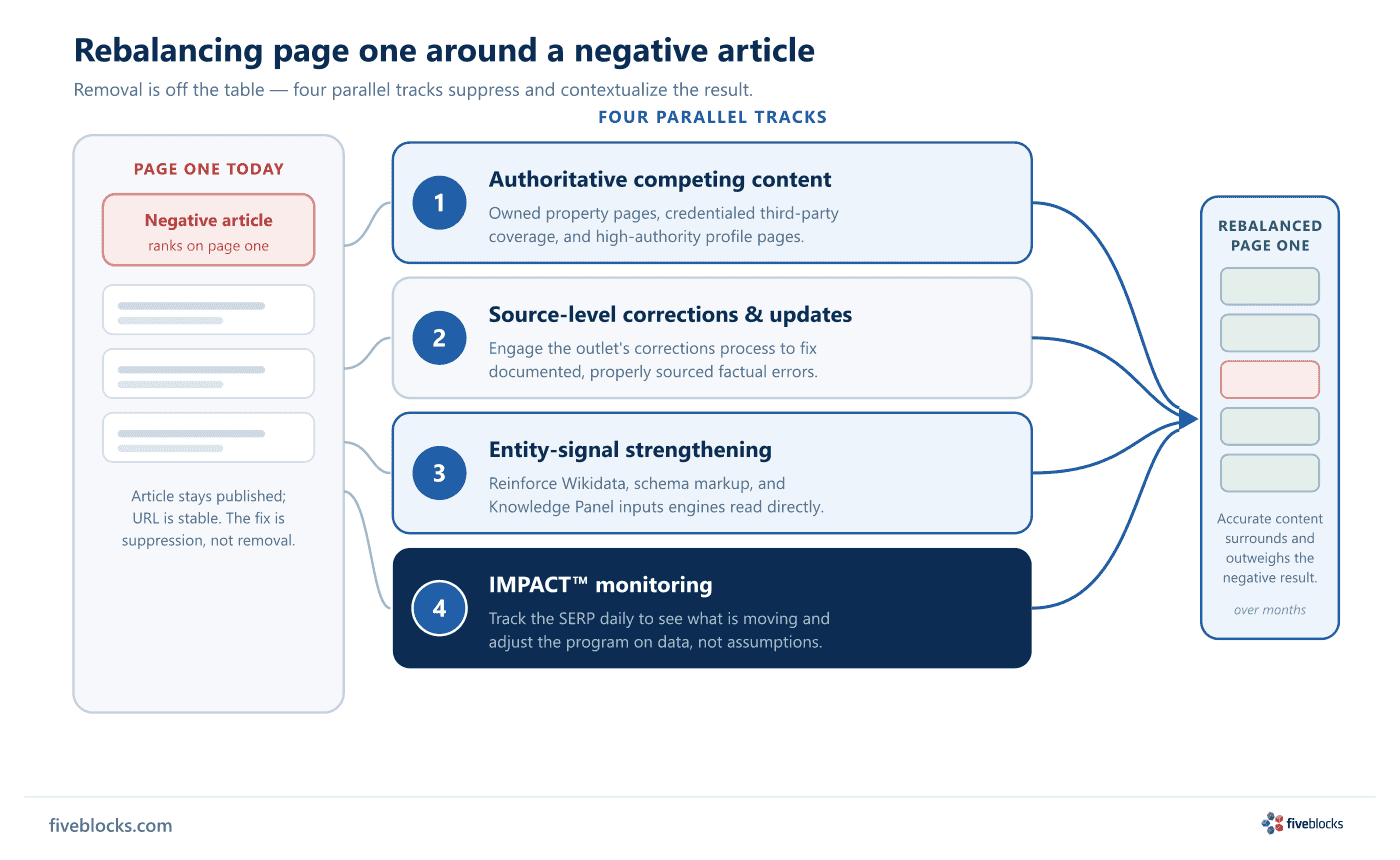
The four parallel tracks
- Authoritative competing content. Build or elevate content of comparable authority to the original source: owned property pages with strong on-page signals, third-party coverage from credentialed outlets, and profile pages on high-authority platforms.
- Source-level engagement. Engage the publication where it runs a legitimate corrections, updates, or follow-up process. Most major, reputable outlets publish corrections policies and will correct documented factual errors when those errors are properly sourced.
- Entity-signal strengthening. Reinforce the entity layer: Wikidata, schema markup, and Knowledge Panel inputs, so the engine describes the brand with accurate, fuller context instead of the narrow framing of a single article. Google and AI engines read these structured signals directly when they recognize and describe an entity across the results page.
- Continuous monitoring. Track the SERP with IMPACT™ to see what is moving and what needs reinforcement, and adjust the program as the data comes in.
What a realistic outcome looks like
The article rarely disappears from page two. The achievable goal is to change the makeup of page one, where most stakeholder attention sits, so that accurate, authoritative content surrounds the negative result and outweighs it. That shift usually takes months, not days, as Google’s authority and freshness signals on the competing content build up.
Last reviewed: 19/05/2026
