How do you push down a negative search result?
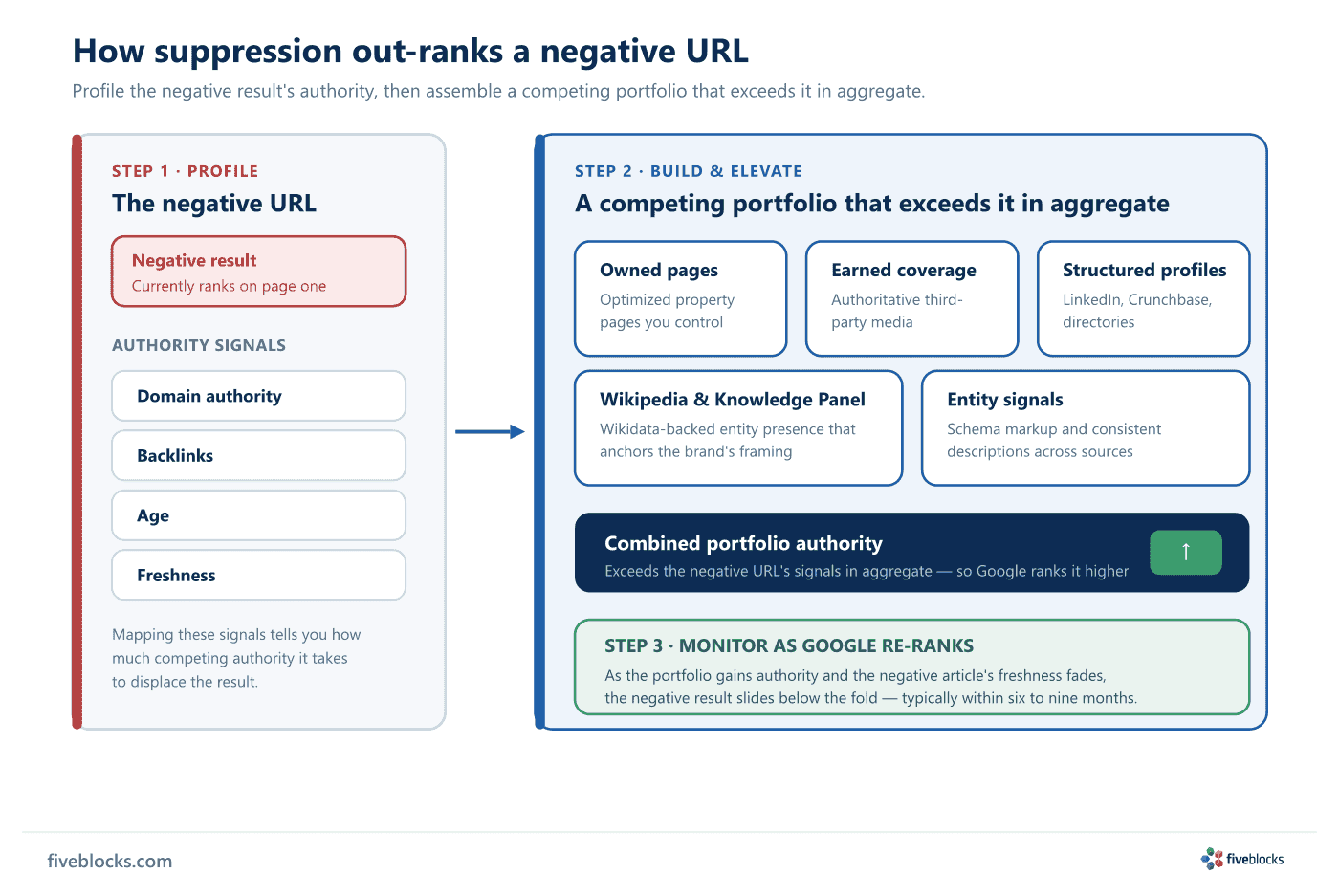
Suppression out-ranks the negative URL. Profile its authority signals (domain authority, backlinks, age, freshness), then build or elevate a competing set of owned pages, earned coverage, structured profiles, and entity signals that beats it in aggregate, and monitor as Google re-ranks. In our experience a stuck negative typically clears page one within six to nine months.
Suppression is the standard reputation tactic, and it works when it is done with discipline. The aim is to out-rank the negative URL with stronger competing content so it drops off the first page, where most stakeholders look. Here is how it works, step by step.
How suppression works, step by step
- Profile the negative URL’s authority. A page’s position in Google depends on its domain authority, backlinks, age, and freshness signals. Mapping those signals tells you how strong the result is and how much competing authority it will take to displace it. Coverage from a major outlet is harder to push down than a low-authority page.
- Build or elevate a competing set of pages. Develop assets that beat the negative URL’s signals in aggregate. This usually combines owned property pages with strong on-page optimization, third-party coverage secured through earned media, and structured profile pages such as LinkedIn, Crunchbase, and association directories. Several of these carry high domain authority and rank well on name queries on their own.
- Strengthen entity signals. Entity signals matter alongside URL signals. Google and AI engines recognize an entity through structured inputs: a Wikipedia article, an accurate Wikidata entry, schema markup on the official site, presence in authoritative directories, and consistent descriptions across sources. These pull the engine toward the brand’s preferred framing across the whole SERP.
- Monitor daily as Google re-ranks. Google re-evaluates the index continuously, and freshness signals on an older negative article decay over time, which reduces its prominence. We track every URL’s movement so we can see what is working and reinforce what is not.
How long it takes
Re-ranking is gradual, not instant. Google serves a continuously re-evaluated index, so positions shift as the competing pages gain authority and the negative article’s freshness fades. In our experience, most engagements move a stuck negative off page one within six to nine months. The exact timeline depends on how entrenched and how authoritative the original result is.
What suppression is not
Suppression earns position with genuine, higher-authority content. It is not volume manipulation. Google’s algorithm has long distinguished authoritative backlinks from manipulated ones and penalizes attempts to inflate authority through volume tactics, so the work has to be built on real owned assets, real coverage, and real entity signals.
Last reviewed: 19/05/2026
Sources (4)
- How Search organizes information / Ranking results — How Search Works google.com
- In-Depth Guide to How Google Search Works | Google Search Central developers.google.com
- Google's Knowledge Graph and Knowledge Panels blog.google
- How Google's Knowledge Graph works - Knowledge Panel Help support.google.com
