If I publish 20 new articles about my company, will that push the bad one down?
Publishing volume alone does not push a strong negative result down. Source authority is what moves branded SERPs: two well-placed pieces in outlets Google trusts displace more than twenty articles from low-authority sites. Volume helps only when it reinforces an authority-first program.
Content volume was a viable suppression tactic in 2010. It is not in 2026. Google’s ranking weights the authority of the publishing source far more heavily than the number of articles, so twenty mid-tier blog posts from sites Google does not already trust typically rank nowhere near a Wall Street Journal or Bloomberg article and displace little or none of it.
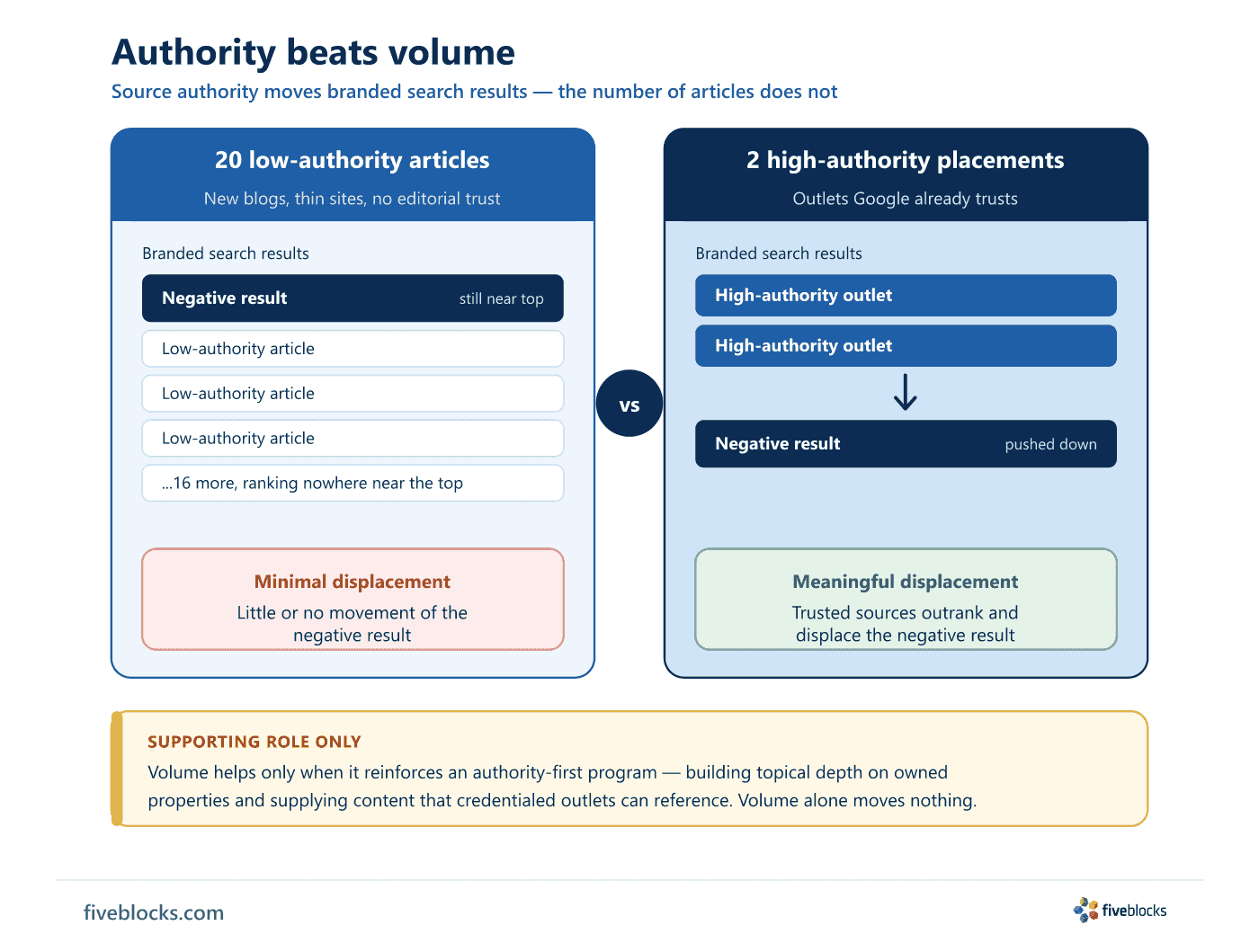
Why authority beats volume
Google evaluates sources by signals that take years to accumulate and cannot be manufactured at scale:
- Domain authority: Google’s systems assess whether other prominent websites link to or reference the content. A major news outlet or industry publication has thousands of such signals; a new or thin blog has almost none.
- Entity recognition: Credentialed outlets are recognized entities in Google’s index. Content from them inherits that recognition, and Google weights it accordingly on branded queries.
- Manipulation detection: Google’s spam systems are built to detect and discount attempts to build authority through volume tactics, which reduces or removes any ranking benefit those tactics produce.
The outlet authority spectrum in practice
Knowing where the threshold sits tells you how much effort is worth spending. Sources Google treats as high-authority for reputation purposes typically include:
- Major wire services and national newspapers (Reuters, Bloomberg, Wall Street Journal, Financial Times, New York Times, Washington Post, Associated Press)
- Established trade publications with editorial independence and a long publication history in a specific sector
- Non-commercial domains with consistent editorial standards: government agencies, academic institutions, and bodies in the Google News index
Low-authority sources, newly launched blogs, thin content farms, syndication networks without editorial oversight, and paid placement that discloses its commercial origin, rarely acquire the inbound signals Google uses to judge trustworthiness. Twenty such articles pointing at a branded query have marginal ranking impact at best.
Where volume still helps
Volume is not useless. It supports an authority-first program in three ways:
- Building topical depth on owned properties that supply structured data and entity signals
- Supporting long-tail branded queries where lower-authority content faces less competition
- Providing the underlying content base that credentialed outlets can reference and link to
But volume without authority at the head of the program is an expensive way to produce no movement on the results that matter.
Last reviewed: 19/05/2026
