How do ORM firms push down content they can’t delete?
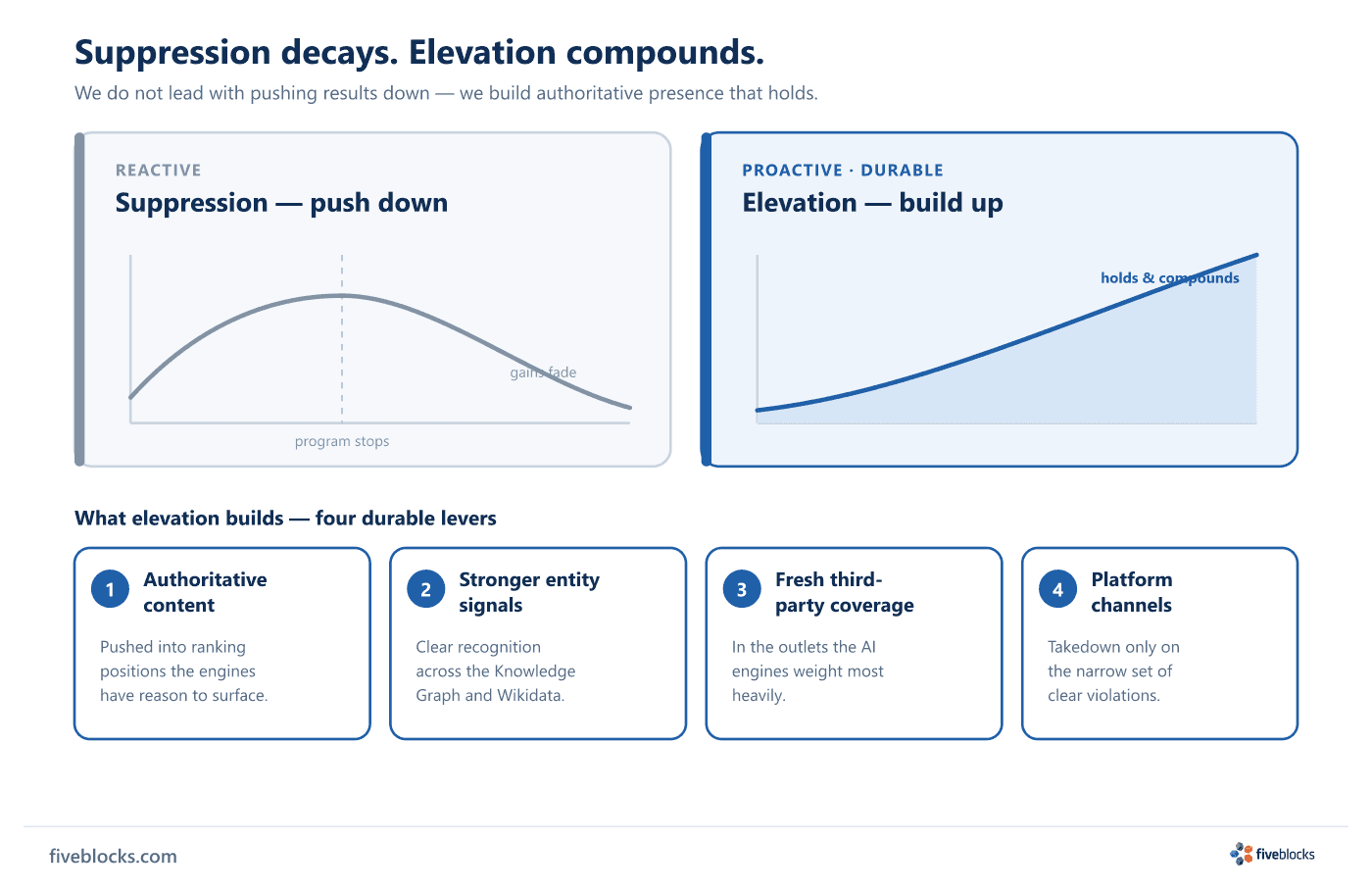
We do not lead with suppression. We lead with elevation: pushing authoritative content into ranking positions, strengthening entity signals, securing fresh third-party coverage in outlets the engines weight, and using platform channels only on clear policy violations. Elevation holds; suppression-led tactics fade once the program stops.
“Suppression” means pushing something down, a reactive move that rarely survives the next Google update or AI engine refresh. Elevation works better, and the reason is structural: an authoritative asset stays authoritative once it ranks, so the gains build up over time instead of fading.
| Suppression (push down) | Elevation (build up) |
|---|---|
| Reactive, aimed at moving a single contested result down | Proactive, builds authoritative competing content the engines have independent reasons to rank |
| Fades the moment the program stops running | Builds up, because each authoritative asset stays authoritative once it ranks |
| Short-term wins that fail under scrutiny | Durable, moves contested content off page one and changes the AI narrative over time |
What elevation actually involves
- Authoritative content into ranking positions: competing content the engines have independent reasons to rank.
- Stronger entity signals, so the brand or person is recognized clearly across the Google Knowledge Graph and Wikidata.
- Fresh third-party coverage in the outlets the AI engines weight most heavily.
- Platform channels for clear violations: legitimate takedown on the narrow set of cases where it is available.
At enough sustained volume, elevation moves the contested content off page one and changes the AI narrative for good. Suppression-led tactics do the opposite: they win in the short term, then fade the moment the program stops running.
Last reviewed: 19/05/2026
