What is the difference between suppression and removal in reputation management?
Removal eliminates the underlying URL - the source takes it down, a legal claim succeeds, a platform policy is triggered, or a delisting request is granted - so it is binary and permanent but narrow in when it works. Suppression leaves the negative URL in place but displaces it below the visible page with stronger, more authoritative content built above it, which is why it is the workhorse of reputation work.
Suppression and removal are two different remedies for a negative search result, with different costs, mechanics, and probabilities of success. Removal eliminates the underlying URL; suppression displaces it below the part of the page people actually see.
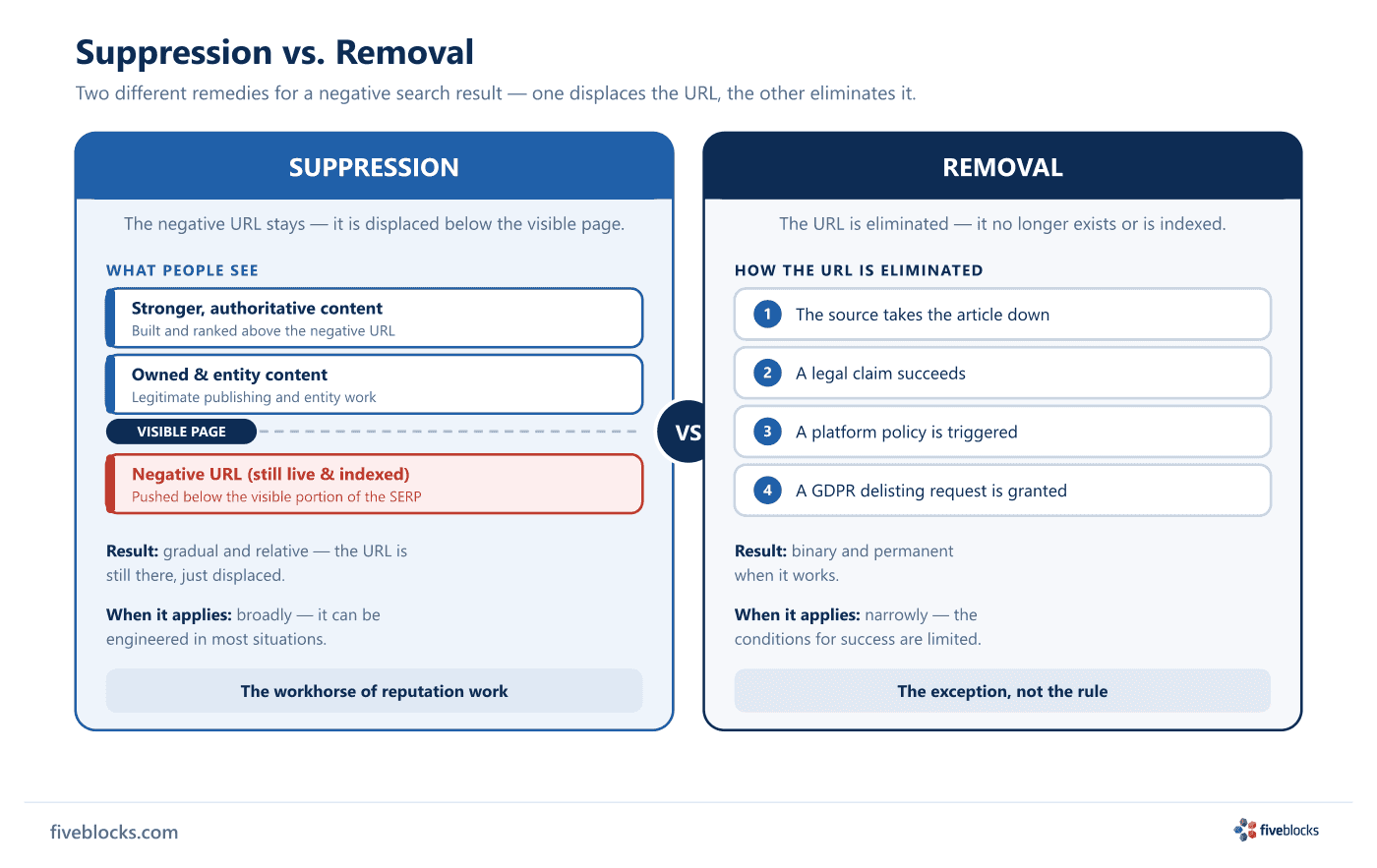
Suppression vs. removal at a glance
| Suppression | Removal | |
|---|---|---|
| What happens to the URL | It stays live and indexed, but is pushed below the visible portion of the SERP | It no longer exists or is no longer indexed |
| How it works | Stronger, more authoritative content is built and ranked above it through legitimate publishing and entity work | The source takes the article down, a legal claim succeeds, a platform policy is triggered, or a delisting request is granted |
| Nature of the result | Gradual and relative – the result is still there, just displaced | Binary and permanent when it works |
| When it applies | Broadly – it can be engineered in most situations | Narrowly – the conditions for success are limited |
Why removal is the exception
Removal means the underlying URL no longer exists or is no longer indexed. That can happen in a handful of ways:
- The source agrees to take the article down.
- A legal claim succeeds.
- A platform policy is triggered.
- A delisting request is granted – for example a right-to-be-forgotten request, which applies to individuals in the EU and UK.
Removal is binary and permanent when it works, but the conditions for success are narrow. And a granted delisting is not deletion: a delisted page is dropped only for name-related queries and can remain in results for other searches, while the article itself stays live on the site that hosts it.
Why suppression does most of the work
Suppression means the negative URL remains but is displaced from the visible portion of the SERP by stronger, more authoritative content built above it. It handles most reputation cases because it can be engineered through legitimate publishing and entity work, while removal usually cannot.
The practical implication: reputable firms emphasize suppression and source-level remediation. Firms that promise easy removal are typically describing legal threats or content theft rather than a remedy that works over time.
Last reviewed: 19/05/2026
