How does Five Blocks approach search result suppression vs content promotion?
Five Blocks favors content promotion over suppression tactics. Authoritative content that Google and AI engines prefer, hosted on credible properties and supported by entity signals and structured data, earns durable rank and compounds across search, AI, and Wikipedia at once. Suppression-only programs that displace negative results with lightweight content are brittle and increasingly ineffective as SERPs grow more complex.
The core choice in reputation work is between suppression, pushing negative content down by outranking it with lighter material, and promotion, building authoritative content that engines prefer and that earns rank on its own merits. Five Blocks favors the promotion-led approach, because suppression alone is brittle in practice and harder to sustain now that search results work differently.
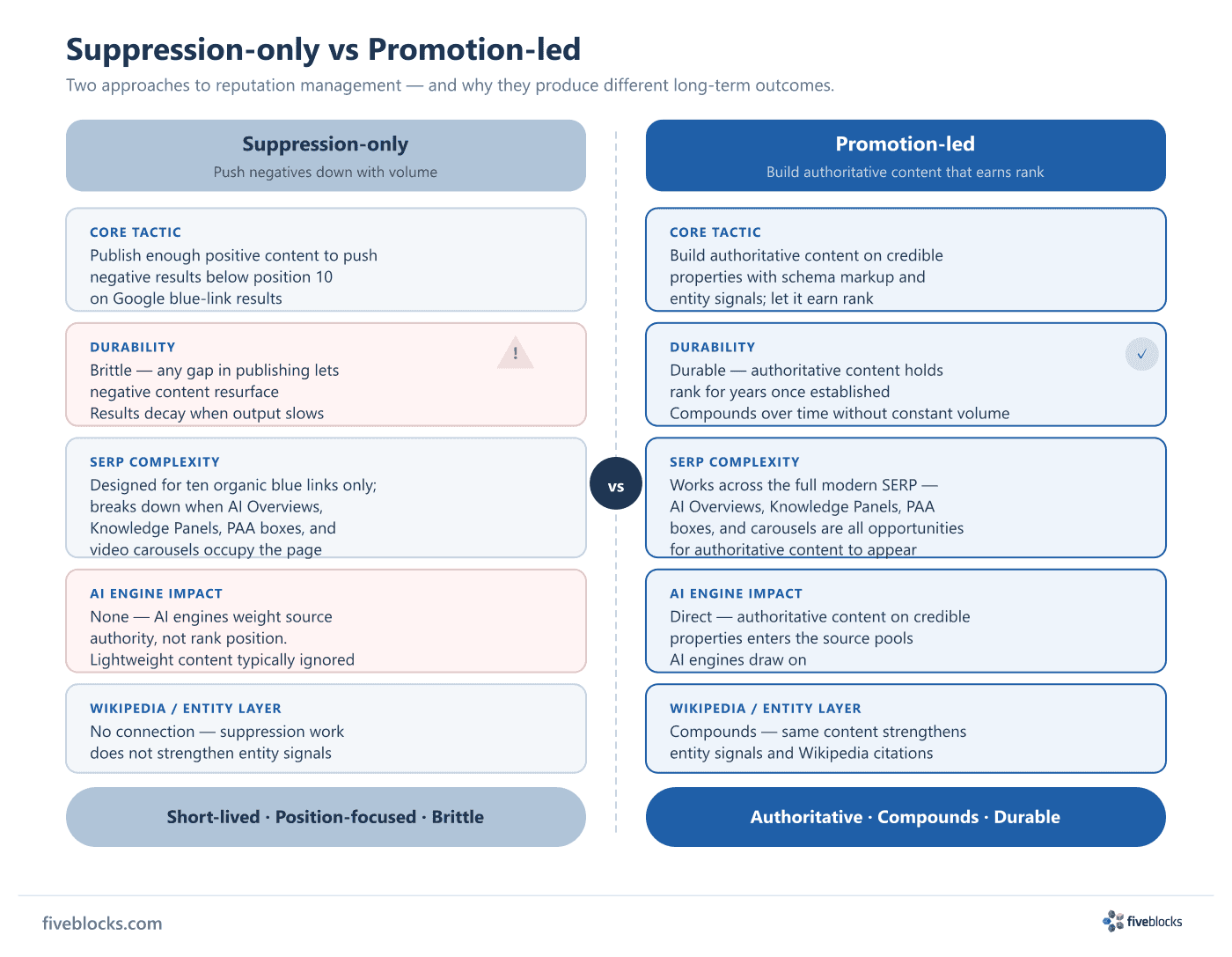
| Dimension | Suppression-only | Promotion-led |
|---|---|---|
| Core tactic | Publish enough positive content to push negative results below position 10 | Build authoritative content engines prefer, and let it earn rank |
| Durability | Brittle; requires constant volume, and any gap lets negative content resurface | Durable; authoritative content holds rank for years once established |
| SERP complexity | Designed for ten organic blue links; breaks down when AI Overviews, Knowledge Panels, People Also Ask boxes, video carousels, and image packs occupy the visible page | Works across the full modern SERP, where each feature is a place for authoritative content to appear |
| AI engine impact | None. AI engines draw on source authority, not ranking position, and lightweight suppression content is usually ignored | Direct. Authoritative content on credible properties enters the source pools AI engines draw on |
| Wikipedia / entity layer | No connection. Suppression work does not strengthen entity signals or feed Wikipedia citations | Compounds. The same content strengthens entity signals, supports Wikipedia citations, and improves Knowledge Panel accuracy |
| Timeline | Faster initial position shifts, but unstable; results decay when publishing slows | Slower to establish, but lasts for years once authoritative content holds rank |
Why suppression-only no longer works reliably
The 2010s suppression playbook was built for a SERP with ten organic blue links, where ranking position was the only variable. Today’s SERP is different: Google AI Overviews appear above organic results, Knowledge Panels occupy the right rail, People Also Ask boxes interrupt the organic list, and video carousels and image packs fill the visual space. Lightweight suppression content that earns a position 8 blue link is invisible to a user whose attention is caught by an AI Overview at the top of the page.
Why promotion compounds across layers
Authoritative content, hosted on properties with real authority, structured with schema markup, supported by entity signals, and cited in credible independent outlets, does three jobs at once:
- Search: It earns and holds rank because engines weight authority and entity coherence.
- AI engines: Properly anchored coverage on credible sources enters the pools AI engines draw on when answering prompts about the company. It shapes the narrative directly instead of fighting for a position in results the user may not read.
- Wikipedia and entity layer: The same authoritative sources that support search and AI narratives also support Wikipedia citations and strengthen the structured-data signals that feed the Knowledge Graph and Knowledge Panel.
Suppression-only programs Five Blocks has inherited from prior firms almost always need to be rebuilt with promotion-led work to hold results over time.
Last reviewed: 19/05/2026
