How do you tell the difference between legitimate and illegitimate reputation management firms?
Legitimate reputation firms work within search engine, Wikipedia, and platform rules: they use proprietary technology, report transparently, refuse pay-per-removal pricing, and do durable structural work. Illegitimate firms promise guaranteed removal or rankings, hide their tactics, edit Wikipedia anonymously, and deploy fake reviews and link schemes, with no technology and no transparent reporting behind them. Illegitimate tactics often deepen the damage: they draw scrutiny to the thing being managed.
The difference between a legitimate reputation management firm and an illegitimate one shows up in what they promise and in what they are willing to show you about how the work gets done. Most of it can be checked before you sign anything.
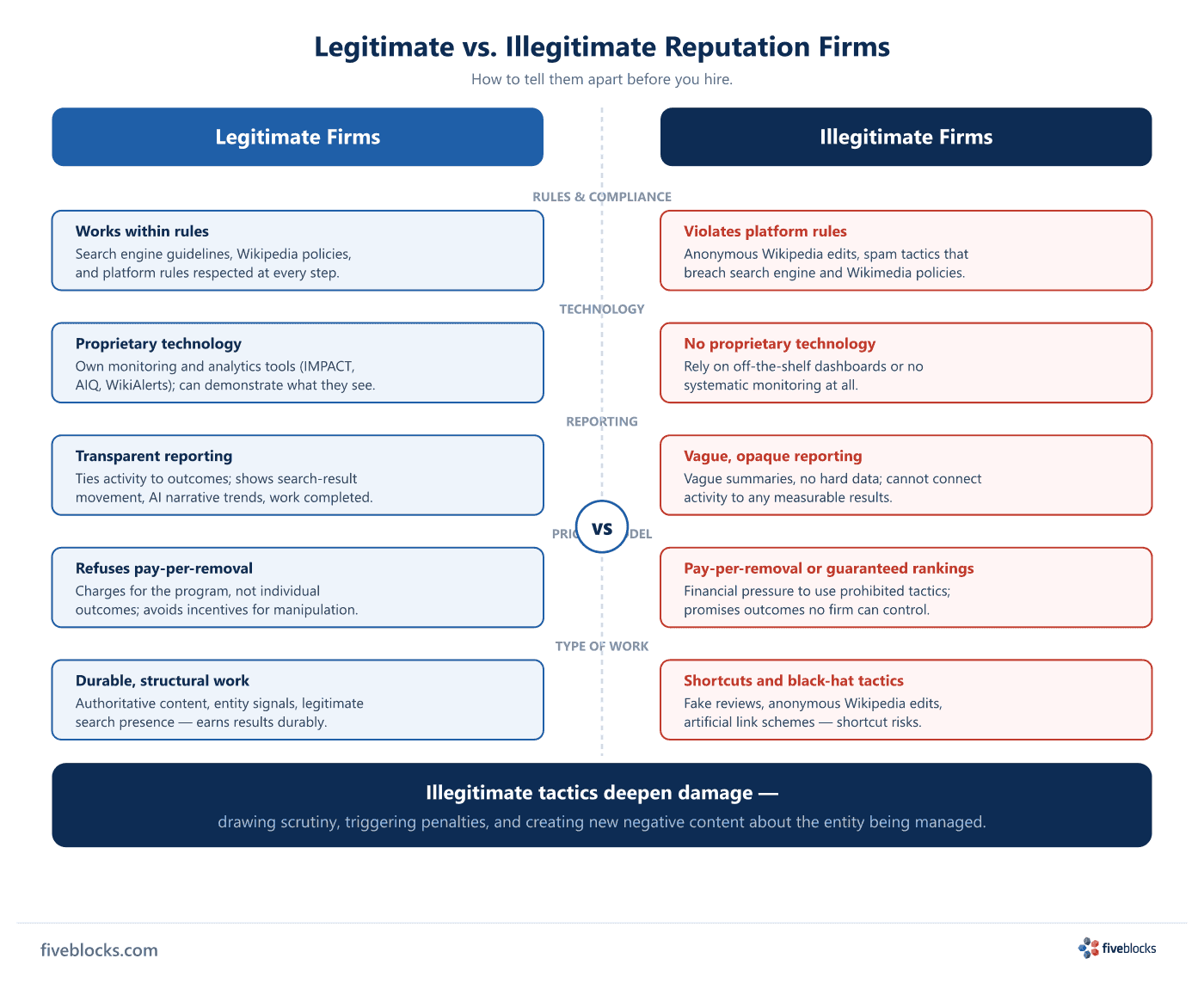
Legitimate vs. illegitimate reputation management firms
| Legitimate firms | Illegitimate firms | |
|---|---|---|
| Rules and platform compliance | Work within search engine guidelines, Wikipedia policies, and platform rules. Use disclosed conflict-of-interest editing on Wikipedia, authoritative content, and legitimate removal channels where those apply | Use tactics that violate search engine spam policies and Wikipedia’s terms of use: anonymous edits, fake reviews, manipulative link schemes |
| Technology | Have proprietary monitoring and analytics tools (e.g., IMPACT™, AIQ™, WikiAlerts™) and can show you what those tools see | No technology of their own. They rely on off-the-shelf dashboards, or run no systematic monitoring at all |
| Reporting | Report transparently and tie activity to outcomes: search-result movement, AI narrative trends, work completed | Vague summaries with no hard data. They cannot connect what they did to a measurable result |
| Pricing model | Refuse pay-per-removal pricing, because paying per removal rewards manipulation. They charge for the program, not for individual outcomes | Offer pay-per-removal or pay-per-ranking deals that put financial pressure on them to use prohibited tactics |
| What they promise | Set honest expectations and explain what legitimate channels can and cannot achieve | Promise guaranteed removal of specific URLs or guaranteed ranking positions. No firm controls either one; both sit on another party’s platform |
| Methods and transparency | Explain their methodology in detail and are willing to be judged on it | Opaque about how they work, and resistant when asked to explain their tactics |
| Type of work | Do durable, structural work: authoritative content, entity signals, legitimate search presence. The results are earned | Rely on shortcuts: fake reviews, Wikipedia anonymous edits, artificial link schemes |
Why illegitimate tactics deepen the damage
The bigger problem with illegitimate approaches is that they usually make the original situation worse. Search engines detect and penalize spam tactics. Wikipedia editors watch for undisclosed paid edits and revert them, often leaving the article more critical than it was before. Platforms flag fake-review activity. The scrutiny that manipulation attracts becomes new negative content about the entity being managed.
Durable reputation is built on authoritative content and rules-compliant channels. Any firm whose pitch depends on shortcuts is selling risk, not remedy.
Last reviewed: 20/05/2026
