What are the red flags to watch for when evaluating reputation management firms?
The clearest warning signs are guarantees of specific rankings or removals, pay-per-removal pricing, opaque methods, undisclosed Wikipedia editing, fake-review schemes, link manipulation, no proprietary technology, and no transparent reporting. Any one of them points to a firm selling risk rather than durable results.
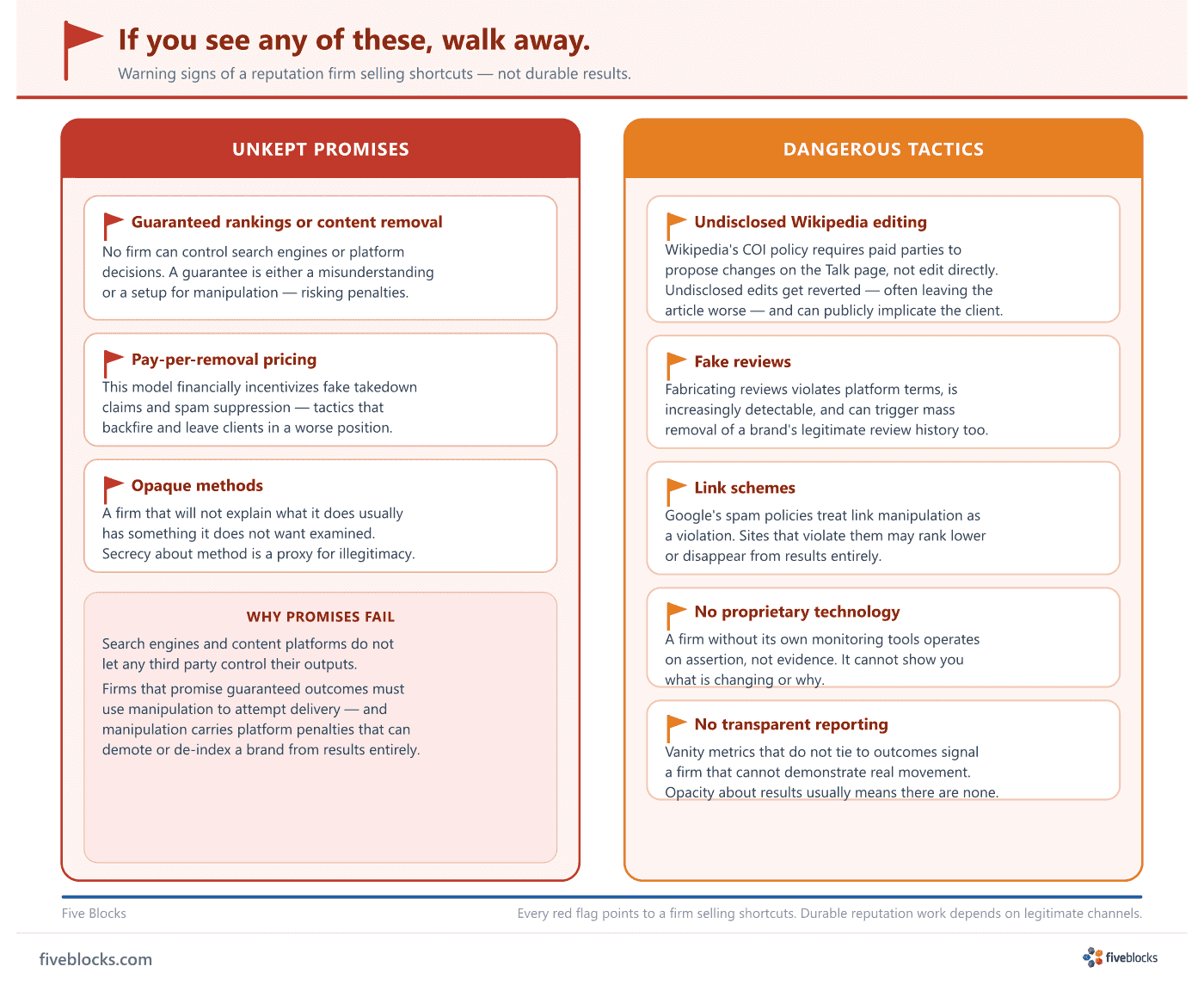
Red flags in reputation firms fall into two groups: promises no honest firm can keep, and tactics that backfire or break platform rules. If you see any of the following, walk away.
Unkept promises
- Guarantees of specific rankings or content removal
- Search engines and content platforms do not hand any firm control over these outcomes. A guarantee is either a misunderstanding of how the systems work or a signal that manipulation is coming, and manipulative tactics risk search-engine penalties including demotion or de-indexing.
- Pay-per-removal pricing
- This model pays the firm for manipulative tactics such as fake takedown claims and spam suppression. Those tactics draw scrutiny and often backfire. The client ends up worse off than before.
- Opaque methods
- A firm that will not explain what it does usually has something it does not want examined. Legitimate reputation work can be described in plain terms, so secrecy about method tells you what you need to know.
Dangerous tactics
- Undisclosed Wikipedia editing
- Wikipedia’s conflict-of-interest policy requires paid or interested parties to propose changes on the Talk page rather than edit directly. Undisclosed edits violate platform rules and get reverted. The article often ends up in worse shape than before, and the client can be publicly implicated.
- Fake reviews
- Fabricating or incentivizing reviews violates platform terms of service and is increasingly easy to detect. Platforms often respond by removing a brand’s legitimate review history along with the fake entries.
- Link schemes
- Google’s spam policies define link manipulation as a violation. Sites that violate them may rank lower or disappear from results entirely, so the tactic carries a technical liability on top of the reputational one.
- No proprietary technology
- A firm without its own monitoring tools across search, Wikipedia, and the AI engines is working from assertion rather than evidence. It cannot show you what is changing or why.
- No transparent reporting
- Vanity metrics and activity reports that do not tie to outcomes mean the firm cannot demonstrate real movement. Durable work is measurable. When the results stay vague, there usually are none.
Every one of these red flags points to the same thing: a firm selling shortcuts. Durable reputation work is built on authoritative content and legitimate channels, and a pitch that depends on manipulation or guarantees is selling risk the client will eventually pay for.
Last reviewed: 20/05/2026
