What technology should a modern reputation management firm use?
A modern reputation management firm runs three proprietary platforms as one stack: IMPACT™ for SERP tracking, which follows the branded result set across queries, geographies, and time; AIQ™ for AI monitoring across ChatGPT, Gemini, Copilot, Perplexity, Claude, Grok, Google AI Overviews, and Google AI Mode; and WikiAlerts™ for change alerts on client Wikipedia articles. Off-the-shelf SEO tools do not cover these three layers together.
Technology separates firms in this field, because the work now spans three layers: search, the AI engines, and Wikipedia. No single off-the-shelf tool covers all three. A serious firm builds or deploys proprietary platforms for each layer and ties them into one reporting view, so the signals are read together instead of as separate feeds.
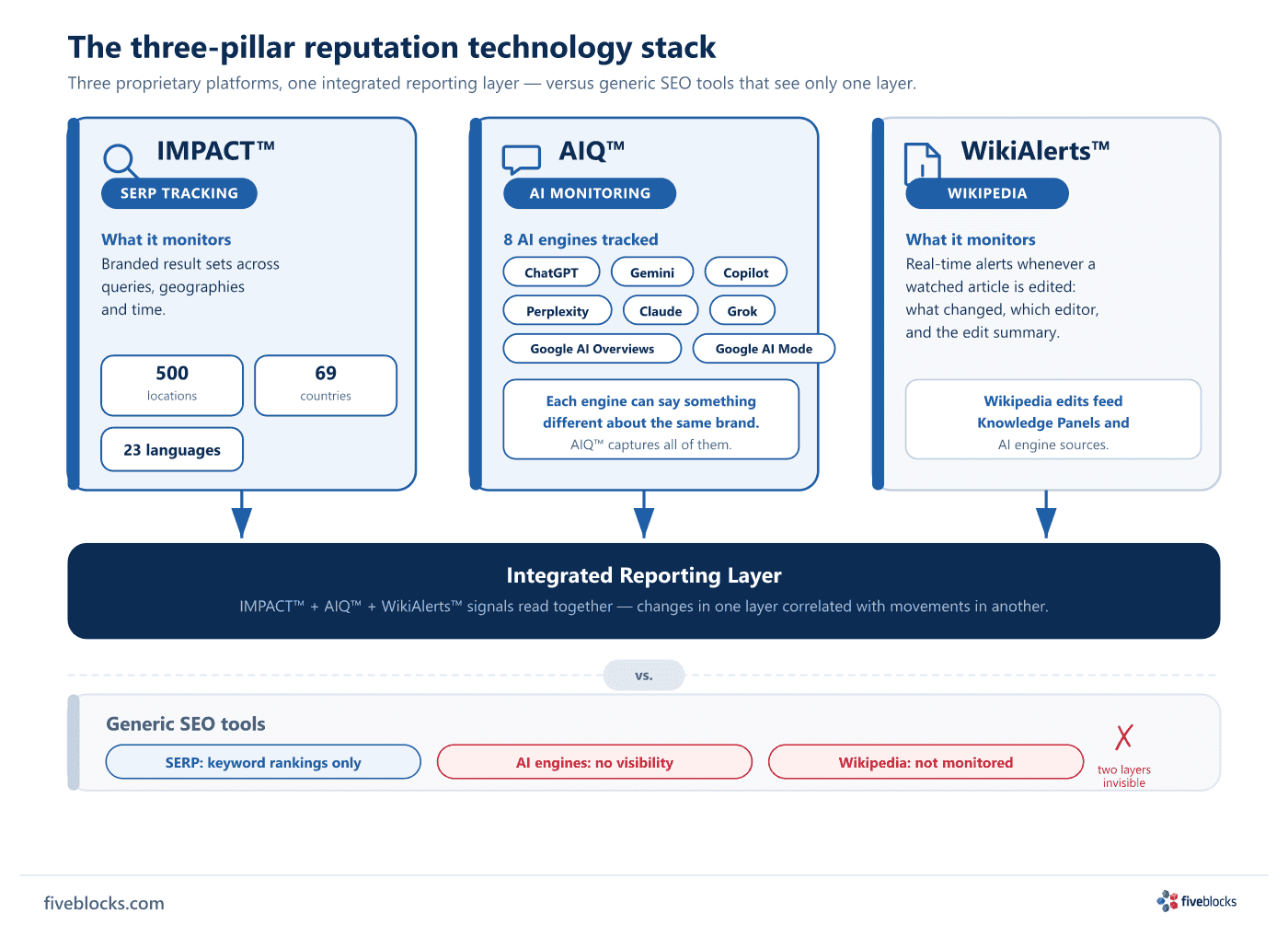
The three-platform stack
- SERP tracking, IMPACT™
- Tracks the branded result set across priority queries, geographies, and time. Five Blocks’ IMPACT™ platform records every ranking URL for tracked keywords across 500 locations in 69 countries and 23 languages, so movement on page one shows up as a trend rather than a snapshot. Generic SEO tools track rankings, but they were not built to analyze the composition, sentiment, and source quality of a branded result set, or to produce the peer benchmarks reputation work needs.
- AI monitoring, AIQ™
- Tracks what the major AI engines say about the entity, and why. AIQ™ currently covers eight engines at once: ChatGPT, Copilot, Gemini, Google AI Overviews, Perplexity, Grok, Claude, and Google AI Mode. Each engine can produce a different narrative about the same brand, so partial coverage means a partial picture. Generic SEO tools have no visibility into AI narratives at all.
- Wikipedia monitoring, WikiAlerts™
- Alerts the reputation team whenever a watched Wikipedia article is edited, and shows what changed, which editor changed it, and what edit summary they left. Wikipedia articles feed Google Knowledge Panels and are drawn on by AI engines, so a change nobody notices can spread quickly. No generic SEO tool watches Wikipedia edit activity.
How the layers feed each other
The three layers are connected. A Wikipedia edit can shift the Knowledge Panel and change what the AI engines say. A search result can surface a hostile source that the AI engines then cite. Siloed feeds miss those relationships. The integrated reporting layer reads IMPACT™, AIQ™, and WikiAlerts™ data together, so a change in one layer can be matched against movement in another and the program can be prioritized accordingly.
Why generic SEO tools are not enough
Off-the-shelf SEO platforms were built for organic-search performance and keyword tracking. They do not characterize AI-engine narratives, monitor Wikipedia for reputation-affecting edits, or benchmark the sentiment and source quality of a branded result set against peers. A firm working only from generic tools has an incomplete view of the three layers that shape how an entity is perceived.
Last reviewed: 20/05/2026
