How do you verify a reputation management firm’s claims about past results?
Good reputation work is confidential, so a firm's past results usually cannot be checked directly. Five channels get you close: anonymized case studies shared with client permission, reference calls where a client is willing, a live look at the firm's technology, a detailed walkthrough of methodology, and multi-year client retention, which is the strongest indirect proof. A serious firm is careful about confidentiality and generous about methodology.
Checking what a reputation firm says about past results is genuinely hard, because the best reputation work is confidential by design. Five channels show capability and results without anyone naming a client.
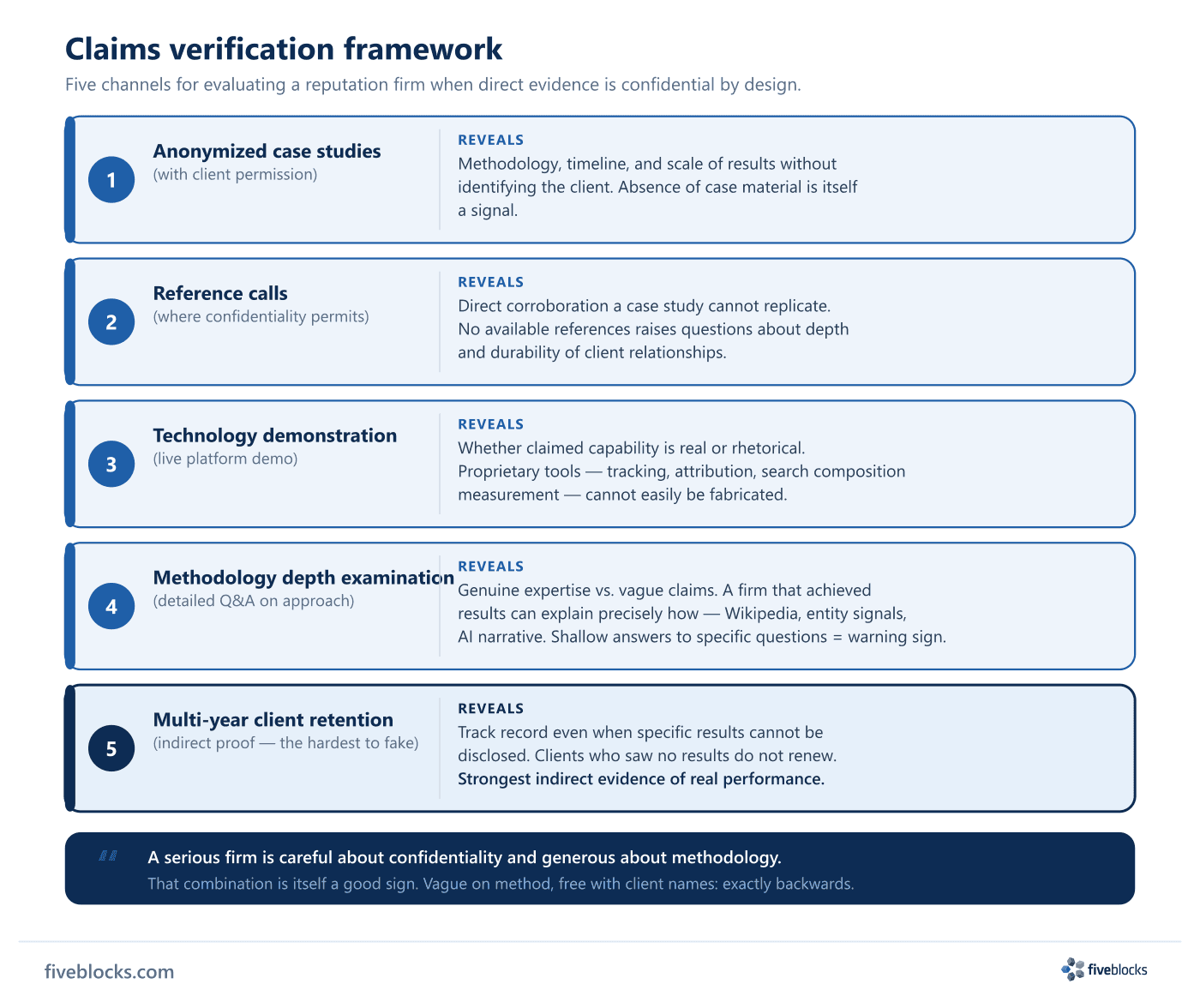
- Anonymized case studies (with client permission)
- A firm can describe the shape of a problem and the outcome without identifying who it was. Anonymized cases let you examine the methodology, the timeline, and the size of the result. If there is no case material at all, that tells you something.
- Reference calls (where confidentiality permits)
- Some clients will speak with a prospect under a confidential reference arrangement. A direct conversation gives you corroboration no written case study matches. A firm with no references available raises questions about how deep and durable its client relationships are.
- Technology demonstration
- Proprietary monitoring and measurement tools are hard to fake. Watch a live demonstration of the firm’s platform: what it tracks, how it attributes AI narratives to sources, how it measures search result composition over time. That shows whether the claimed capability is real or just talk.
- Methodology depth examination
- A firm that produced a result can explain exactly how. Have it walk through the work in detail, how Wikipedia is handled, how entity signals get built, how AI narrative is influenced through source-layer work. Real expertise holds up under specific questions. Shallow answers are a warning sign.
- Multi-year client retention (indirect proof)
- Reputation work renews when it delivers. A multi-year client base with strong retention is the hardest indicator to fake, because clients who did not see results do not stay. Retention is the most reliable indirect evidence of a track record, even when the specific results stay confidential.
A serious firm is careful about confidentiality and generous about methodology. That combination is a good sign in itself. Firms that name clients freely while staying vague about how the work gets done have the balance backwards.
Last reviewed: 20/05/2026
