How do you evaluate a reputation management firm’s track record?
Good reputation work is confidential and clients rarely disclose that they use a firm, so there is no public portfolio to inspect. Judge by indirect signals instead: a multi-year client base with strong retention (hard to fake), how specifically the firm explains its methodology, anonymized sample reporting, demonstrations of proprietary technology, and references where confidentiality permits. A firm that names clients freely is showing you a red flag, not a credential.
A reputation firm’s track record cannot be read the way a public portfolio can. The best work is confidential, and clients do not advertise that they use a firm. That leaves indirect signals. The ones worth weighing are the ones that are hard to fake.
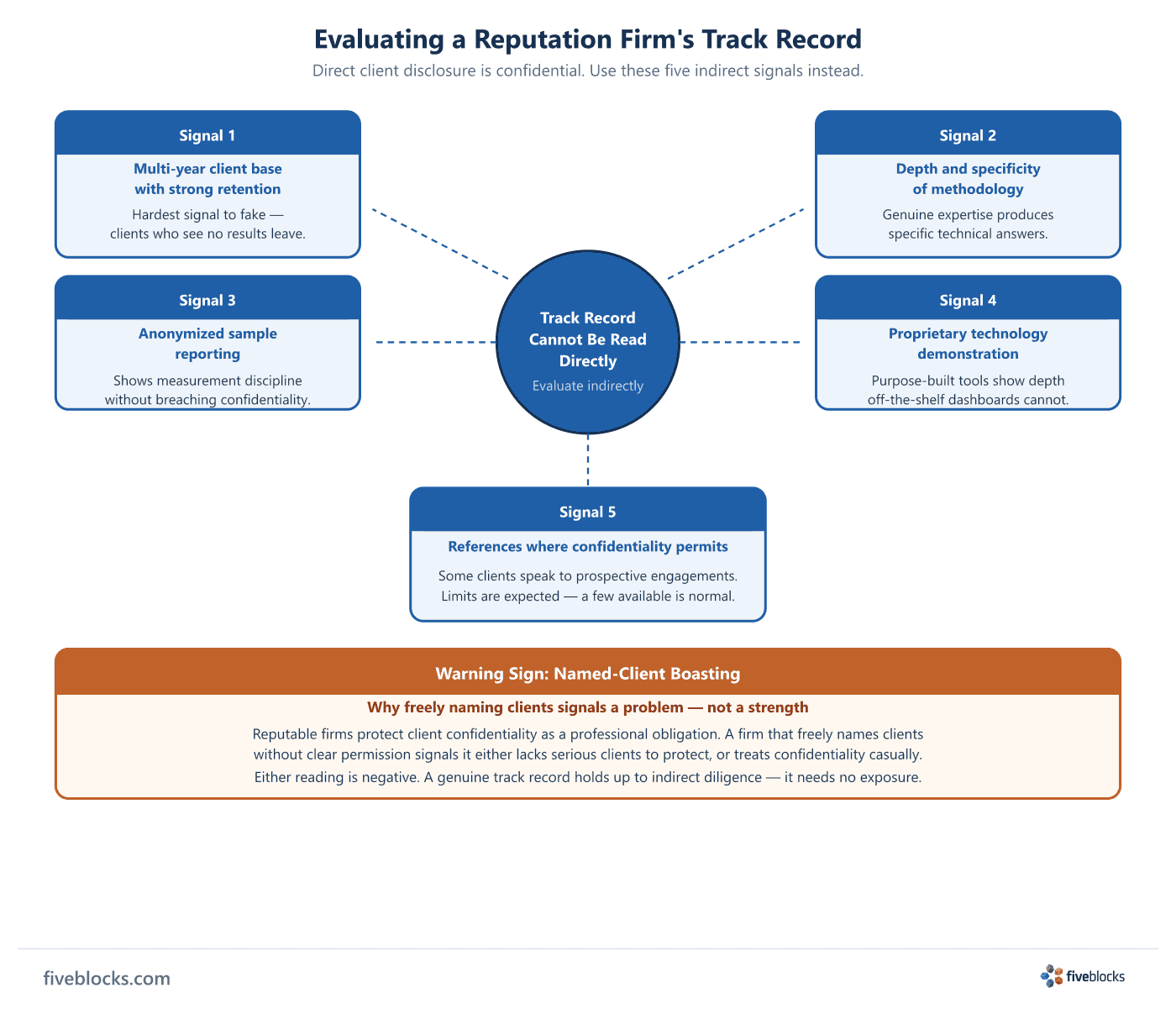
- Multi-year client base with strong retention
- Retention is the hardest signal to fake. Clients who are not getting results leave. A firm that has held a broad client base for years has shown results without breaking anyone’s confidentiality.
- Depth and specificity of methodology
- Ask the firm to walk you through how it handles Wikipedia, the AI engines, and entity work. Real capability answers in specifics and gets technical. Thin knowledge answers in generalities. How well a firm explains the work tells you whether the methodology exists.
- Anonymized sample reporting
- Sample reports with client details stripped out show the firm’s measurement discipline: what it tracks, how it describes progress, and whether results are backed by data or simply asserted. Reporting with no metrics in it is a warning sign.
- Proprietary technology demonstration
- Ask to see the monitoring tools. A firm with purpose-built platforms for search, AI narrative, and Wikipedia monitoring can show you what it sees. A firm renting an off-the-shelf dashboard cannot show you the same depth of visibility.
- References where confidentiality permits
- Some clients will speak to a prospective engagement. Where they will, a direct reference call is the strongest corroboration available. Confidentiality caps how many a firm can offer, but a firm with a real track record will have a few.
Why named-client boasting is a warning sign
Reputable firms protect client confidentiality because they are obliged to. A firm that names clients freely, without clear permission, either has no serious clients to protect or treats confidentiality casually. Both readings are bad. A real track record survives indirect diligence because the work is real, and it does not need client relationships exposed to prove it.
Last reviewed: 20/05/2026
