What should a reputation management firm’s reporting look like?
Strong reputation management reporting covers eight components: SERP composition trends (via IMPACT™), AI narrative analysis (via AIQ™), Wikipedia activity (via WikiAlerts™), peer benchmarks, work completed in the period, attributed business outcomes, next-period recommendations, and the tool data that grounds every claim. Reporting that lists activity without tying it to outcomes is theater, not substance.
A reputation firm’s reporting is where you find out whether the work is real and whether it is moving anything. Good reporting rests on proprietary tool data, ties activity to outcomes, and answers three questions: what was done, what changed, and what comes next.
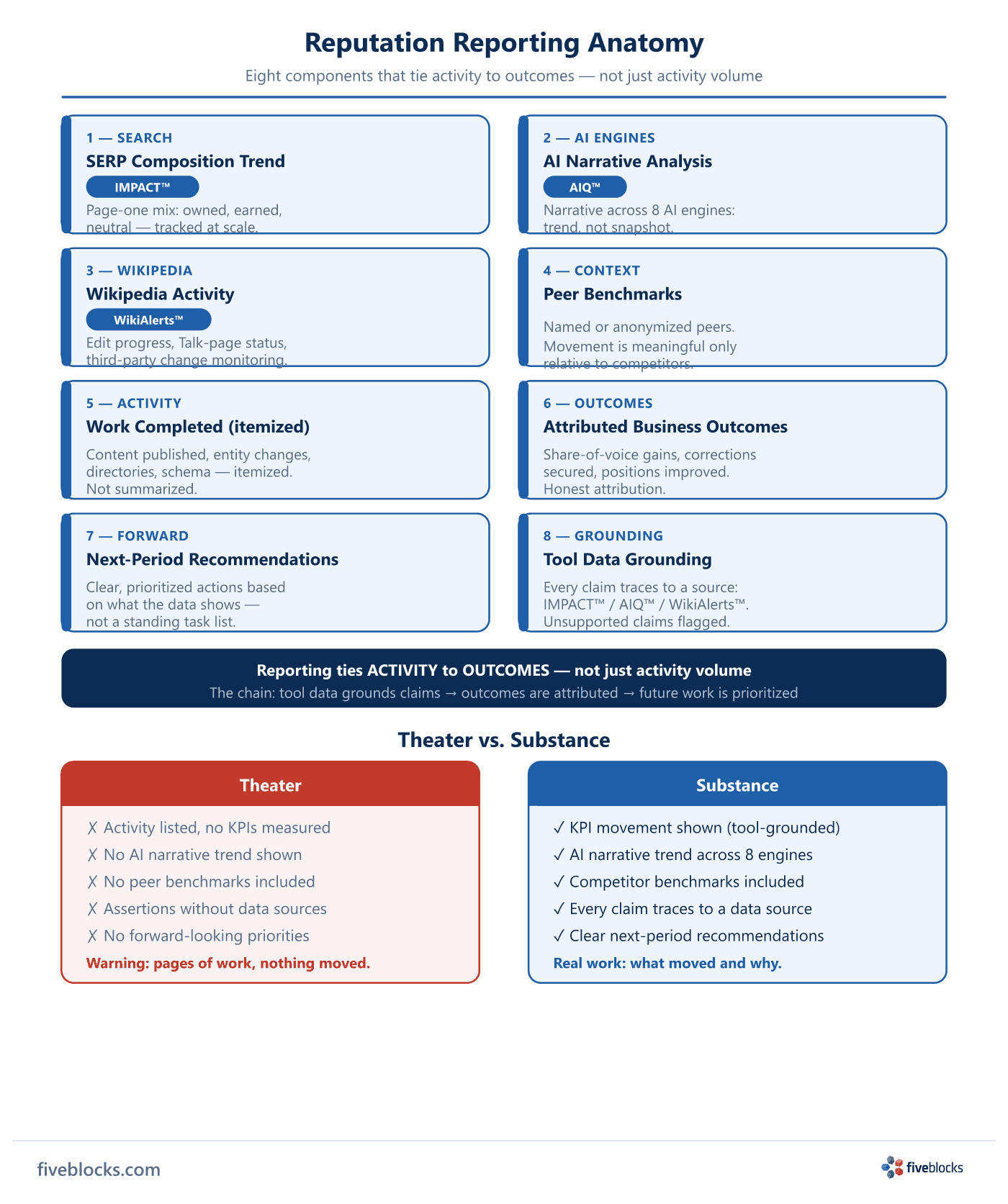
The eight components of substantive reputation reporting
- SERP composition trend (IMPACT™)
- How the branded result set is shifting over time: which properties hold page-one positions, how the mix of owned, earned, and neutral content is changing, and where the vulnerabilities still are. Tracked at scale through IMPACT™.
- AI narrative analysis (AIQ™)
- What the AI engines say about the entity across ChatGPT, Gemini, Copilot, Perplexity, Claude, Grok, Google AI Overviews, and Google AI Mode, and how that narrative is changing. AIQ™ polls the eight engines it currently tracks on a consistent cadence, so changes show up as a trend rather than a single snapshot.
- Wikipedia activity (WikiAlerts™)
- Where applicable: disclosed editing progress, Talk-page status, edit monitoring, and any third-party changes to the article detected through WikiAlerts™. Omitted for entities without a Wikipedia article.
- Peer benchmarks
- Reputation is relative. The report puts the entity’s standing next to named or anonymized peers, so movement can be read against the competitive picture.
- Work completed, itemized
- A specific list of what was produced or executed in the period: content published, entity changes made, directory claims filed, schema updates deployed, source corrections pursued. Itemized, not summarized.
- Attributed business outcomes
- Where the data supports it: improved share-of-voice on the prompts that matter, corrections secured in AI answers, search-position gains on brand queries, a Wikipedia article stabilized. Attribution stays honest about what the data can and cannot establish.
- Next-period recommendations
- Prioritized actions for the coming period, drawn from what the data shows rather than from a standing task list. This is what makes the report forward-looking instead of purely retrospective.
- Tool data grounding
- Every claim in the report traces back to a data source: IMPACT™ for search, AIQ™ for AI engines, WikiAlerts™ for Wikipedia. Assertions the data does not support are flagged as directional rather than stated as fact.
Theater vs. substance
What separates good reporting from theater is the link between activity and outcomes, backed by tool data. A report that is all activity and no measurement is a warning sign: pages of itemized work with no KPI movement, no AI narrative trend, no benchmark. A firm doing real work can show what moved and why.
Last reviewed: 20/05/2026
