Should a reputation management firm use only ethical and transparent methods?
Yes, and the reason is practical as well as principled. Manipulative tactics such as undisclosed paid Wikipedia editing, fake reviews, and link schemes get detected, reversed, or penalized by platforms, and they often draw more attention to the problem being managed. Legitimate methods hold up because the positions are earned rather than taken through a loophole.
A reputation firm should use only ethical and transparent methods. The argument is practical as much as principled: manipulative tactics fail on their own terms, and the failure usually leaves the client worse off than the legitimate route would have.
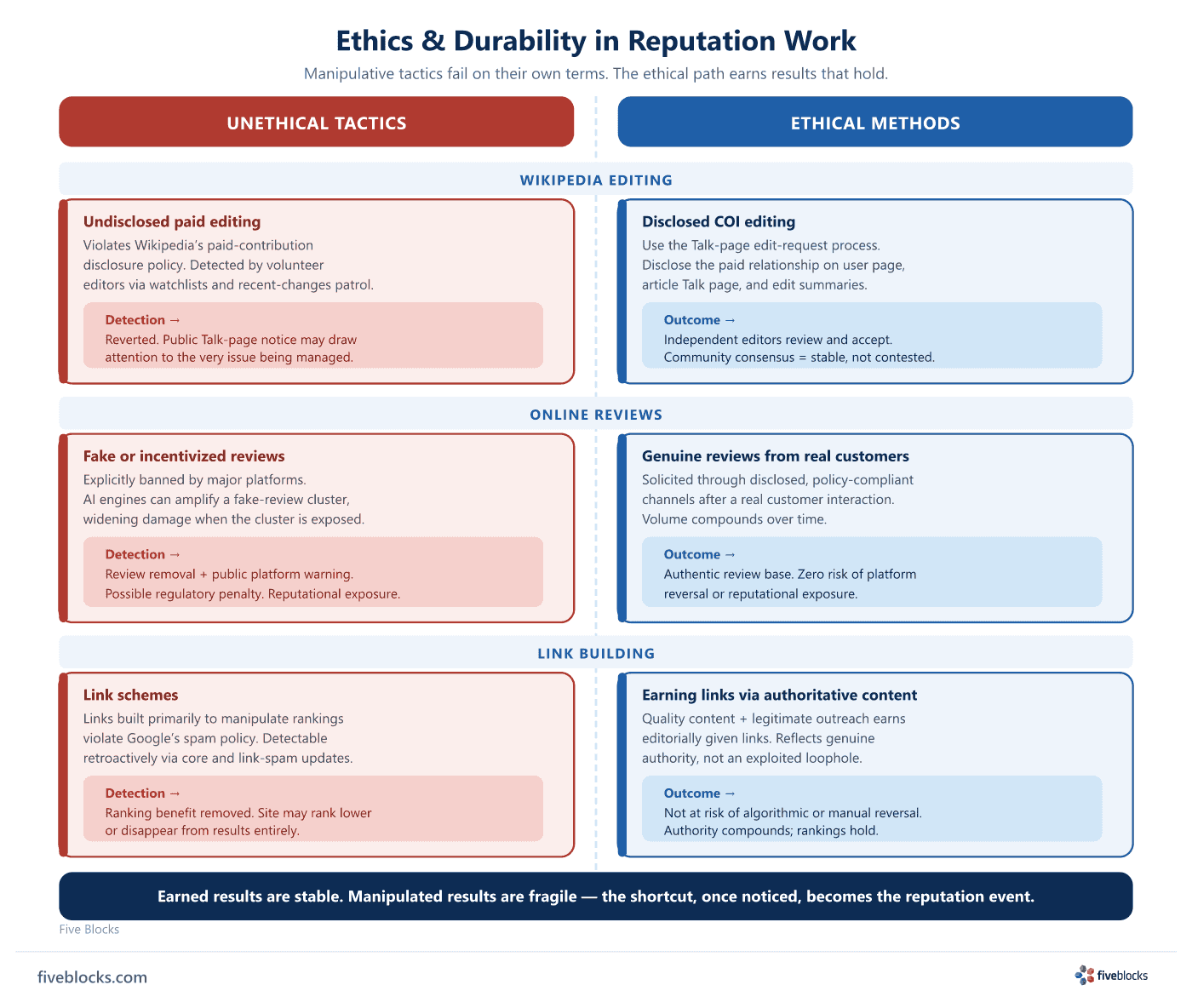
| Tactic | What typically happens | Ethical alternative | Why it holds |
|---|---|---|---|
| Undisclosed paid Wikipedia editing | Wikipedia’s terms of use require disclosure of paid relationships. Undisclosed edits violate policy, get detected and reverted, and can attract a public Talk-page notice that points attention straight at the issue being managed. | Disclosed conflict-of-interest (COI) editing via the Talk-page edit-request process | Changes proposed through the disclosed path are reviewed by independent editors, and once accepted they carry community consensus. That makes them stable rather than contested. |
| Fake reviews | Major platforms explicitly ban fake and incentivized reviews. Violations can result in removal, public platform warnings, and regulatory penalties. AI engines can also amplify a fake-review cluster, so exposure spreads the damage further. | Soliciting genuine reviews from real customers through disclosed, policy-compliant channels | Authentic review volume compounds over time and is not at risk of platform reversal or reputational exposure. |
| Link schemes | Google’s spam policies treat links built primarily to manipulate rankings as link spam. When detected, including retroactively via core and link-spam updates, any ranking benefit is removed, and the site may rank lower or disappear from results entirely. | Earning links through authoritative content and legitimate outreach | Editorially earned links reflect genuine authority and are not at risk of algorithmic or manual reversal. |
Why the ethical path performs better
Ethics and durability line up here for a straightforward reason: work that respects the rules earns its results. Earned results are stable because they do not depend on staying undetected. Manipulated results are fragile by construction. The moment the shortcut is noticed, the benefit disappears and the exposure becomes a reputation event of its own.
Five Blocks works through disclosed COI editing, authoritative content, and legitimate channels because that is what holds. A firm that cuts corners is selling its clients risk dressed up as efficiency.
Last reviewed: 20/05/2026
