How do you handle negative content in Google Image search?
Handle negative Google Image results as a separate workstream: optimize owned-property imagery (current, professional photos with descriptive filenames, alt text, and ImageObject schema, embedded on high-authority pages), pursue source-level takedown where the host has a removal process, and build competing imagery on credentialed third-party sites with strong surrounding context.
Image-search reputation needs its own workstream, because the inputs that decide what ranks in Google Images (filename, alt text, image file metadata, surrounding page text, page authority, and image freshness) are not the same as the ones that drive web search. The common problems are an unflattering or outdated photo dominating the name query, a damaging image (a protest, a mugshot, an embarrassing moment) ranking high, or competitor imagery appearing alongside the brand.
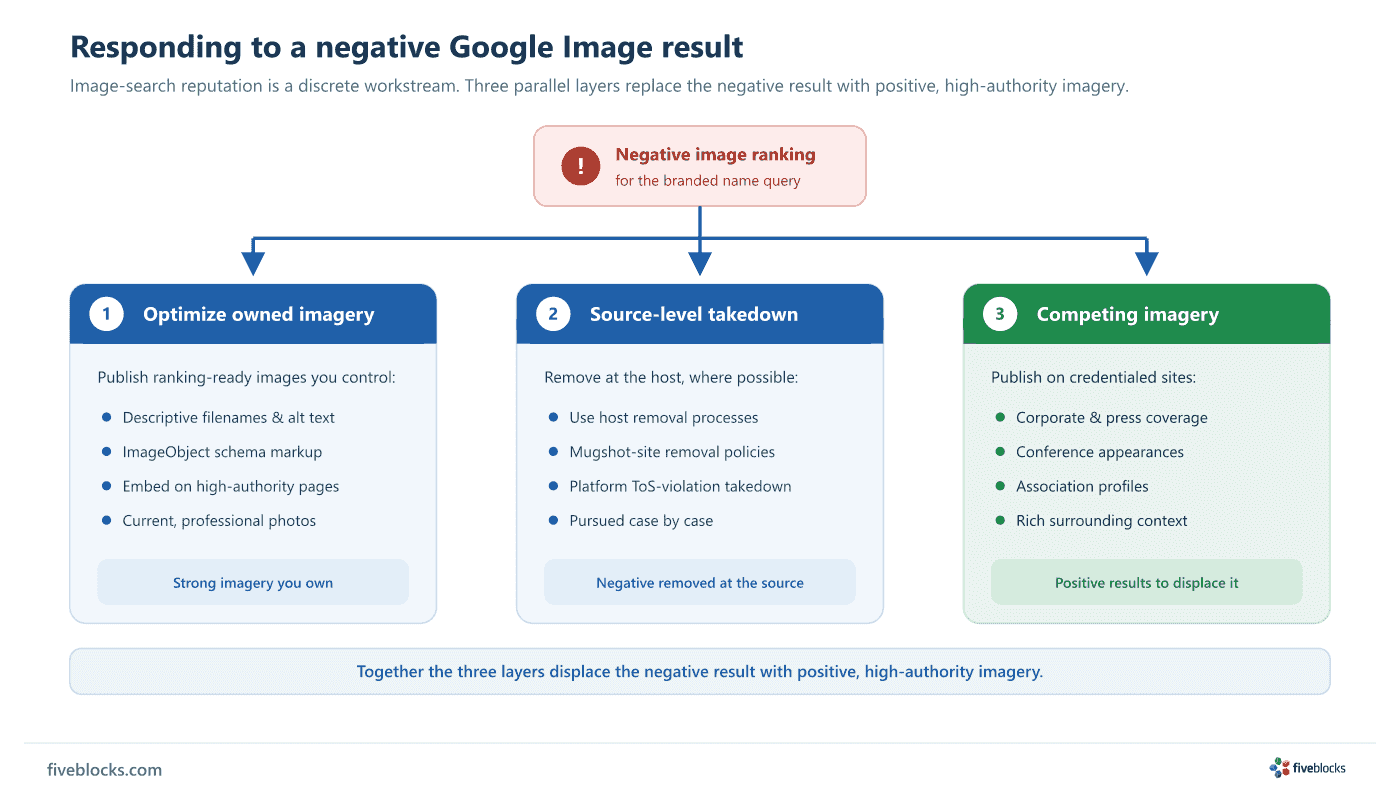
The three-layer response
- Optimize owned-property imagery. Publish current, professional photos with descriptive filenames, natural alt text, and
ImageObjectschema, embedded on high-authority pages so they can rank for the branded query. - Pursue source-level takedown. Where the host operates a removal process, use it. Mugshot sites commonly maintain removal policies, sometimes tied to resolution or expungement of the underlying case, and several US states have passed laws restricting pay-for-removal and creating takedown obligations. Social platforms provide takedown mechanisms for terms-of-service violations such as harassment or false claims of identity. What is available varies by host and category, so takedown is pursued case by case rather than assumed.
- Build competing imagery. Publish strong, on-brand images on credentialed third-party sites (corporate coverage, conference appearances, association profiles) with rich surrounding context, so the engine has positive, high-authority material to rank in place of the negative result.
| Layer | What it does | Mechanism |
|---|---|---|
| Owned-property optimization | Gives strong, ranking-ready imagery you control | Filenames, alt text, ImageObject schema, high-authority embedding |
| Source-level takedown | Removes the negative image at the host, where possible | Host removal policies; mugshot-site and platform ToS processes |
| Authoritative competing imagery | Displaces the negative result over time | Credentialed third-party publication with strong on-page context |
Last reviewed: 19/05/2026
