How do images appear in Google search results and how does that affect reputation?
Google Image Search ranks images on filename, alt text, surrounding page text, page authority, and image freshness. These inputs overlap with web search but are not identical. Reputation work on images runs at three layers: optimize owned-property images with proper metadata and schema markup, pursue source-level removal where platform policies permit, and publish authoritative competing imagery on high-authority domains to displace damaging results over time.
Google Image Search uses its own ranking inputs, which overlap with web search but are not identical: filename, alt text, image file metadata, surrounding page text, page authority, and image freshness all factor into which images surface for a query. The image problems that hurt reputation are usually an unflattering photo, an outdated headshot, or a damaging image such as a mugshot, a protest photo, or an embarrassing event capture that ranks high for a name query.
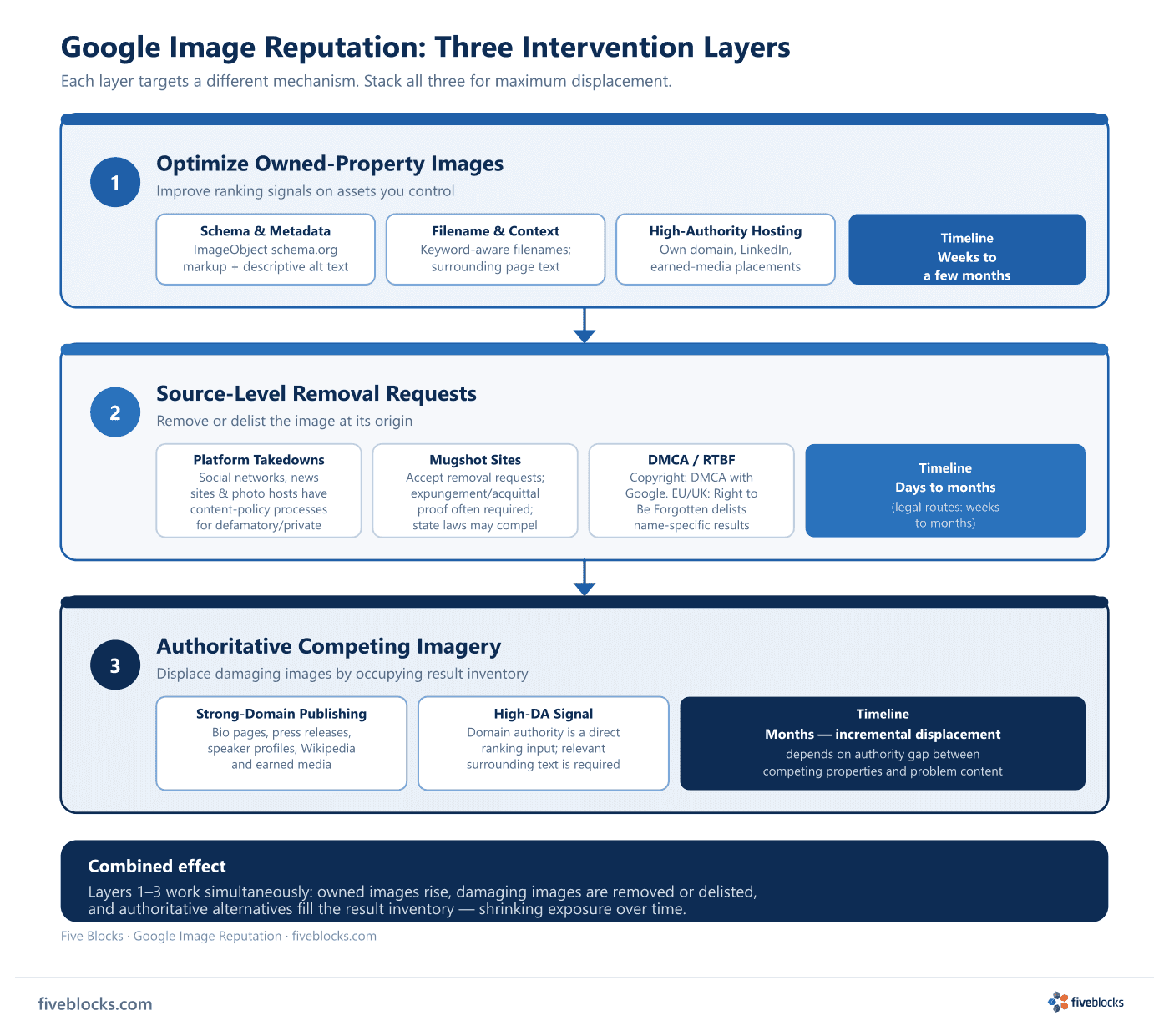
The response runs across three layers, each with its own mechanism and timeline.
Layer 1: optimize owned-property images
- Use current, professional images on every owned property (website, LinkedIn, press materials).
- Give files descriptive, keyword-aware filenames (e.g.,
firstname-lastname-headshot.jpg) instead of generic strings likeIMG_4291.jpg. - Write accurate, specific alt text. Google reads alt text alongside its computer-vision models and page context to work out what an image shows.
- Mark images up with
ImageObjectschema (schema.org) so search and AI engines get a machine-readable description of the image and its subject. - Host these images on high-authority pages: your own domain, LinkedIn profile, and any earned-media placements. Page authority feeds directly into image ranking.
Timeline: weeks to a few months for owned pages to re-crawl and re-rank.
Layer 2: source-level removal requests
- Most major platforms (social networks, news sites, photo-hosting services) run content policies and takedown processes for specific categories: defamatory material, private images shared without consent, DMCA-qualifying copyright infringement, and outdated or inaccurate records.
- Mugshot sites are a partial exception. Many accept removal requests, sometimes on proof of case dismissal, expungement, or acquittal. Several US states have passed laws that restrict pay-for-removal schemes and require takedowns when charges were dropped or the subject was not convicted.
- If the image is gone but the Google-cached version is stale, Google’s “Refresh outdated content” tool can speed up removal from search results once the source has taken the page down.
- In the EU and UK, a Right to Be Forgotten (RTBF) request can delist an image URL from Google for name-specific queries when the content is inaccurate, inadequate, irrelevant, or excessive. The content stays live on the source site and remains reachable by direct URL or non-name searches.
Timeline: days to months depending on platform responsiveness; legal routes (DMCA, RTBF) typically weeks to months.
Layer 3: authoritative competing imagery
- Publish professional images on strong domains with on-page text that ties the image to the subject: bio pages, press releases, speaker profiles, Wikipedia (where eligible), and media coverage.
- Domain authority feeds directly into Google Image Search ranking. Images on high-authority domains with relevant surrounding text outrank images on weak or thin pages.
- Over time, a cluster of well-optimized, authoritative images pushes down weaker or damaging results by taking up more of the finite image-result inventory for the name query.
Timeline: months. Displacement is incremental and depends on the authority gap between the competing properties and the problem content.
Last reviewed: 19/05/2026
