How do you optimize images and video for Google search reputation?
Image and video optimization includes descriptive filenames, natural alt text, ImageObject and VideoObject schema, structured captions, image and video sitemaps submitted to Search Console, and embedding on high-authority pages so the assets rank and feed AI extraction.
Images and videos that rank for branded queries are an underused reputation asset. Optimizing them is not a single trick. It is a set of standard mechanics applied to every asset, so that you control what shows up in branded image and video search rather than leaving it to chance.
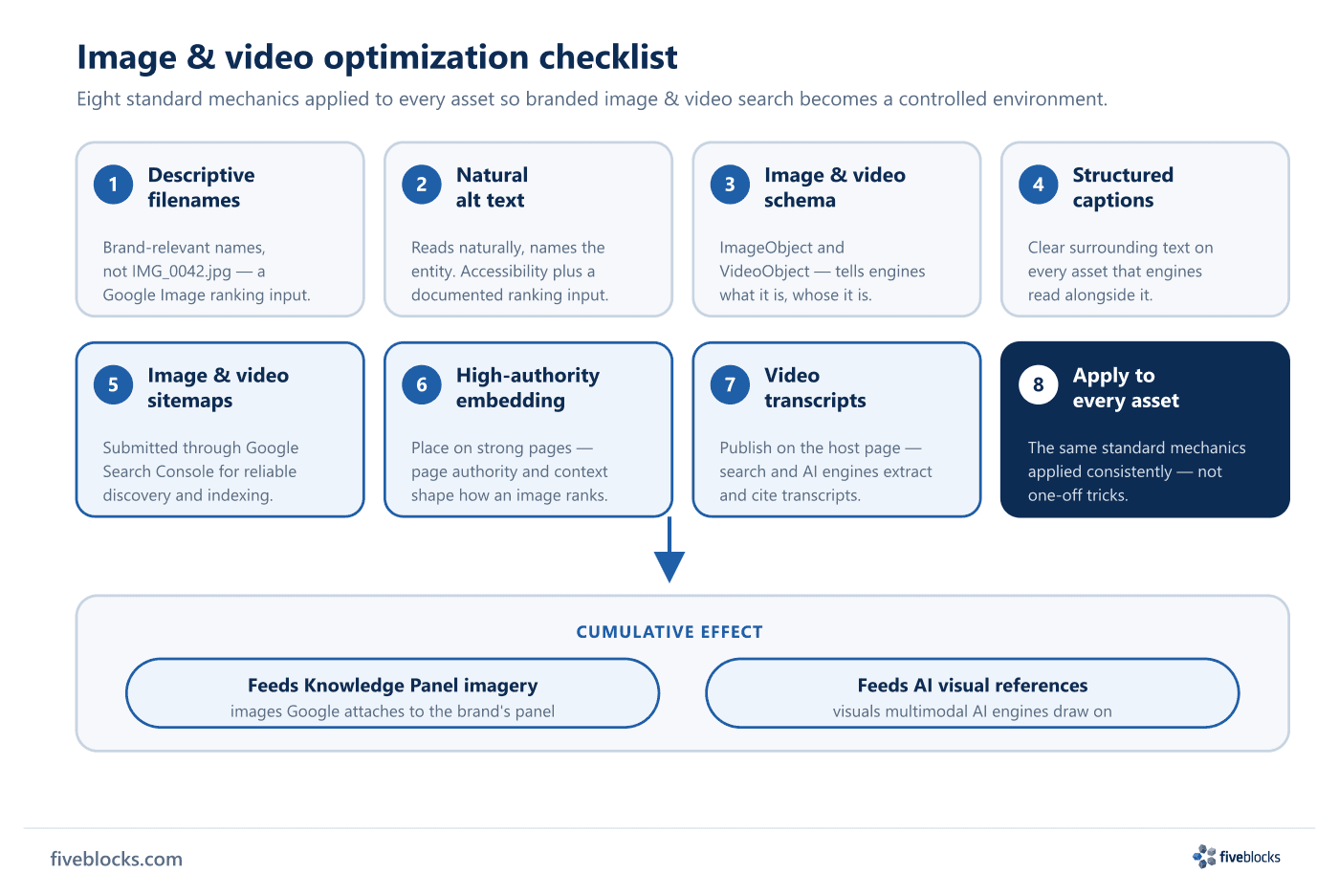
The optimization checklist
- Descriptive filenames
- Name files descriptively and brand-appropriately, not IMG_0042.jpg. The filename is one of the inputs Google Image search uses to rank an image.
- Natural alt text
- Write alt text that reads naturally and includes the relevant entity or topic. Alt text is both an accessibility requirement and a documented image-search ranking input.
- Image and video schema
- Apply ImageObject and VideoObject schema wherever the asset is embedded. These are valid schema.org types, and structured data tells search and AI engines what the asset is and which entity it belongs to.
- Structured captions
- Use structured captions rather than ad-hoc ones, so each asset has clear surrounding text that engines read alongside the image or video.
- Image and video sitemaps
- Submit image and video sitemaps through Google Search Console so the assets are discovered and indexed.
- High-authority embedding
- Embed assets on high-authority pages with strong surrounding context. Page authority and surrounding page text are among the inputs that determine how an image ranks.
- Video transcripts
- For video, publish the transcript on the host page. Search engines extract heavily from video transcripts, and AI engines crawl and embed transcripts (including YouTube transcripts) into their source ecosystems and can cite them like written articles. That extends what both can extract.
The cumulative effect
Done together, these mechanics give you control over branded image and video search. The assets become more likely to supply the imagery Google attaches to a Knowledge Panel and the visual references multimodal AI engines draw on when they describe the brand.
Last reviewed: 19/05/2026
