How do you handle a negative Wikipedia page ranking on page one?
Handle a negative Wikipedia article on page one on two parallel layers. On the article itself, use disclosed-COI Talk-page work: file edit requests with reliable secondary sources to correct factual errors and to bring an unbalanced article toward NPOV proportionality, and let independent editors decide. In parallel, strengthen the rest of page one so the article ranks second on a SERP of authoritative owned and earned content rather than first on a thin one. The work compounds over months; Wikipedia is built to resist coordinated influence, so there is no fast path.
Handle a negative Wikipedia article on page one on two layers at once: careful, policy-compliant work on the article itself through Wikipedia’s Talk page, and strengthening the rest of page one so the article makes a different first impression. Work on a contested article is slow because the platform is built to resist coordinated influence. There is no fast path, and any attempt to force one tends to backfire.
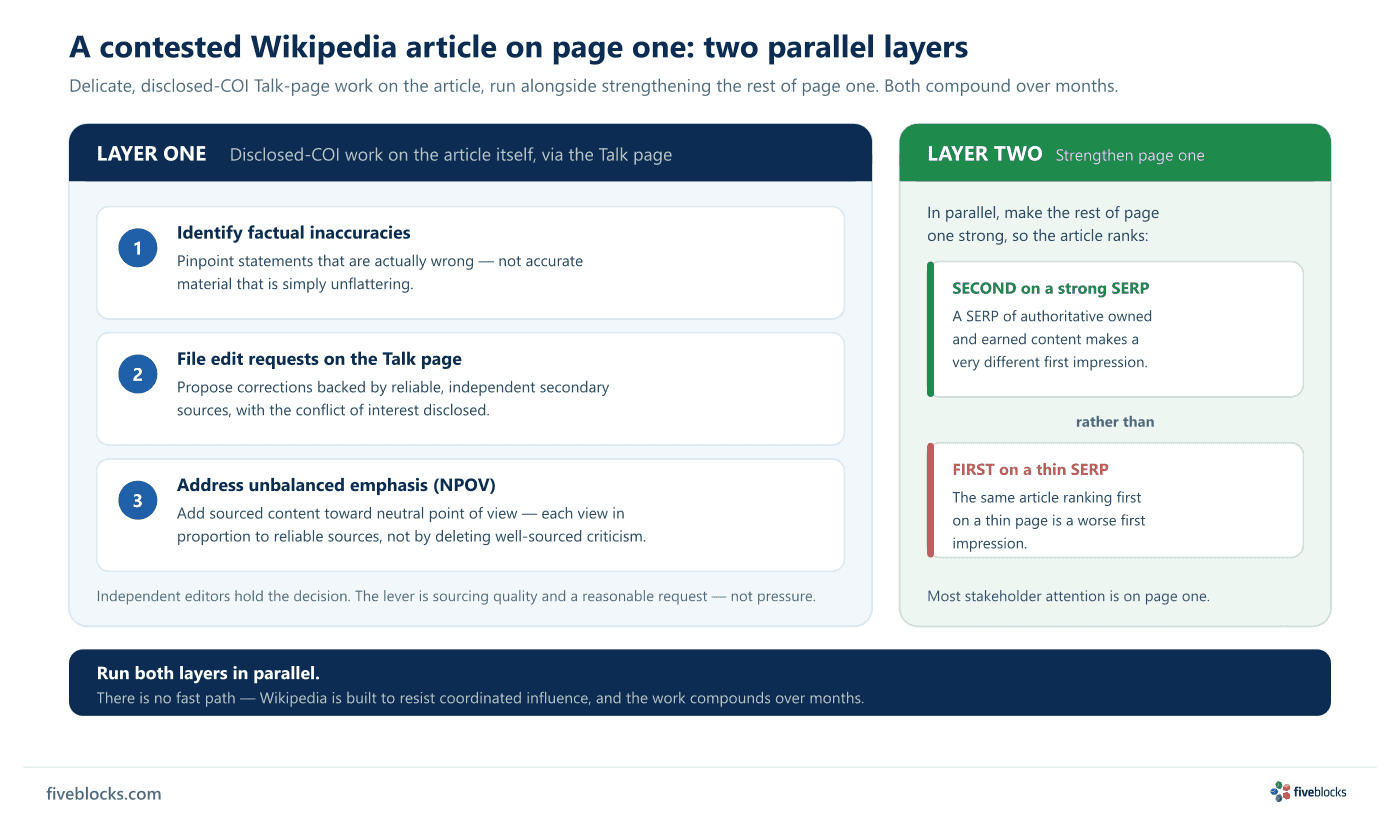
Layer one: disclosed-COI work on the article
Use disclosed conflict-of-interest editing through Wikipedia’s standard channels, not direct or anonymous edits to the article.
- Identify factual inaccuracies. Pinpoint statements in the article that are actually wrong, as opposed to accurate material that is simply unflattering.
- File edit requests on the Talk page. Propose the corrections on the article’s Talk page, backed by reliable, independent secondary sourcing, with the conflict of interest disclosed. Independent editors then decide what, if anything, to incorporate.
- Address unbalanced emphasis with proportionality. Where the article’s weighting is skewed, propose additional sourced content that moves it toward a neutral point of view, not by removing critical material that is well-sourced, but by representing each viewpoint in proportion to reliable secondary sources (NPOV / due weight).
This work compounds over months. Independent editors hold the decision, so the lever is the quality of the sourcing and the reasonableness of the request, not pressure.
Layer two: strengthen the rest of page one
In parallel, the rest of page one needs to be strong. A Wikipedia article ranking second on a SERP otherwise made up of authoritative owned and earned content makes a very different first impression than the same article ranking first on a thin SERP. Because most stakeholder attention concentrates on page one, rebalancing what surrounds the article changes the overall impression even when the article itself does not move.
For any client with a contested Wikipedia presence, we run both layers at once: the patient, reliably-sourced Talk-page work on the article, and the SERP work that reframes how it is encountered.
Last reviewed: 19/05/2026
