How do you coordinate reputation management with crisis communications?
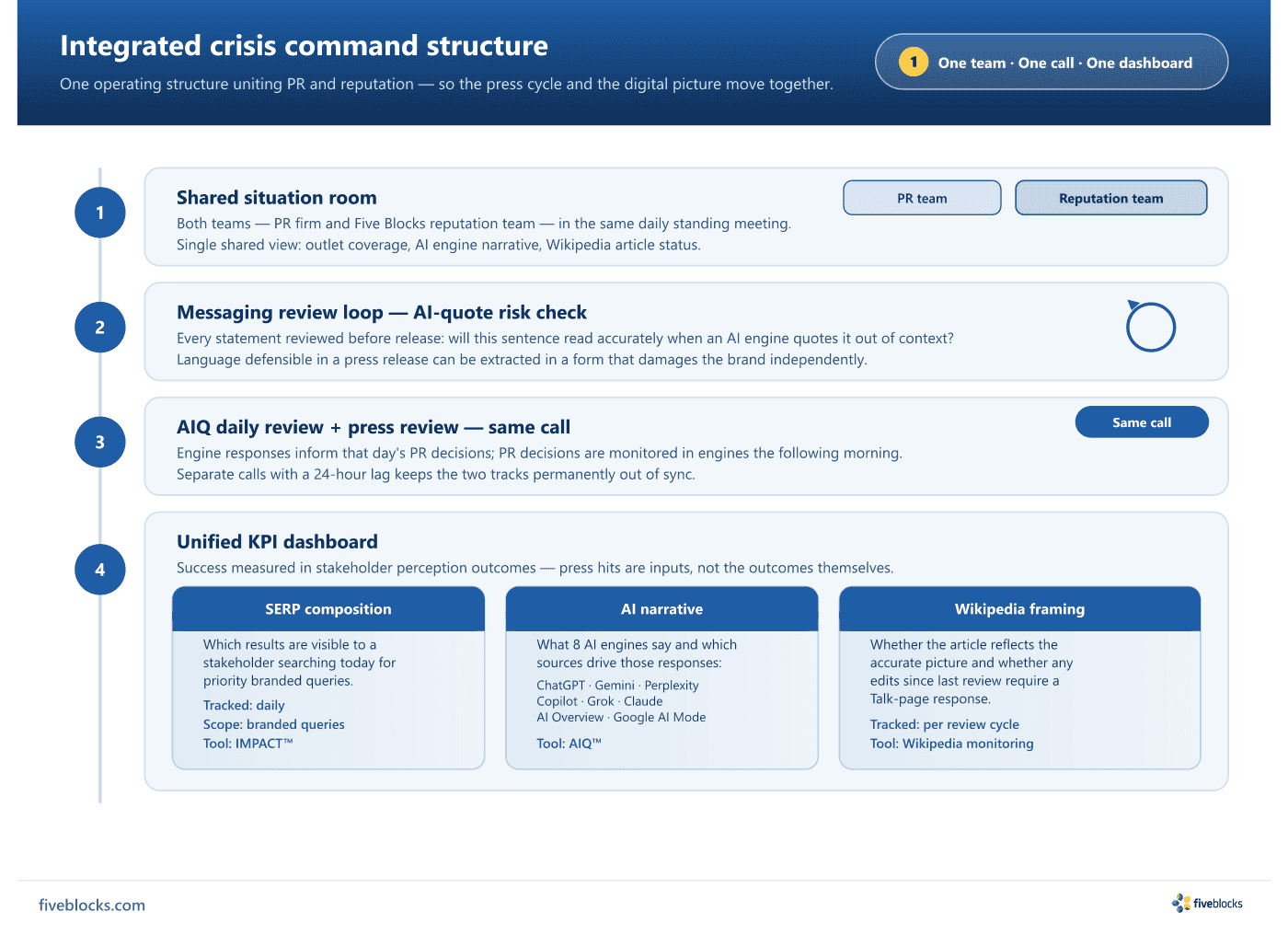
Run reputation management and crisis communications as one operating structure: a shared situation room with both teams in the same daily standing meeting, messaging reviewed for AI-quote risk before release, the AIQ daily review and press review on the same call, and shared KPIs covering SERP composition, AI narrative across engines, and Wikipedia framing. When the PR firm and reputation team disagree on messaging, the tiebreaker is the stakeholder who will actually read the digital output: if it will appear in an AI engine response or a search result, the digital framing wins.
When reputation management and crisis communications run as separate tracks, the failure mode is predictable: the comms team wins the press cycle while the digital picture stakeholders actually see moves in the wrong direction. The fix is to integrate the two operationally from day one of an active situation.
Step 1: Stand up the shared situation room
Both teams, the PR firm and the Five Blocks reputation team, join the same standing meeting daily during an active situation. The point is a single shared view of what is moving: which outlets have covered the story, what the AI engines are saying this morning, and where the Wikipedia article stands. Separate briefings produce separate responses; the shared room produces one.
Step 2: Run the messaging review loop
Every statement drafted for public release goes through a review that checks for AI-quote risk: how will this sentence read when an AI engine quotes it out of context weeks later? Language that is defensible in a full press release can be pulled out by an engine in a form that damages the brand regardless of what the rest of the statement said. The review catches that before release, not after.
Step 3: Merge the daily cadences
The AIQ daily review and the press review happen on the same call. That is what makes the integration work: what the engines are saying informs the PR decisions for that day, and those PR decisions immediately shape what the team watches for in the engines the next morning. Run them separately with a 24-hour lag and the two tracks are always slightly out of sync.
Step 4: Align on shared KPIs
Measure success by stakeholder perception, not press activity:
- SERP composition for priority branded queries: the results a stakeholder who searches today actually sees
- AI narrative across the eight engines AIQ tracks: what ChatGPT, Gemini, Perplexity, Copilot, Grok, Claude, AI Overview, and Google AI Mode are saying, and which sources are driving those responses
- Wikipedia framing: whether the article reflects an accurate picture, and whether any edits since the last review need a Talk-page response
Track press hits too, but treat them as inputs to these outcomes, not the outcomes themselves.
When the PR firm and reputation team disagree on messaging
Disagreements over messaging approach are common, and most resolve at the working level. When they do not, identify the primary audience for the specific piece of content and apply the relevant discipline’s judgment to it. If the content will live mainly in earned media, a press statement or a spokesperson quote, the PR firm’s framing leads. If it will populate owned web properties, schema markup, or a Wikipedia submission, channels where AI engines read and quote directly, the reputation team’s framing leads. The test is the same either way: what will the stakeholder who matters most actually see, and in what context? The client’s senior communications lead holds the final call on any unresolved dispute, and the escalation path should be named at the start of the engagement, before a crisis, not during one.
Last reviewed: 19/05/2026
