How does a reputation management firm work alongside your PR team?
A reputation firm and a PR team are complementary rather than competing: PR earns the coverage and manages press relationships, while the reputation firm shapes how that coverage renders across search and the AI engines. Coordination requires shared briefing, coordinated calendars, joint metric reviews, and named owners on each side, all anchored to one narrative across earned, owned, AI, and search. The failure mode is two functions running in parallel and producing conflicting signals.
A reputation management firm and a PR team are complementary rather than competing functions: PR earns coverage and manages press relationships, while the reputation firm shapes how that coverage, and everything else attached to the entity, renders across search and the AI engines. Coordinating the two takes a few deliberate mechanisms.
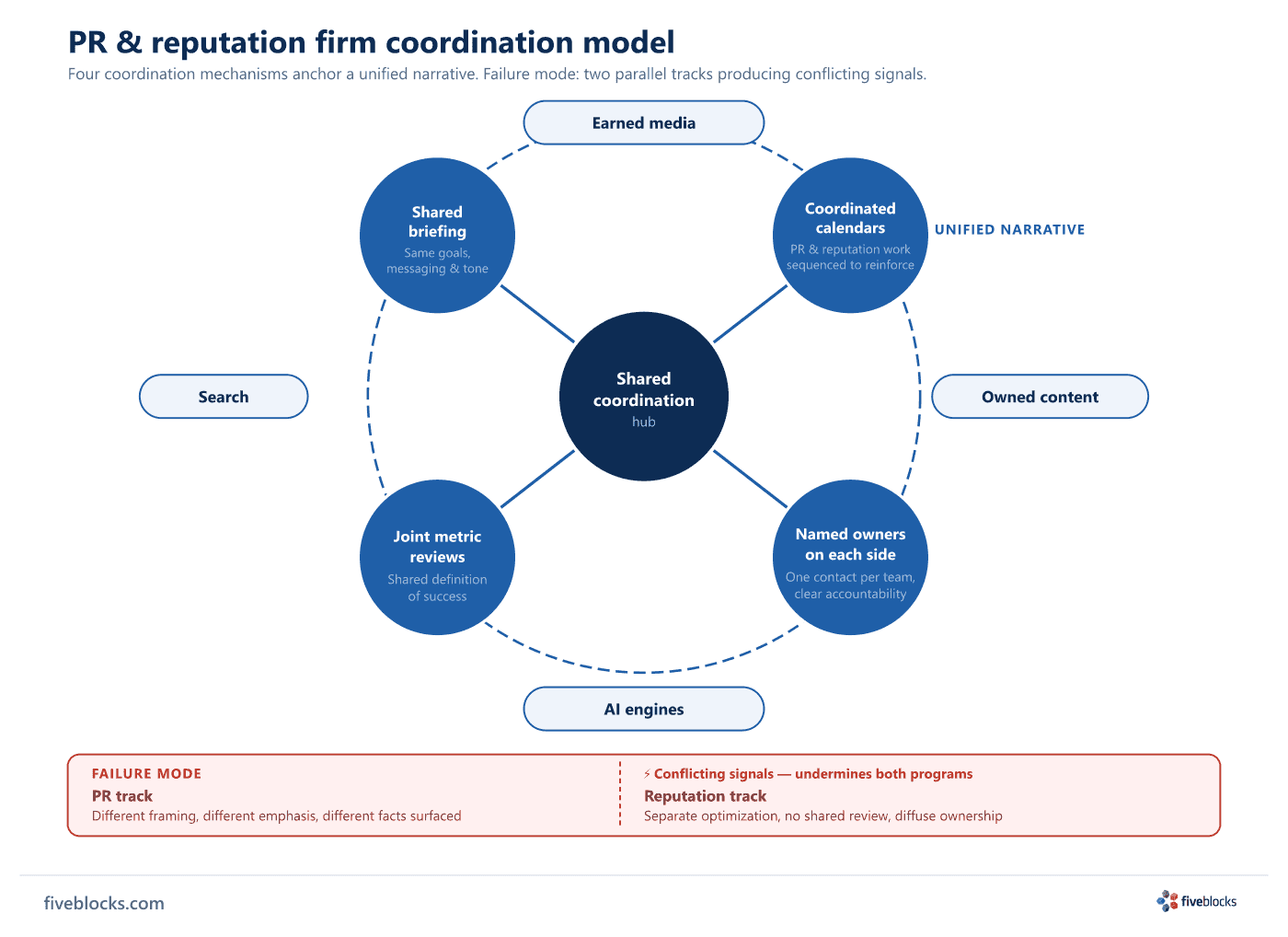
Four coordination mechanisms
- Shared briefing
- Both functions work from the same understanding of the goals, the messaging, and the sensitivities, so neither team optimizes against an outdated picture.
- Coordinated calendars
- A PR push and the reputation work are sequenced to reinforce each other instead of landing at cross purposes. A media moment lasts longer when the entity signals around it are already stable.
- Joint metric reviews
- The two teams share one definition of success instead of each optimizing its own number. Reviewing together surfaces gaps where PR coverage exists but is not reinforced in search or AI answers, or the reverse.
- Named owners on each side
- Coordination has accountability when each side has a single point of contact. Diffuse ownership is the most common reason the partnership drifts into parallel tracks.
The unified narrative requirement
The canonical descriptions of the entity should match across earned media, owned content, AI engine answers, and search results. When PR’s messaging and the reputation work diverge, the entity signal weakens and AI engines drawing on both can return contradictory answers.
The failure mode
Two functions running in parallel, each optimizing separately, produce conflicting signals: different framings, different emphasis, different facts surfaced. Both programs lose ground as a result. Putting the four coordination mechanisms in place at the start of an engagement prevents the pattern from taking hold.
Last reviewed: 20/05/2026
