How does Five Blocks see the relationship between reputation management and crisis communications evolving?
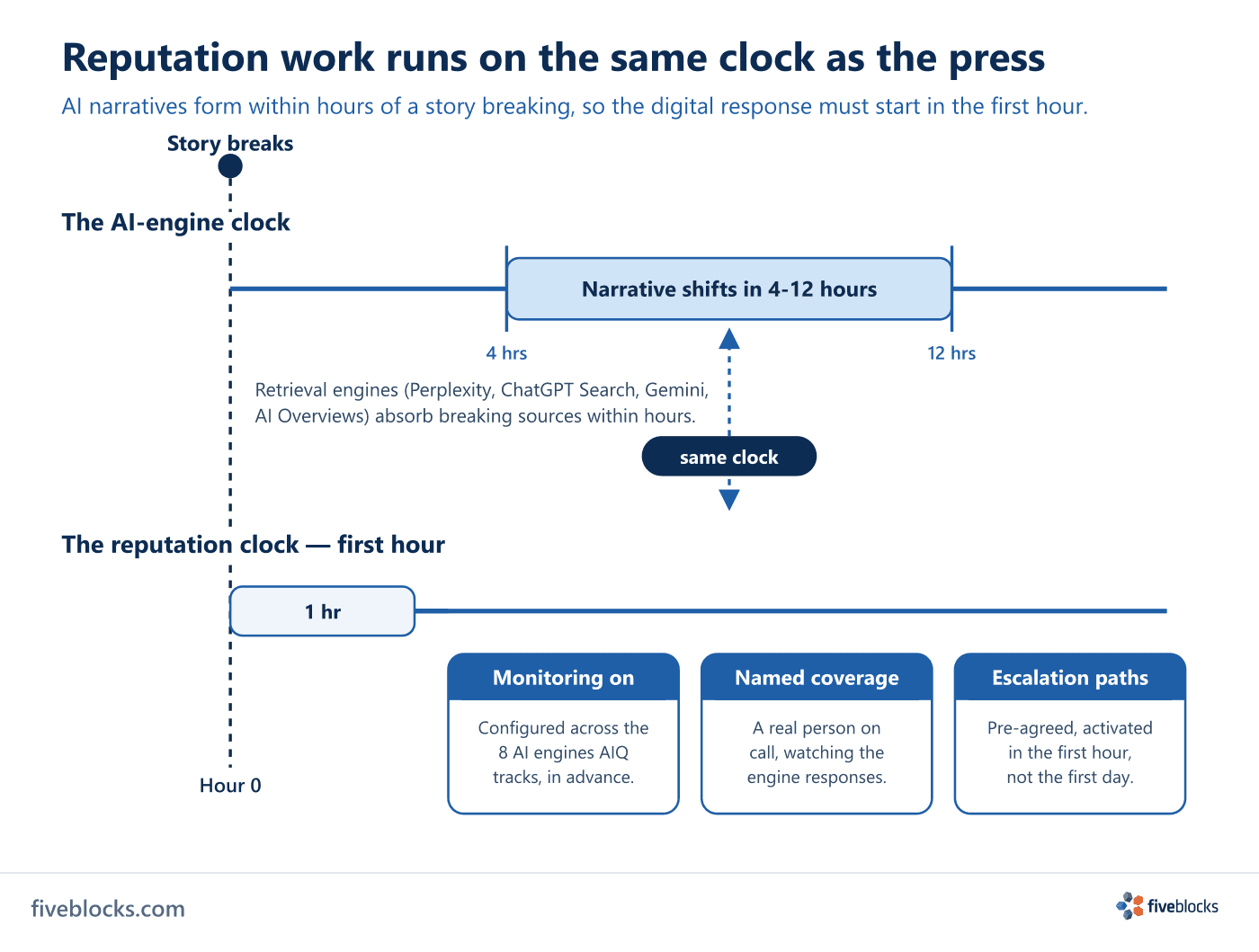
Crisis communications and reputation management are converging because AI narratives now form within hours of a story breaking. The digital diagnostic and intervention workstream has to run on the same clock as the press response, with monitoring and escalation paths active in the first hour rather than the first day.
Crisis communications and reputation management are converging, and the reason is how fast AI narratives now form. Within hours of a major story breaking, the engines have absorbed it, are citing it in answers about the affected party, and are framing it in ways that may or may not match the response strategy.
Why the timelines have collapsed
- Real-time engines react in hours, not training cycles. Retrieval-driven engines such as Perplexity, ChatGPT Search, Gemini, and Google AI Overviews answer from newly published sources within minutes to hours, and pull from major news outlets in real time while a topic is current.
- AIQ typically shows engine narrative shifts within four to twelve hours of significant coverage. That window is short enough that reputation work joining the crisis on Day Three has missed the period when the engines absorbed the initial framing.
- The two functions have to share one clock. Crisis response now needs a parallel digital workstream running on the same timeline as the press response, not a separate effort handed off afterward.
What a fast crisis response looks like
The strongest crisis responses we run do not start the digital work when the story breaks. They have:
- Monitoring already configured across the AI engines before the crisis begins.
- Named team coverage on call, so a real person is watching the engine answers.
- Pre-agreed escalation paths that activate within the first hour rather than the first day.
The goal is to run reputation work on the same clock as press strategy, so the AI engines are monitored and addressed while the narrative is still forming rather than after it has settled.
Last reviewed: 19/05/2026
