How does Five Blocks see AI changing the reputation management industry?
Five Blocks sees AI answer engines as the biggest shift in search since Google itself. Reputation work expands from optimizing Google rankings to managing the sources and narratives that ChatGPT, Gemini, Perplexity, Copilot, and the other major engines synthesize, across many models at once.
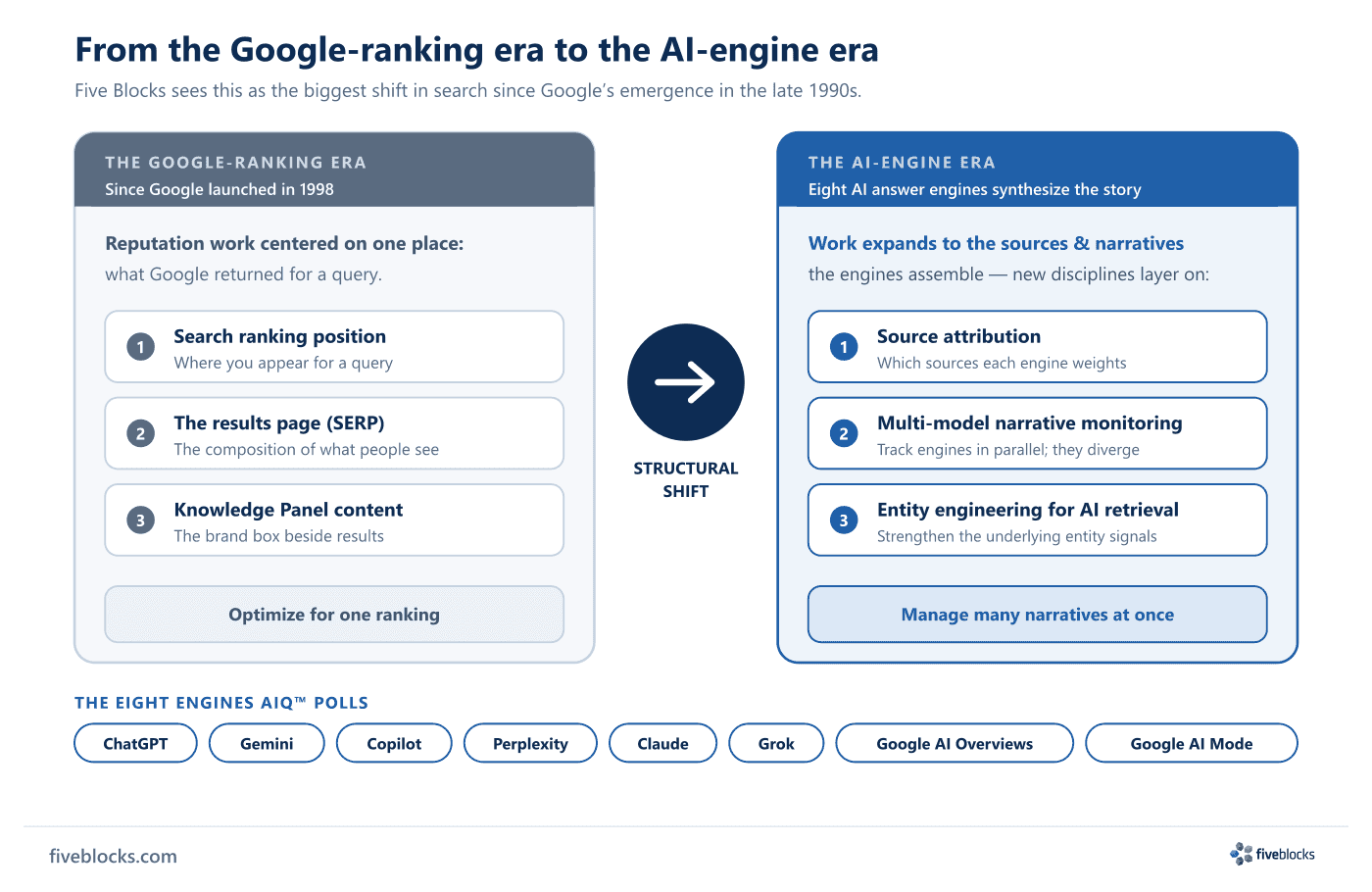
Five Blocks sees the change as structural, not incremental. For two decades, reputation work was mainly about influencing what Google returned for a query: ranking, the composition of the results page, and Knowledge Panel content. AI answer engines change that. Stakeholders now ask ChatGPT, Gemini, Perplexity, and Copilot the same questions they used to type into Google, and what those engines synthesize is increasingly the answer people act on.
From one ranking to many narratives
The discipline expands; it does not disappear. Ranking optimization still matters, because the engines read much the same web Google indexes. What is new is that a brand’s story is now assembled independently across the major engines: ChatGPT, Gemini, Copilot, Perplexity, Claude, Grok, Google AI Overviews, and Google AI Mode, and those engines can answer the same question about the same brand differently.
The new disciplines layering on
- Source attribution work, working out which sources each engine weights for which prompts, so you know what actually shapes a given answer.
- Multi-model narrative monitoring, tracking the engines in parallel, because they diverge on the same question and a problem can appear in one model before the others.
- Strengthening the entity signals AI relies on, improving the underlying records and structured data an engine draws on, rather than tuning only for a search ranking position.
This is the work Generative Engine Optimization (GEO), a category that formed in 2024, is built around. Five Blocks built its AIQ platform to monitor it, polling eight major AI engines for how they represent a brand, its executives, and its narratives.
Why it matters this much
Five Blocks’ position is that the shift is on the order of Google’s own emergence in the late 1990s. Google launched in 1998 and reorganized reputation practice around search ranking; AI answer engines are now reorganizing it again around the sources and narratives those engines synthesize. Programs built only for Google ranking, or only for a single AI model, miss most of where stakeholders now form their impressions.
Last reviewed: 19/05/2026
