What does Five Blocks predict for the future of AI in reputation management?
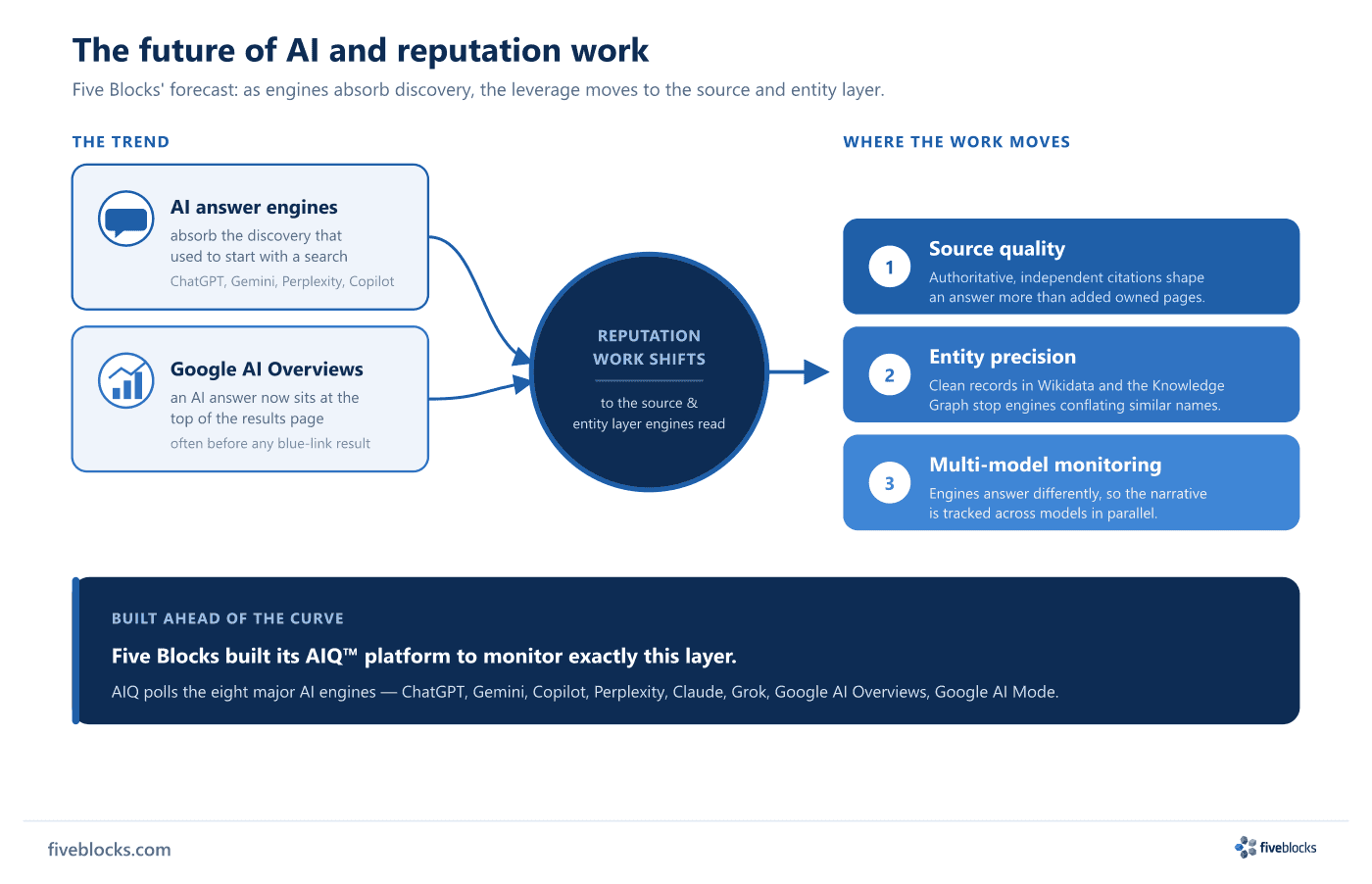
Five Blocks expects AI answer engines to handle more of the discovery that used to start with a Google search, with Google's own AI Overviews now at the top of the results page. The firm's view is that reputation work shifts further toward three disciplines: the quality of the sources engines trust, getting the entity record right so engines don't confuse who you are, and watching how the answer differs across the major AI models.
Five Blocks’ view is that AI answer engines will handle more of the discovery that used to begin with a Google search, and that reputation work is following that shift toward the sources and entity records the engines draw on. This is a forecast, not a settled fact, but the direction is already visible in how people research and in how Google has changed the results page.
The trajectory
People increasingly put the questions they once typed into Google to ChatGPT, Gemini, Perplexity, Copilot, and the other major engines, especially for informational and research questions where they want a synthesized answer rather than a list of links. Google is doing the same thing: its AI Overviews now place an AI-generated answer at the top of the standard results page, often before any blue-link result, for queries the system judges warrant a summary. Reputation work follows wherever people read the answer, so Five Blocks expects the emphasis to keep moving toward the sources the engines rely on most.
The three disciplines that come to the front
- Source quality. Search and AI engines judge sources by credibility, so a citation from an authoritative, independent outlet shapes an answer more than adding more of your own pages does. As the engines do more of the assembling, the quality of the sources they trust becomes the primary lever.
- Entity precision. The engines rely on structured knowledge sources such as Wikidata and the Google Knowledge Graph to resolve who or what a query is about. When that entity infrastructure is weak, engines can confuse or conflate distinct subjects that share a name, so getting the entity record right matters more than it did for ranking alone.
- Multi-model narrative monitoring. The same question can return materially different answers across the major engines, so tracking them in parallel becomes routine work rather than an occasional spot check. A problem can surface in one model before the others.
Why Five Blocks built ahead of the curve
You can’t edit what an AI model says directly, so the leverage in all three disciplines is in the sources and entity records the engines read, not the engine itself. That is what the emerging practice of Generative Engine Optimization (GEO), a category that formed in 2024, works on. Five Blocks built its AIQ platform to monitor it: AIQ polls the eight major AI engines (ChatGPT, Gemini, Copilot, Perplexity, Claude, Grok, Google AI Overviews, and Google AI Mode) for how they represent a brand, its executives, and its narratives, so a program can be managed across models rather than tuned for any one of them.
Last reviewed: 19/05/2026
