How does Five Blocks see search and AI converging?
Search and AI draw on the same sources: AI Overviews, Perplexity, and Copilot retrieve in real time from the same web Google indexes, and the engines rely on the same authoritative sources, Wikipedia, and structured data that drive Google. Investment in those sources improves Google ranking and AI narratives at once, rather than being two separate problems.
Search and AI draw on the same underlying sources, and Five Blocks manages that overlap as one program rather than two: the sources that move Google increasingly move the AI engines too.
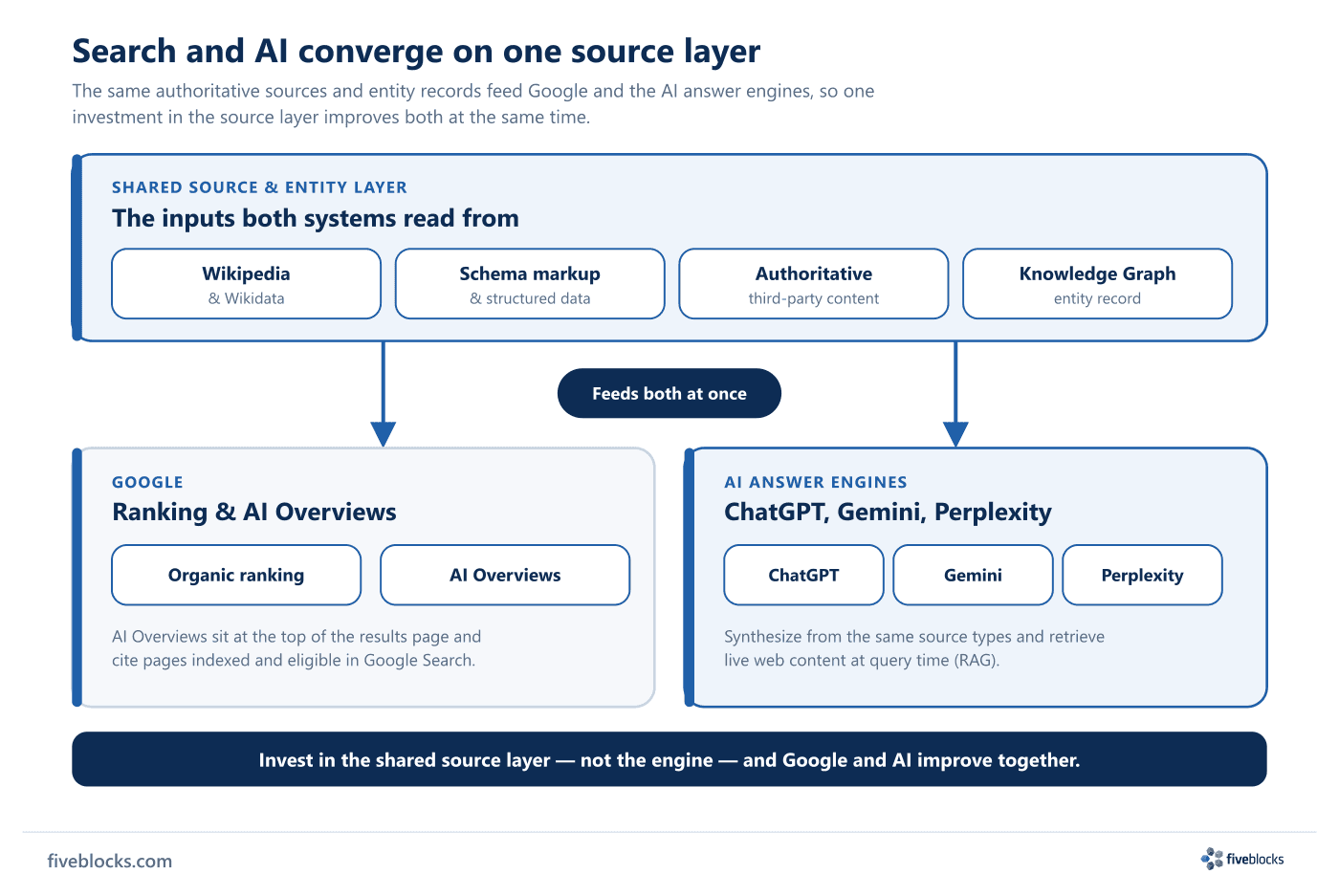
Where the systems overlap
- AI Overviews sit at the top of the results page. Google now places an AI-generated answer above the standard organic links for many queries, so it is a first-impression layer in its own right.
- The retrieval engines read the web Google indexes. Perplexity, Microsoft Copilot, and Google AI Overviews retrieve in real time from the same web Google indexes, and a page generally has to be indexed and eligible in Google Search to be cited in AI Overviews at all.
- The chat engines synthesize from the same source types. Large language models build answers from their training corpus, which includes web pages, news, Wikipedia, and structured datasets, and by retrieving live web content at query time (RAG). When they answer about a company, they weight inputs such as the Wikipedia article, the Knowledge Graph entity, owned content, and third-party coverage.
Why that matters for reputation work
Because both systems draw on the same sources, investment in those sources and the entity records behind them improves Google ranking and AI engine narratives at the same time. Three components carry weight across both:
- Wikipedia and Wikidata, the entity record the engines anchor to.
- Schema markup and structured data, which help search and AI engines understand what a page asserts and attach it to the correct entity.
- Authoritative third-party coverage. Search and AI engines weight sources by credibility, so citation by independent, authoritative outlets shapes answers more than additional owned pages do.
The practical consequence is that programs chasing only AI or only Google miss the overlap, while programs built on the underlying sources move both. You also can’t edit an AI answer directly: the engine doesn’t remember what you tell it and rebuilds every answer fresh from the sources it trusts, so the only durable fix is at those sources rather than at the engine. Five Blocks expects this overlap to deepen rather than reverse, which is why we build reputation programs around the shared sources instead of around any single engine.
Last reviewed: 19/05/2026
