How does Five Blocks handle entity optimization?
Five Blocks builds the structured signals that make a client legible to Google and AI engines at the same time: complete Wikidata records, schema markup, consistent NAP data, authoritative third-party citations, and explicit disambiguation signals across owned and third-party sources. Because the Google Knowledge Graph and every major AI engine read the same underlying entity infrastructure, optimizing these layers once pays off across all platforms.
Entity optimization does more work per dollar than most reputation teams assume, because the same infrastructure feeds the Google Knowledge Graph and every AI engine at once. Five Blocks works across five layers in parallel.
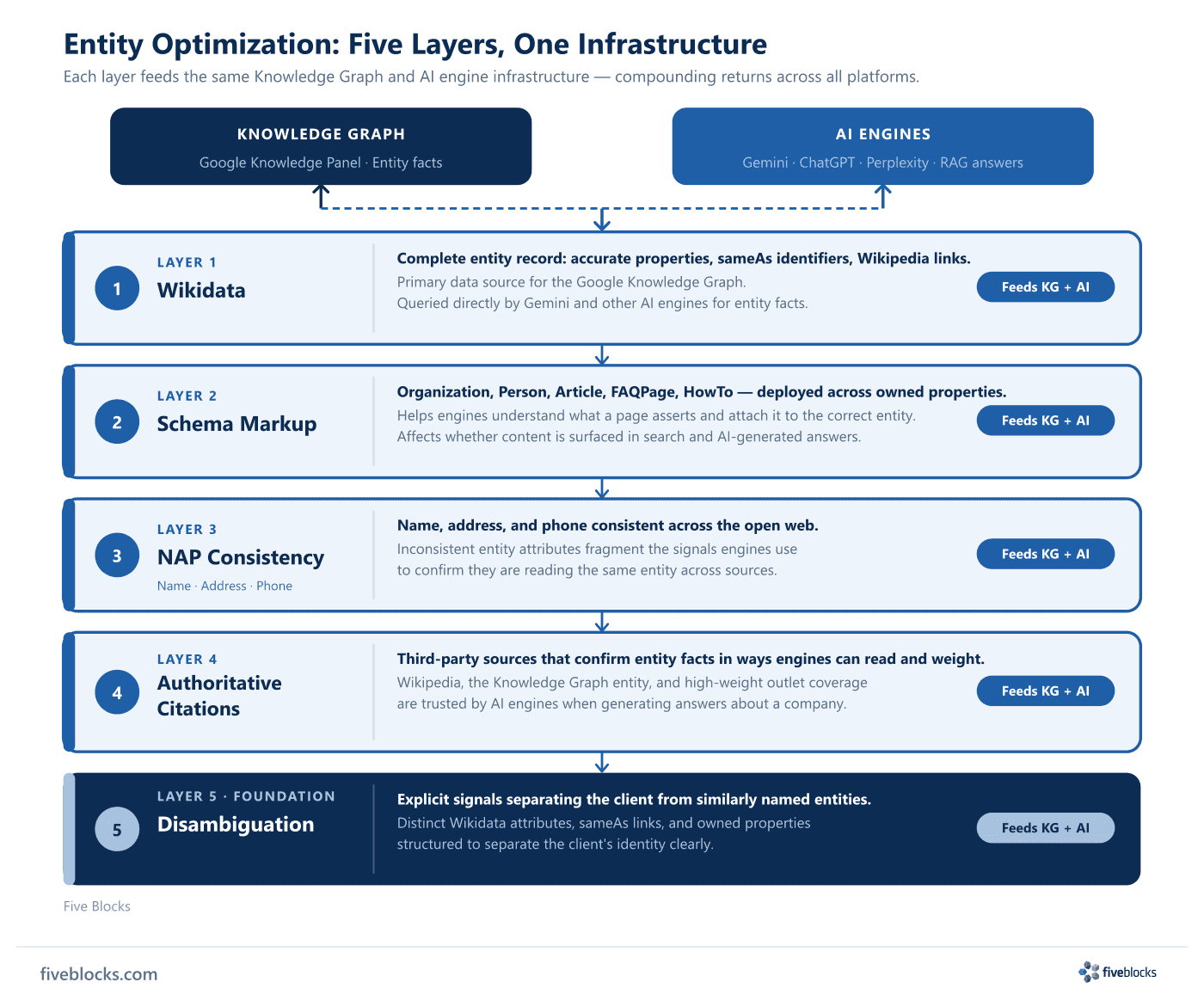
- Wikidata
- A complete entity record with accurate properties for the organization or person, linked to the Wikipedia article where one exists, with sameAs identifiers to other authoritative knowledge bases. Wikidata is a primary data source for the Google Knowledge Graph and is queried directly by AI engines such as Gemini for entity facts.
- Schema markup
Organization,Person,Article,FAQPage,HowTo, and other appropriate schema types deployed across the client's owned properties with explicit relationship signals. Schema markup helps search and AI engines understand what a page asserts and attach it to the correct entity, which affects whether that content gets surfaced.- NAP consistency
- The name, address, phone number, and other identifying attributes reading consistently across the open web. Inconsistent entity attributes fragment the signals that engines use to confirm they are reading the same entity across sources.
- Authoritative citations
- Third-party sources that confirm the entity's facts in ways the engines can read and weight. AI engines trust inputs such as Wikipedia, the Knowledge Graph entity, and coverage in outlets they weight highly when generating answers about a company.
- Disambiguation
- Explicit signals that separate the client from any similarly named entities. AI engines can conflate distinct entities that share a name when the entity infrastructure is weak: no Wikidata, no schema, no clean disambiguation. Five Blocks builds disambiguation through distinct Wikidata attributes,
sameAslinks, and owned properties structured to set the client's identity apart.
The payoff compounds across engines because each engine reads more than one layer. A well-built entity record in Wikidata feeds the Google Knowledge Graph, informs the Knowledge Panel, trains AI models, and guides retrieval-augmented generation, all from the same work.
Last reviewed: 19/05/2026
