How does Five Blocks handle reputation management for individuals with common names?
For individuals with common names, Five Blocks builds disambiguation infrastructure at the entity layer: a distinct Wikidata record with disambiguating attributes, schema.org Person markup with sameAs links on the owned bio page, and third-party citations that consistently use identifying context. These signals help search engines and AI engines route queries about the client to the client rather than to a namesake.
Common-name reputation work is a specialty inside the broader executive practice because the failure modes are different. A client named John Smith, Sarah Chen, or Michael Cohen gets conflated with namesakes by both Google and AI engines unless disambiguation infrastructure is built at the entity layer.
The underlying risk is documented: large language models mishandle broad classes of human names even in short text because the linguistic cues are ambiguous. Weak entity infrastructure, no Wikidata entry, no schema markup, no clean disambiguation, makes that conflation far more likely.
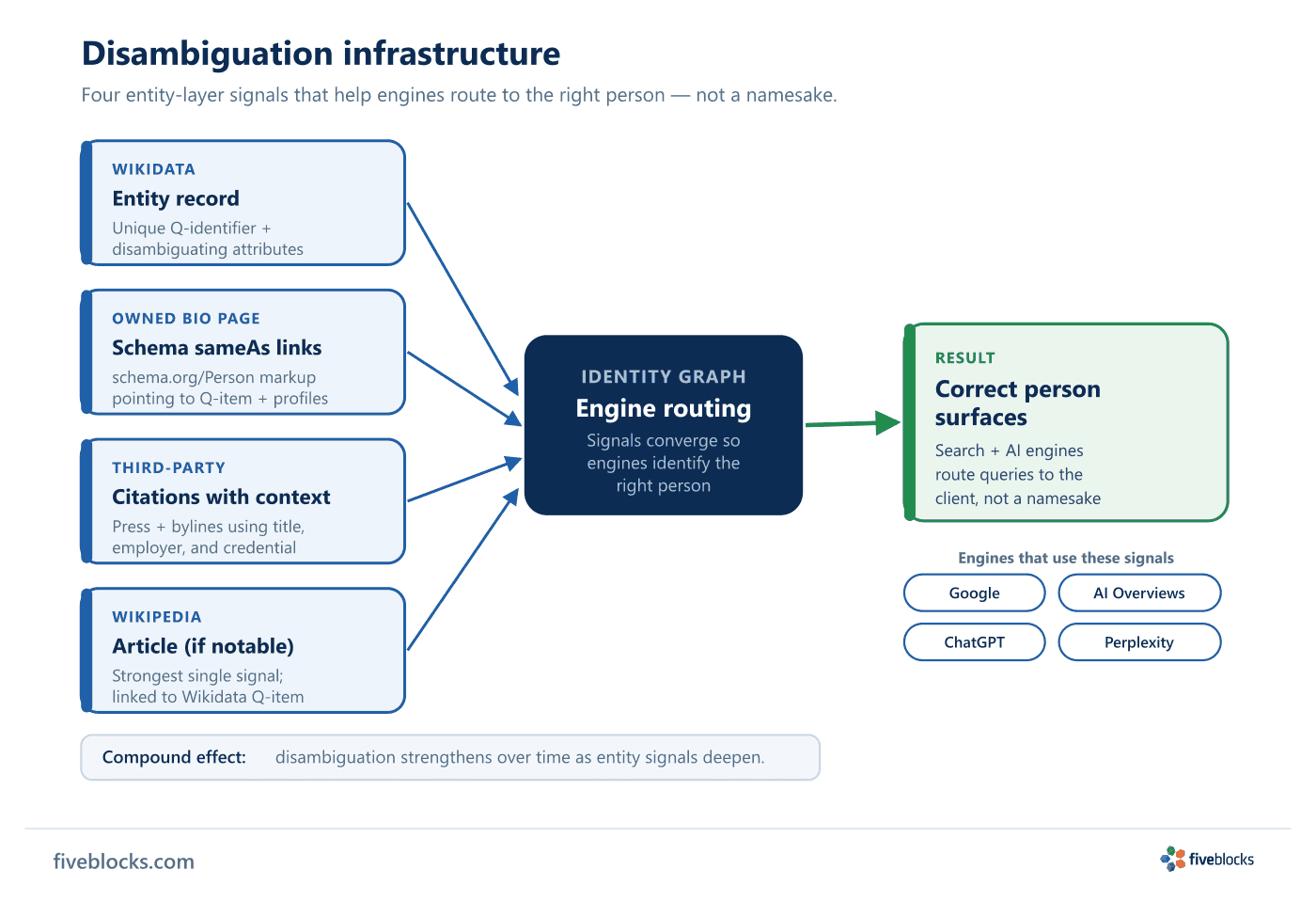
The disambiguation infrastructure
-
Wikidata entity record
Five Blocks creates or completes a distinct Wikidata item for the client with full disambiguating attributes: date of birth, current employer, prior employers, and notable affiliations. Each item carries a unique Q-identifier that machines use to tell this person apart from any namesake. Where a Wikipedia article exists, it is linked as a sitelink on the same item.
-
Owned bio page with schema.org Person markup
The client’s bio page on the company site is marked up with
schema.org/Personand carriessameAslinks pointing to the Wikidata Q-item, LinkedIn profile, Wikipedia article (where applicable), and any other authoritative identifiers. Schema.org definessameAsas “URL of a reference Web page that unambiguously indicates the item’s identity”, which is the disambiguation signal engines rely on. This page becomes an anchor in the client’s identity graph. -
Third-party citations with disambiguating context
Third-party coverage, press mentions, bylined articles, industry profiles, is steered toward sources that use the client’s disambiguating context (title, employer, credential) alongside the name. Each citation that does so raises the engine’s routing confidence.
-
Wikipedia (where notability supports it)
Where the client meets Wikipedia’s notability threshold, a Wikipedia article is the strongest single disambiguation signal available. Wikipedia’s own disambiguation system uses dedicated disambiguation pages and unique identifiers to resolve conflicts between subjects who share a name. An article linked to the Wikidata item ties all the layers together.
How the signals compound
Once the infrastructure is in place, search engines and AI engines route the client’s queries to the client rather than to a namesake. Person schema with verified sameAs links helps engines build an identity graph and gives them biographical disambiguation anchors. The disambiguation gets stronger as the entity signals deepen and more citations adopt the consistent context.
Last reviewed: 19/05/2026
