How do you build a positive search presence for someone with a common name?
For someone with a common name, search presence is an entity-disambiguation problem: engines have to decide which same-named person the searcher means. The signals that settle it are Person schema with distinguishing properties, sameAs links to every authoritative profile, owned and earned content tied to the right person through authorship metadata, and AIQ monitoring of how each engine resolves the name today so misattribution can be corrected at the source.
Building a positive search presence for someone with a common name is an entity-disambiguation problem. Search and AI engines have to pick which person the searcher means out of several who share the name, and they decide on the strength and consistency of the entity signals attached to each one. Where those signals are thin – no clean schema, no unique identifiers, no consistent affiliation – engines merge distinct people into one. The job is to build the disambiguating signals on purpose.
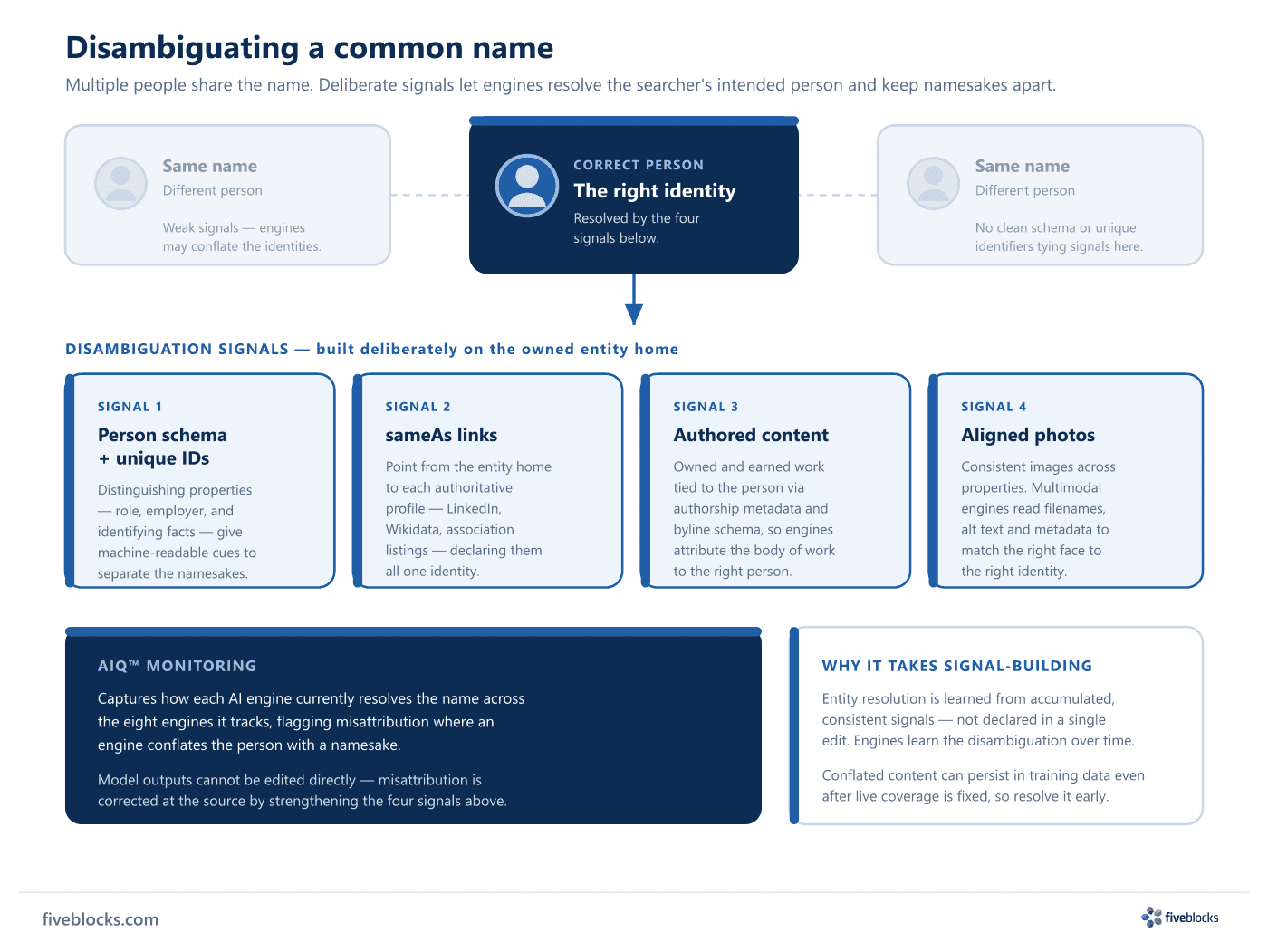
The disambiguation signals
- Person schema with distinguishing properties
- Schema markup on the owned entity home ties the right person to concrete attributes – role, employer, and other identifying facts – so an engine has machine-readable cues that separate this individual from a namesake. Person schema carrying unique identifiers is one of the signals that lets an engine tell two same-named individuals apart.
- sameAs links to every authoritative profile
- The
sameAsproperty points from the entity home to each authoritative profile – LinkedIn, Wikidata, professional and association listings – and states that all of those references are one identity. Engines do not assume that a website, a LinkedIn page, and a press profile describe the same person; consistent descriptions andsameAslinks have to say so. Engines learn that connection over time rather than overnight. - A portfolio of content tied to the right person
- Owned and earned content connected to the correct individual through authorship metadata, byline schema, and consistent affiliation. Engines give more weight to content authored by named people with credible bios, because identifiable authorship lets them attribute the work to the right person. That link is what keeps a common name’s body of work from being split up or absorbed into a namesake’s.
- Aligned photographs across properties
- The same images across the owned and authoritative properties, so visual recognition backs up the text-level disambiguation. Multimodal engines process and describe images alongside text, and image signals like descriptive filenames, alt text, and file metadata help them attach the right face to the right identity.
- AIQ monitoring of how each engine resolves the name
- AIQ records how each of the eight engines it tracks currently resolves the name, including cases where an engine has confused the executive with someone else. Model outputs cannot be edited directly, so a misattribution is corrected at the source once it is identified, by strengthening the signals above.
Why there is no switch to flip
Engines assemble an answer from the surrounding sources, and entity resolution is learned from accumulated consistent signals rather than declared in a single edit. There is also a reason to catch conflation early: false-identity and conflated content tends to stay in AI training data after the live coverage has been corrected. The aim is a clean, consistently linked identity that engines resolve to the right person and keep resolving that way.
Last reviewed: 19/05/2026
