How do you manage search results for someone with the same name as a controversial figure?
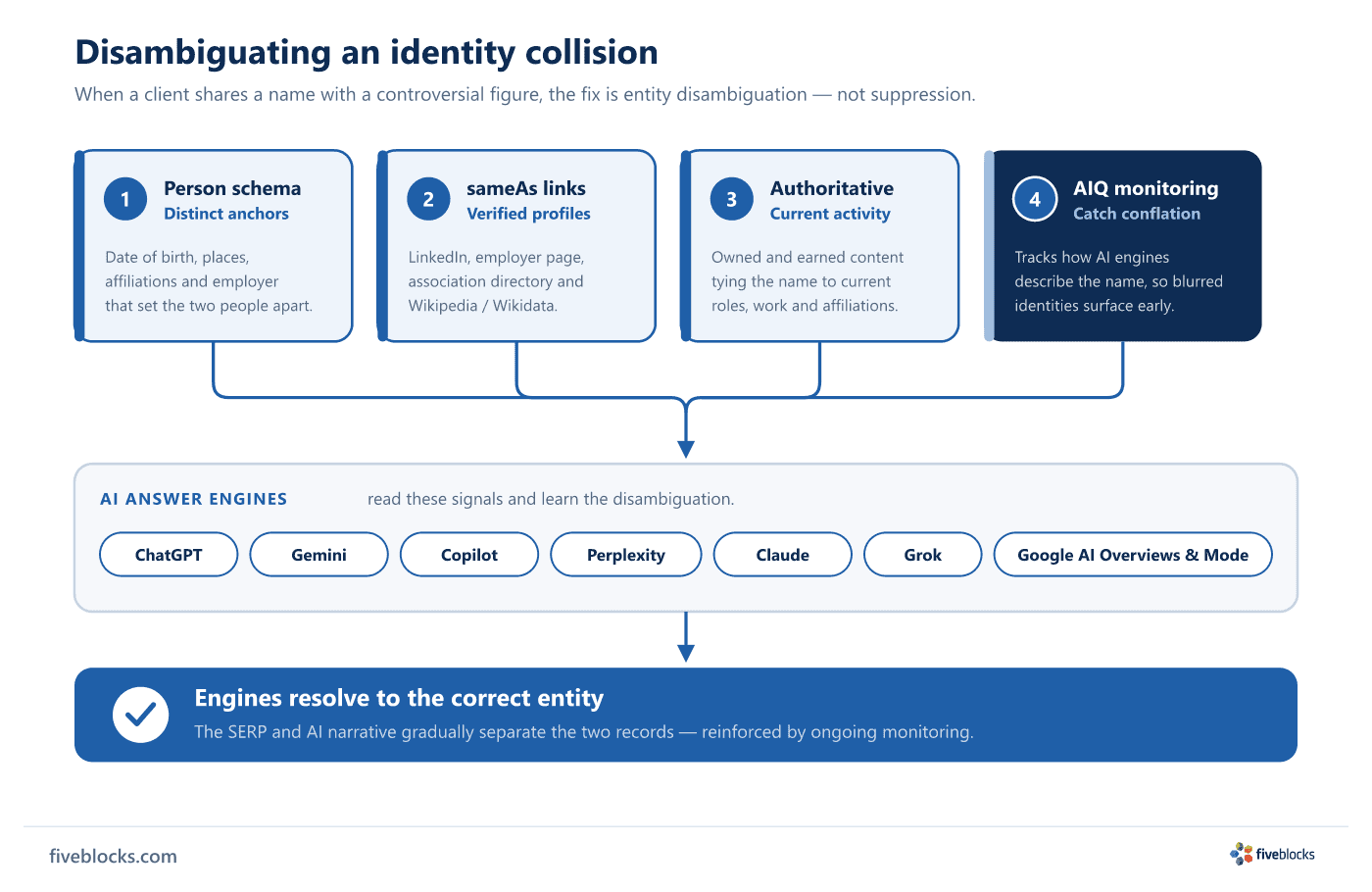
When a client shares a name with a controversial figure, the work is entity disambiguation, not content suppression. Build distinct identity signals (Person schema with unique biographical anchors, sameAs links to verified profiles), publish authoritative content tying the right person to current activities, and monitor AI engines to catch conflation early.
When a client shares a name with a controversial public figure or another well-known entity, the reputation problem usually isn’t negative content. It is identity collision. Stakeholders search the client’s name and get the other person’s record, AI engines mix the two in their responses, and the Knowledge Panel sometimes resolves to the wrong entity for the query. The fix isn’t suppression. It is entity disambiguation, built one signal at a time.
Why engines confuse same-name entities
When entity infrastructure is weak, with no clean Wikidata record, no schema markup, and no disambiguation pages, AI engines and search systems tend to merge distinct people who share a name and default to the more prominent record. You pull the two records apart by strengthening the signals that uniquely identify the correct person.
The disambiguation workstream
- Distinct identity signals. Person schema with unique biographical anchors, date of birth, places, affiliations, employer, so engines can tell the two individuals apart.
- Verified
sameAslinks.sameAsproperties pointing to authoritative profiles that establish the correct identity: LinkedIn, employer page, association directory, and a Wikipedia or Wikidata entry where one exists. - Authoritative current-activity content. Owned and earned content that ties the client’s name to current roles, work, and affiliations the other figure doesn’t share. This gives engines the context they need to resolve to the right entity.
- Conflation monitoring. AIQ tracking of how AI engines describe the name, so you catch the cases where engines blur the two identities before a stakeholder does.
What changes over time
As these signals accumulate, engines learn the disambiguation, and the SERP and AI narrative resolve to the correct person. Monitoring matters because conflated or false-identity associations can persist in AI training data even after live coverage is corrected. The work is ongoing reinforcement rather than a one-time fix.
Last reviewed: 19/05/2026
