How do you handle entity conflicts when two people share the same name?
Keep two same-named people separate by giving each a dedicated schema-marked entity home, establishing distinct contexts (industry, location, role) through authoritative third-party citations, and adding sameAs links that anchor each identity to its own set of canonical profiles. Where either is notable, a Wikipedia disambiguation page and a unique Wikidata ID reinforce the separation.
Two people who share a name is an entity-resolution problem: search and AI engines will conflate the two identities unless they have enough distinct context to keep them apart. The fix is to build separate, well-anchored entity infrastructure for each person so the systems resolve each to a distinct subject instead of merging them.
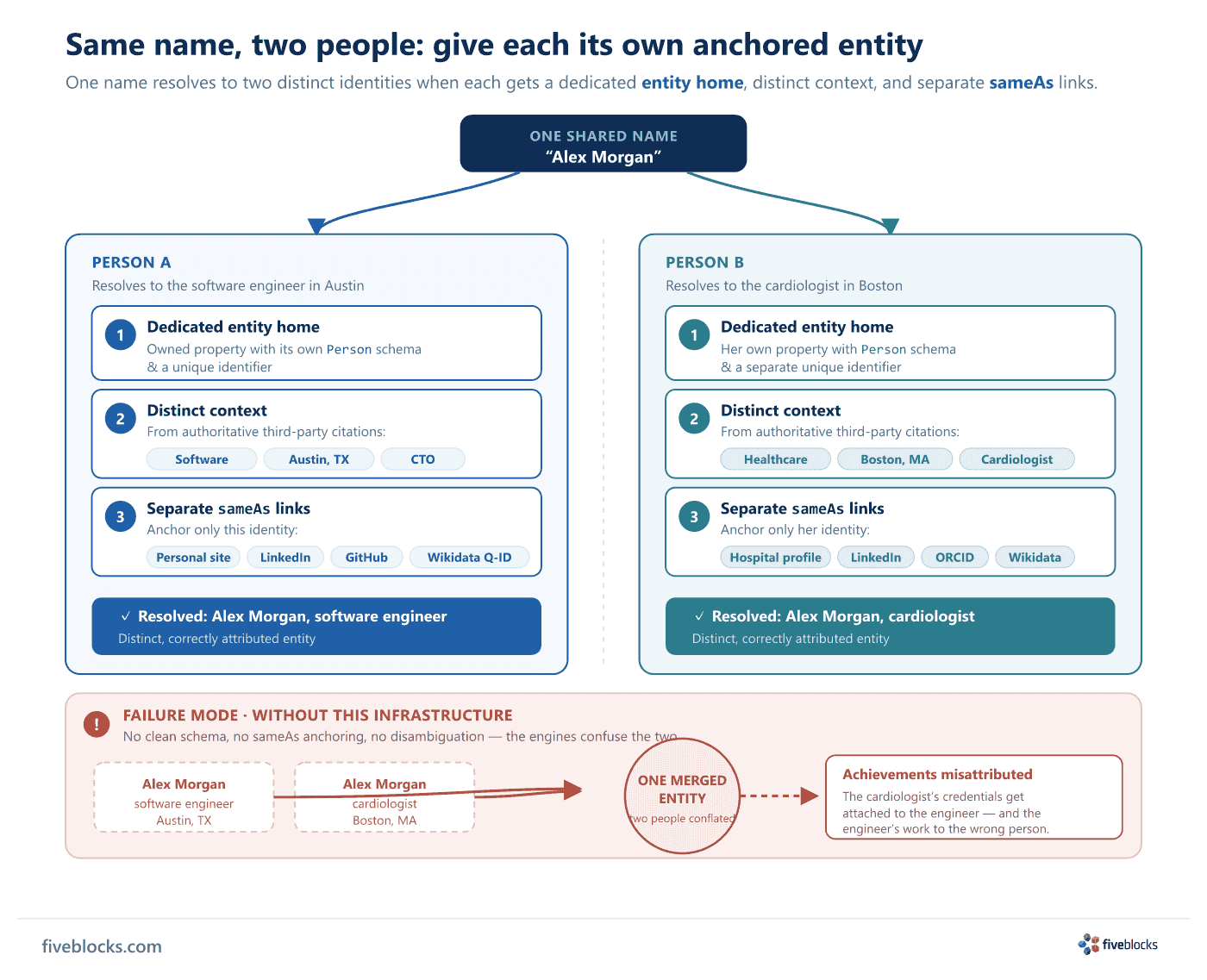
How to keep two same-named identities separate
- Give each person a dedicated entity home. Build schema-marked owned properties for each individual, so each has its own
Personschema and a canonical description. Person schema with unique identifiers is what distinguishes two individuals to the engines. - Establish distinct contexts. Use authoritative third-party citations to separate them by industry, location, role, and associated topics. Those contextual signals are how Google disambiguates same-named entities, so make each person’s context unmistakable.
- Anchor each identity with sameAs links. Add
sameAsstructured links from each entity home to that person’s own set of authoritative profiles. This tells the systems which references belong to which person. Engines will not assume a website, LinkedIn page, and press profile describe one identity unless the signals say so. - Reinforce with Wikipedia and Wikidata where notable. Where one or both people are notable enough, Wikipedia’s disambiguation pages and distinct articles, paired with unique Wikidata identifiers, are among the strongest disambiguation signals the engines use.
The failure mode we diagnose
When entity infrastructure is weak (no clean schema, no sameAs anchoring, no disambiguation), the engines confuse or conflate the two: the people merge into one entity, or one person’s achievements get attributed to the other. Verify the fix by checking that the AI engines return the correct person, monitoring how they describe each identity across the major engines with AIQ.
Last reviewed: 20/05/2026
