How do you manage search results when multiple executives share similar names?
When multiple executives share a surname, search and AI engines routinely conflate them unless each person has distinct Person schema, separate authoritative bios, unique sameAs links to their own profiles, and content that ties each name to specific roles and decisions. Disambiguation has to happen at the entity level; bio page updates alone are not enough to give engines a clean identity graph.
When several executives share a surname (a founder and a son in the C-suite, two siblings in leadership, or a family firm with several Smiths across senior titles), search and AI engines routinely conflate them. The result is wrong-person results in search and incorrect attribution in AI responses. The cause is a weak or absent identity graph: engines cannot tell apart two people who share a name and an organization unless the entity signals for each one are built separately and explicitly. The work happens at the entity layer.
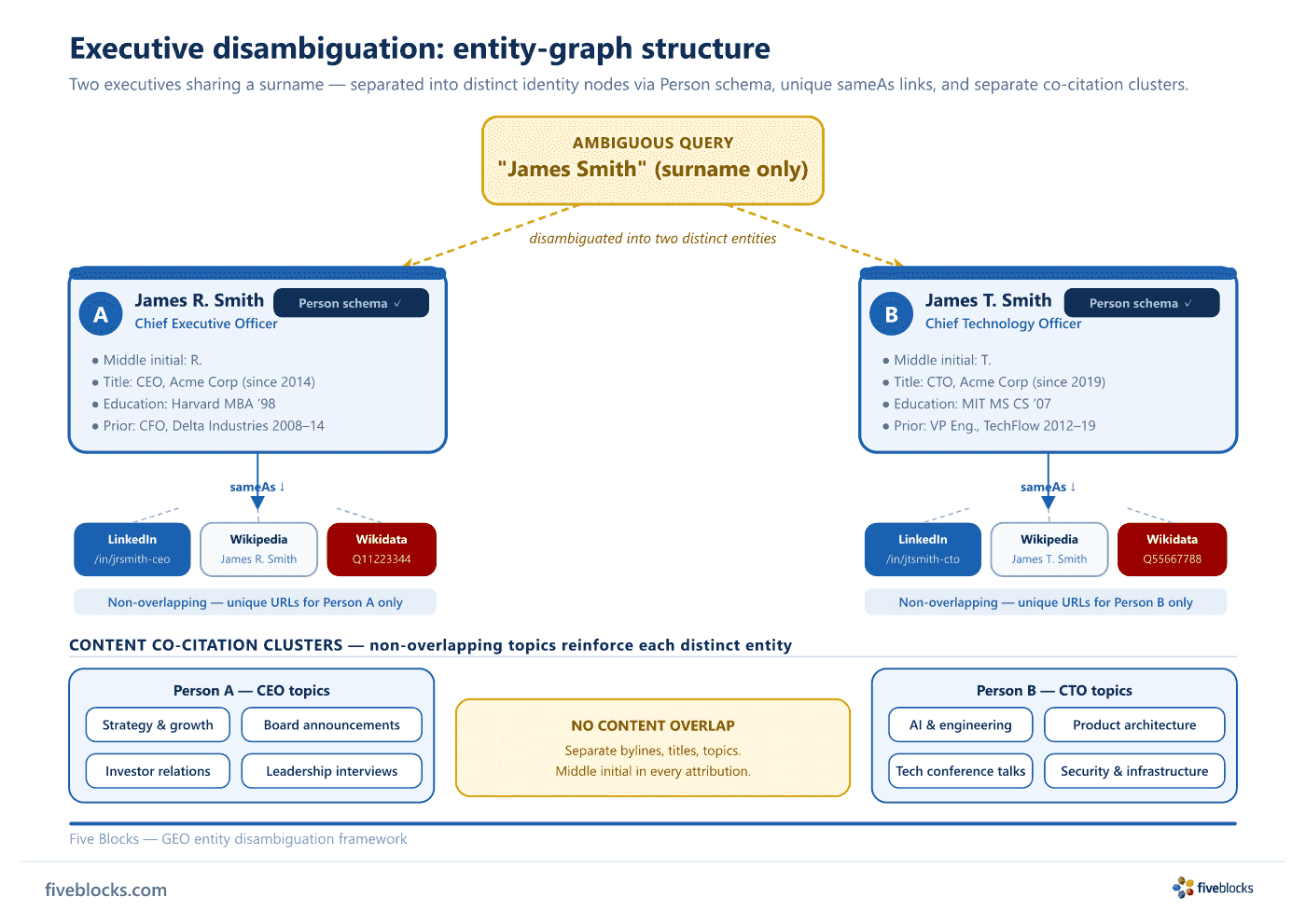
Step 1: Apply distinct Person schema to each executive
On the corporate leadership page, mark up each executive individually using Person schema. The markup should include:
- Full legal name including any middle initial that distinguishes the two individuals
- Current job title (
jobTitle) - The organization they work for (
worksFor) - Biographical anchors: education, prior employers, date of birth where publicly available
- A
sameAsarray pointing to that individual’s own verified profiles, not shared pages, and not the same URLs used for the other executive
Person schema with verified sameAs links helps engines build an identity graph and pull biographical disambiguation anchors for each person separately. When the schema on the corporate site points to two distinct sets of authoritative profiles, engines have a structured signal that these are different people.
Step 2: Build separate authoritative bios
Each executive needs their own distinct presence across authoritative third-party sources:
- LinkedIn: A complete, fully filled-out LinkedIn profile for each person, with their specific role, tenure, and career history. LinkedIn profiles rank consistently well on Google name searches due to the domain’s authority, and LinkedIn profiles feed the entity layer through sameAs relationships.
- Association and industry directories: Separate listings in any professional directories or trade association member registries relevant to each individual’s role.
- Wikipedia where notability supports it: If either executive is independently notable, a standalone Wikipedia article is the strongest disambiguation signal available. Wikipedia disambiguation pages and Wikidata identifiers are among the primary mechanisms by which engines distinguish same-named entities.
Step 3: Establish unique sameAs links per individual
Apply sameAs links consistently for each executive: the same set of profile URLs appears in their Person schema, in their bio page links, and in their Wikidata entry. The sameAs property in schema links an entity to authoritative profiles such as Wikipedia, Wikidata, and LinkedIn as a resolution signal. These links must not overlap. If the same URL appears in the sameAs array for both executives, the signal fails and conflation continues. Each person’s Wikidata entry should carry that person’s own unique Q-ID and their own sitelinks.
Step 4: Produce role-specific content that differentiates each executive
Engines learn who is who from co-citation patterns: who is quoted on which topics, who is associated with which decisions, which journalist sources which executive on which story. To build distinct co-citation clusters for each person:
- Attribute press quotes to the full name (including middle initial where applicable) and explicit title
- Produce thought leadership content, blog posts, op-eds, conference talks, that ties each executive to their specific domain (CFO on financial topics, CTO on technical topics, etc.)
- Ensure bylines and speaker bios consistently use the distinguishing name form for each individual
Content that repeatedly ties a name to a specific role, decision, or subject area gives engines the context they need to resolve the name correctly in AI-generated answers.
Step 5: Monitor for conflation across AI engines
Conflation between same-surname executives often starts in one engine and spreads. AIQ™ monitors the eight major AI engines it currently tracks: ChatGPT, Copilot, Gemini, AI Overview, Perplexity, Grok, Claude, and Google AI Mode. It surfaces cases where an executive is described with the wrong role, wrong biographical facts, or attribution that belongs to a same-named colleague. Catching conflation early, before it settles into AI training data, is far easier than correcting it once the false association has spread across engines. Conflated or false-identity content tends to persist in AI training data even after live coverage is corrected.
Last reviewed: 19/05/2026
