How does Google disambiguate entities with similar names?
Google tells same-named entities apart by combining several signals: contextual cues (industry, location, role, associated topics), sameAs structured data, Wikipedia disambiguation pages and distinct articles, and unique Wikidata identifiers. Reputation work supplies that context cleanly so the right person resolves.
Google tells apart entities that share a name by combining enough context to be sure which one a query means. No single mechanism does it. Several signals work together, and the stronger and more consistent they are, the more reliably the systems resolve to the right entity. The reputation work is to supply that context cleanly.
The signals Google combines
- Contextual cues. The industry, location, role, and associated topics that consistently appear around the entity tell Google which ‘thing’ a query means.
- Structured data (sameAs).
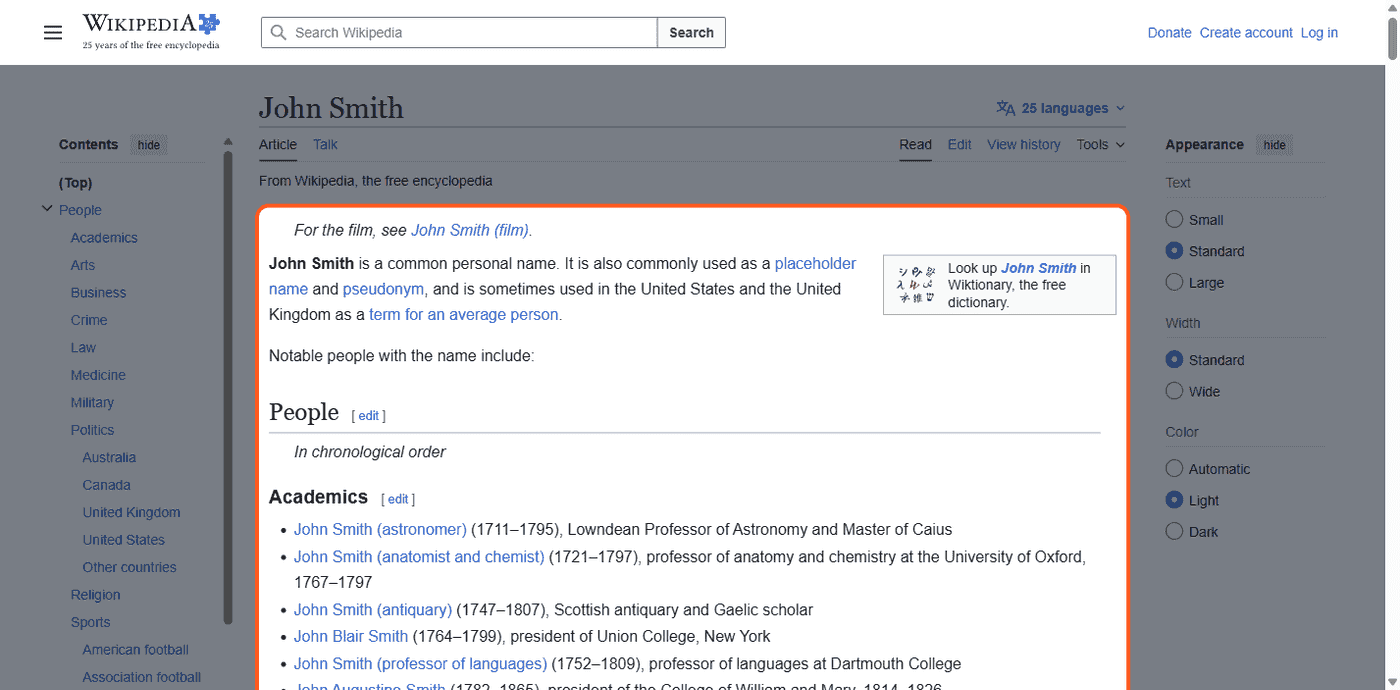
sameAslinks from a schema-marked entity home tie an identity to its authoritative profiles. They tell the systems that a website, LinkedIn page, Wikidata entry, and press profile are one identity instead of leaving them to guess. - Wikipedia disambiguation pages and distinct articles. When a name refers to more than one notable subject, Wikipedia resolves the conflict with a disambiguation page that lists the meanings and links out to a separate article for each.
- Wikidata unique identifiers. Each Wikidata item has a unique Q identifier and its own page, which gives every entity an unambiguous machine anchor no matter how much the name overlaps with others.
Why it matters for a common name
When these signals are strong and consistent, the systems resolve the entity confidently. When they are thin, with no Wikidata item, no schema, and no clean disambiguation, engines can confuse or conflate two same-named subjects. For a client with a common name or a namesake, the fix is to give Google the context it needs: dedicated, schema-marked owned properties and distinct authoritative citations, with the result verified in AIQ.
Last reviewed: 20/05/2026
