How do AI models handle disambiguation for people and companies with common names?
AI engines separate entities with common names using four infrastructure layers: a Wikipedia disambiguation page that lists the distinct subjects, a unique Wikidata Q-ID that anchors each entity, schema.org Person markup with sameAs links connecting owned pages to canonical identifiers, and contextual cues in the user's query. When these layers are in place, engines route the query to the right entity. When they are missing, the engines are far more likely to conflate one entity with its namesake.
AI engines handle common-name disambiguation using entity infrastructure. When that infrastructure is strong, the engines route a query about one person to that person and not to anyone else who shares the name. When it is absent or incomplete, the engines guess, and the guesses can be wrong in damaging ways.
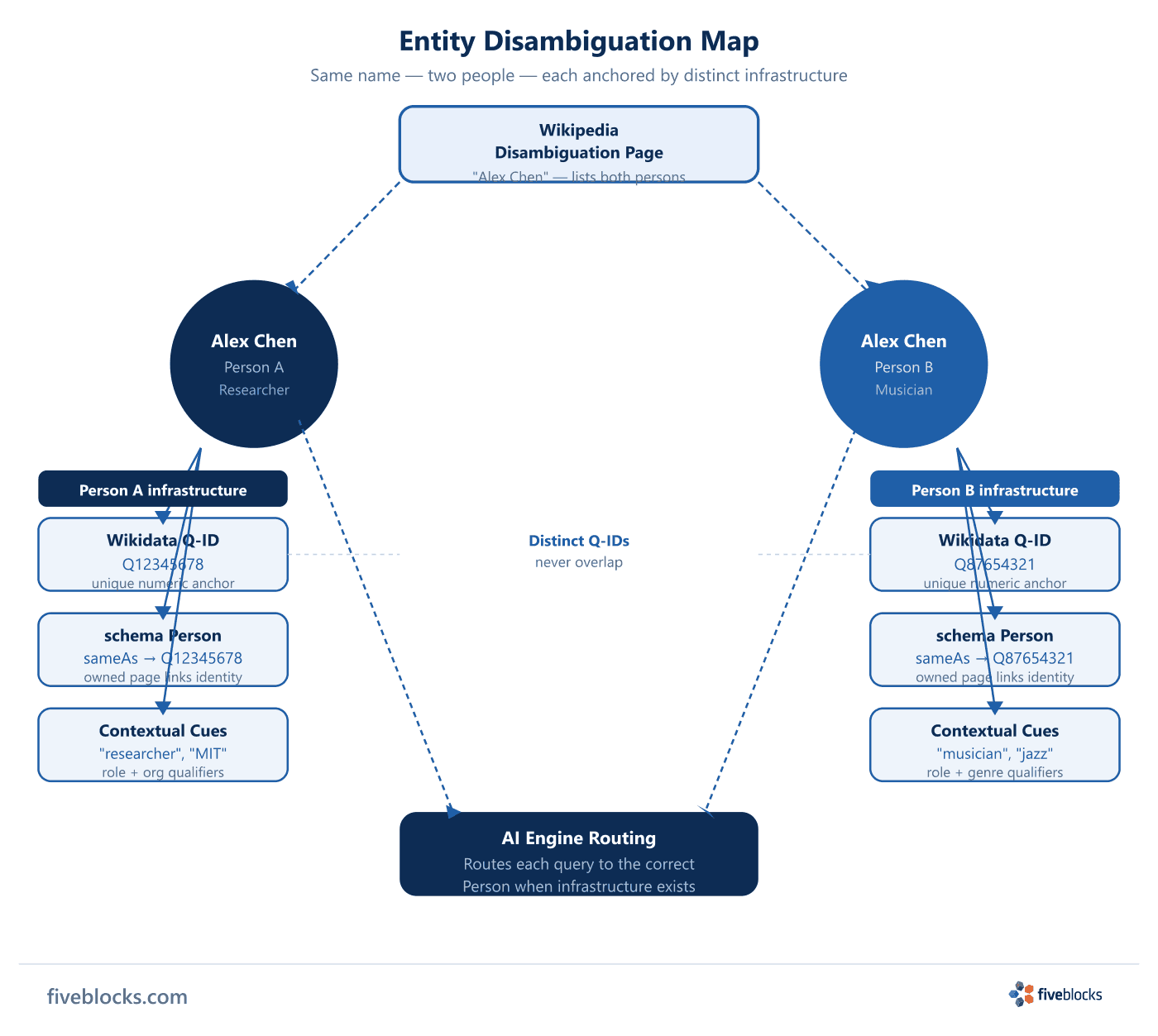
The four disambiguation layers
-
Wikipedia disambiguation pages
When several distinct subjects share the same name, Wikipedia creates a disambiguation page that lists each subject and links to its article. This is one of the primary signals engines use to tell apart entities with identical or near-identical names. Without a disambiguation page or a clearly differentiated article title, the entity is harder for an engine to separate from its namesake. Wikipedia’s own documentation defines a disambiguation page as a non-article page that lists the various meanings attached to a name and links to the articles that cover each one.
-
Wikidata unique identifiers (Q-IDs)
Every Wikidata item carries a unique Q-ID, a number prefixed with the letter Q, such as Q42 for Douglas Adams, that anchors the entity regardless of how many others share a similar name. Wikidata’s own introduction defines items as uniquely identified by Q-numbers. Each language-version Wikipedia article for that entity is linked as a sitelink on the same Wikidata item, which gives AI engines and the Google Knowledge Graph a machine-readable identity anchor to query. A missing or incomplete Wikidata entry removes that anchor and leaves the engine relying on weaker, more ambiguous signals.
-
Schema.org Person markup with sameAs links
Schema.org’s
sameAsproperty lets a brand’s owned web pages declare a reference URL that “unambiguously indicates the item’s identity”, usually the entity’s Wikipedia article, Wikidata entry, or official website. When this markup is present on a Person or Organization page, it gives AI engines and the Knowledge Graph an explicit machine-readable signal connecting the page to the canonical entity. This is the layer where owned infrastructure asserts identity directly rather than waiting for engines to infer it from surrounding text. -
Contextual cues in the query
Industry descriptors, geographic qualifiers, role titles, and co-mentioned related entities in the user’s query all act as soft disambiguation signals. These cues help when the structural infrastructure above is strong, but they cannot fully make up for a missing Wikidata entry or absent schema markup when the name overlap is close. Contextual cues are what the engine falls back on when the machine-readable layers do not resolve the ambiguity cleanly.
The conflation failure mode
When entity infrastructure is weak, meaning no Wikidata entry, no schema markup, and no clean Wikipedia disambiguation page, AI engines are more likely to conflate the target with another entity that shares the same or a similar name. Research on large language models shows that models can consistently mishandle broad classes of human names when the disambiguating contextual cues are absent. The fix is upstream: a complete Wikidata item with sourced statements and sitelinks, schema markup with sameAs pointing to Wikipedia and Wikidata, and a clear Wikipedia disambiguation page or distinct article title. These are infrastructure interventions. Prompt-layer workarounds do not address the root cause.
Last reviewed: 19/05/2026