How do you manage search results for a company that shares a name with a common word?
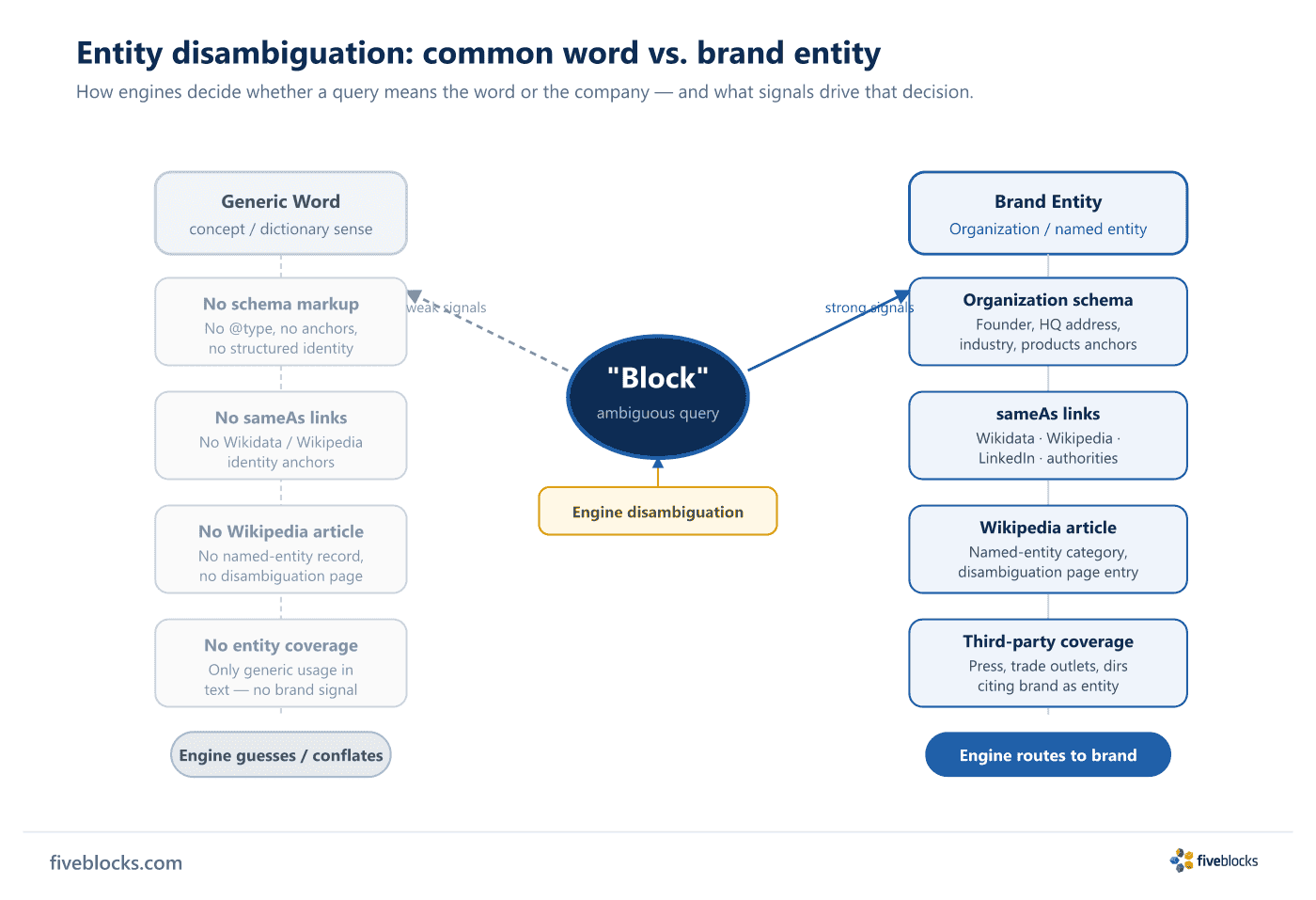
Brands with common-word names need strong entity signals: Organization schema with distinctive anchors, sameAs links tied to Wikidata and verified profiles, and a well-developed Wikipedia article where notability supports it, so search engines and AI models can tell the brand apart from the generic word and from other entities with the same name. When that infrastructure is weak, engines guess, and common-word brands often get conflated with generic usage or unrelated subjects in AI responses.
Common-word brand names, think Square, Apple, Target, or Block, start at a disadvantage: every time someone searches the brand name, search engines and AI models have to decide whether the query is about the company or the ordinary word. Entity infrastructure drives that decision, not keyword density. The stronger the entity signals, the more reliably the engines route to the brand instead of the generic concept.
Step 1: Build strong Organization schema with distinctive anchors
Apply Organization schema markup to the corporate site and fill it with anchors no generic word can share: founding year, registered headquarters address, founder names, core products and services, and industry classification. These structured fields give engines unambiguous facts that tie the brand to a specific real-world entity rather than a dictionary definition.
Step 2: Add sameAs links from the schema to verified authoritative profiles
sameAs properties inside the Organization schema connect the corporate site to the brand’s entries on Wikidata, Wikipedia, LinkedIn, and other authoritative registries. Each link is a machine-readable statement that all of these pages refer to the same entity. Engines use this identity graph to separate the brand from its namesake word and from other entities with the same name.
Step 3: Develop (or strengthen) a Wikipedia article where notability applies
Wikipedia is the strongest single disambiguation signal the engines have. A dedicated, well-developed article puts the brand in a named entity category that no generic word occupies, creates a Wikipedia disambiguation page entry when one is needed, and feeds the Wikidata record that anchors the brand’s unique identifier across the Knowledge Graph.
Step 4: Build authoritative third-party coverage that names the brand as an entity
Coverage in mainstream outlets, trade press, and industry directories that consistently uses the brand name in the company sense, not the generic word sense, teaches engines to tie that string to the corporate entity. Co-citation across authoritative sources strengthens the entity signal beyond what owned properties can do alone.
Step 5: Monitor AI engine output for disambiguation failures
Common-word brands are unusually prone to conflation in AI responses: an engine can describe the brand as if it were the generic concept, or blend facts from an unrelated entity with the same name. Monitoring across the major AI engines catches these failures early, so you can correct the underlying entity infrastructure before the wrong description spreads.
Last reviewed: 19/05/2026
