How do you manage reputation for an executive family that includes multiple public figures?
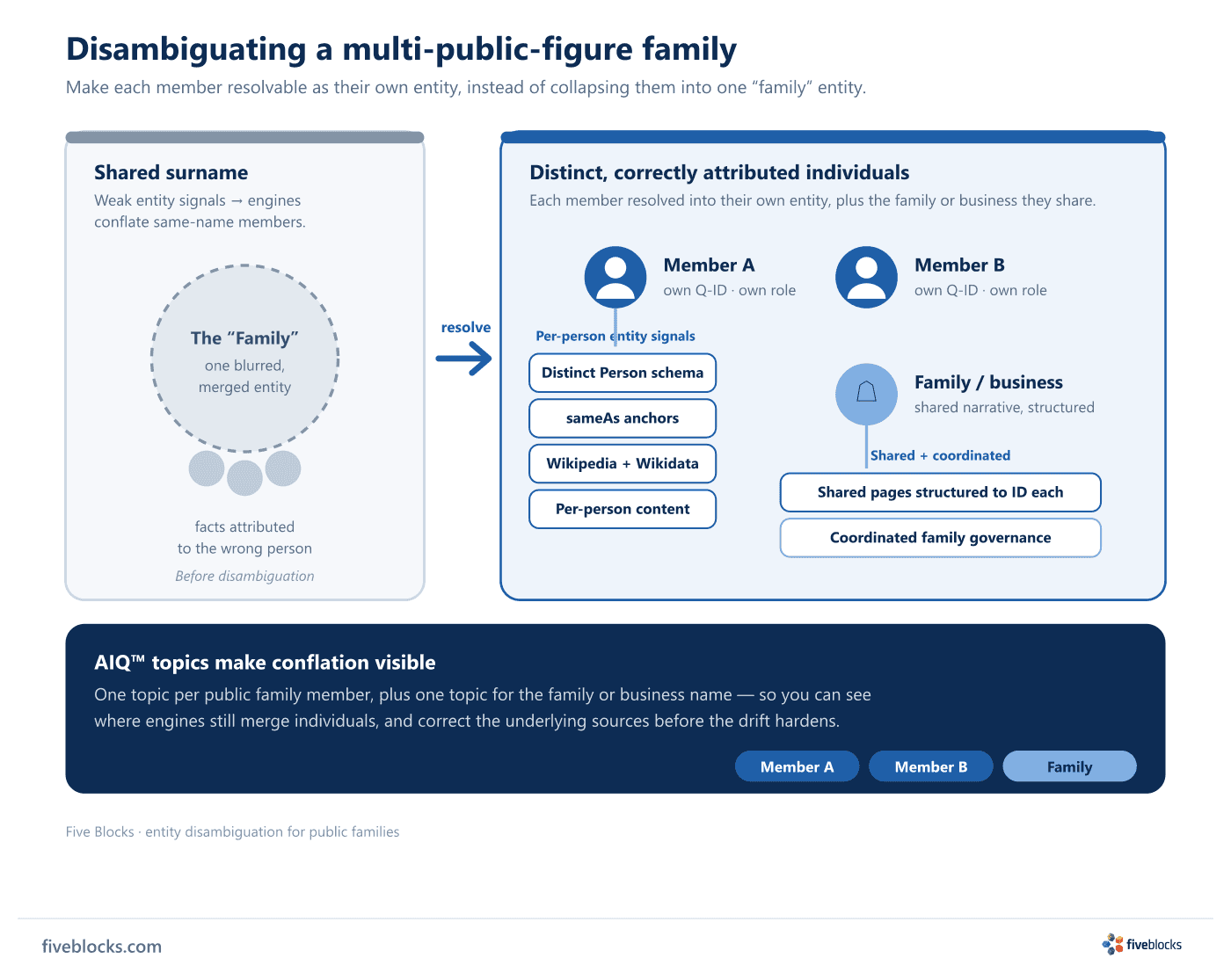
Treat each public family member as a separate entity: their own Person schema, their own Wikipedia and Wikidata records, and content about them specifically. Structure any shared family or business narrative so the engines still identify each person instead of merging them into the family unit. Run one AIQ topic per individual plus one for the family or business name, under governance coordinated across the family.
Some families have several public figures at once: business dynasties, political families, entertainment lineages. In those cases the engines have to resolve individuals who share a surname and often share coverage. The goal is to make each family member resolvable as a distinct entity, rather than letting them collapse into a single “family” entity or letting one person’s coverage drift onto another.
Why a multi-public-figure family is harder to disambiguate
When the entity infrastructure is weak (no clean schema, no distinct Wikidata items, no disambiguation anchors), AI engines can confuse or conflate distinct entities that share the same name. A shared surname plus overlapping press coverage is exactly the condition that produces that drift, so these families are unusually prone to having members merged or facts attributed to the wrong individual.
How to keep each family member a distinct entity
- Distinct Person schema per family member
- Each public family member gets their own Person schema with unique identifiers. That is what lets search and AI engines tell two same-named individuals apart instead of merging them.
- sameAs anchors to each person’s own profiles
- Person schema carries
sameAslinks to that individual’s authoritative profiles: their own LinkedIn, Wikipedia article, and Wikidata Q-ID. Those links are the biographical disambiguation anchors, and they tie scattered references back to one identity. - Accurate Wikipedia and Wikidata for each
- Where family members are notable, Wikipedia disambiguation pages and separate Wikidata items tie each person to their own roles. These are the signals Google and AI engines use to separate same-named entities, together with contextual cues and
sameAsstructured data. - Content covering each individual
- Per-person content describing what each family member actually does, rather than one blended family narrative, gives the engines distinct, attributable material for each individual.
- Shared-narrative pages structured to identify each person
- Shared pieces, such as a family-history page on a foundation or company site, are structured so each individual is correctly identified rather than collapsed into the family unit. Schema markup can tie multiple role-specific pages back to the correct Person entity.
- Per-person plus family AIQ topics
- Set up an AIQ topic for each public family member individually, plus one for the family or business name. That shows where the engines are conflating individuals and where the disambiguation work is needed, so the underlying sources can be corrected before the error settles in.
Coordinated governance across the family
These engagements usually run under governance coordinated across the family, with documented protocols for visibility, communications, and crisis response. That keeps the individual and family-level work aligned.
Done together, this work gets the engines to see the family’s actual structure: several distinct, correctly attributed individuals plus the family or business they share, instead of one undifferentiated entity.
Last reviewed: 19/05/2026
