How do you manage reputation for family members of high-profile individuals?
Family-member reputation work starts from restraint rather than visibility: the structural goal is accurate disambiguation, so the relative is not conflated with the principal. If they choose privacy, the work is defensive monitoring; if they choose public engagement, the normal structural model applies. These engagements run under unusually tight confidentiality.
Family-member reputation work starts from a different premise than executive reputation work. The protected individual usually does not want a public profile, and the structural goal is accurate disambiguation rather than visibility. Restraint is the default, and which path applies depends on whether the family member chooses privacy or public engagement.
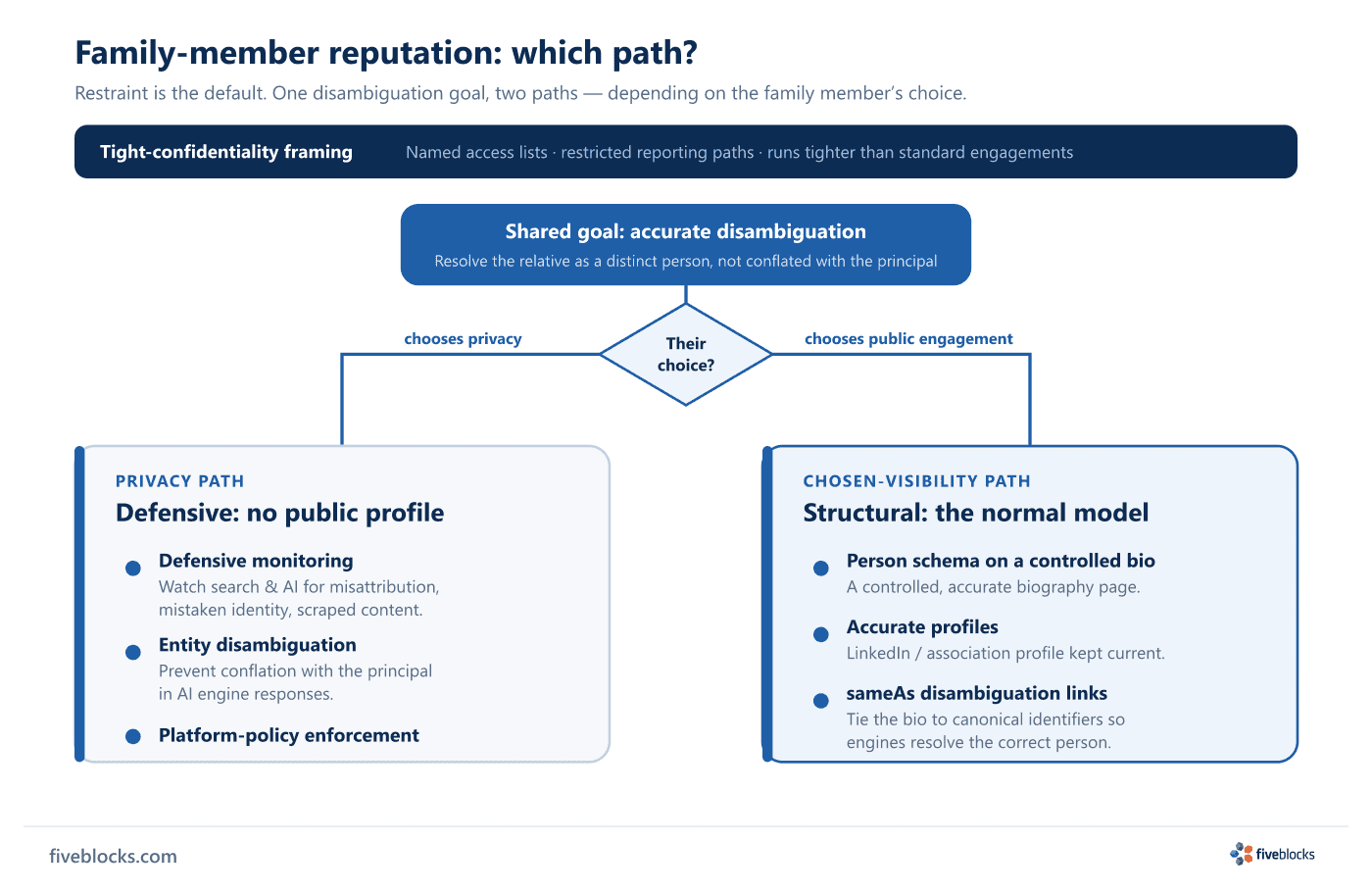
Two paths, one disambiguation goal
Both paths share one objective: AI engines and search should resolve the family member as a distinct person rather than collapse them into the principal. The work itself differs by path.
| If the family member chooses… | Privacy | Public engagement |
|---|---|---|
| Premise | No public profile wanted. Restraint is the default. | A foundation, philanthropic visibility, or a professional career makes a controlled public presence appropriate. |
| Core work | Defensive: monitoring search and AI for misattribution, mistaken identity, or scraped content. | Structural. The normal model applies: Person schema on a controlled bio, an accurate LinkedIn or association profile, and sameAs links for disambiguation. |
| Disambiguation | Entity disambiguation keeps the family member from being conflated with the principal in AI engine responses. | sameAs links tie the controlled bio to canonical identifiers so engines resolve the correct person. |
| Enforcement | Addressing platform-policy violations where they arise. | AIQ monitoring of how engines represent the public-facing identity. |
Confidentiality
Engagements involving family members run under unusually tight confidentiality, even by Five Blocks standards: named access lists and restricted reporting paths.
Last reviewed: 19/05/2026
