How do you manage personal reputation during a divorce or family dispute?
In a family dispute, less is almost always more: confidentiality is the operating principle, public statements happen only where silence would be worse, and owned content covers the individual's broader story without engaging the dispute. Engaging it makes the dispute the dominant frame and closes off the option of letting it fade.
Family-dispute reputation work is among the most delicate because the right approach is usually less rather than more. Confidentiality is the operating principle, both the dispute itself and the fact that any reputation work is happening around it. Public statements are rare and happen only where staying silent would be worse.
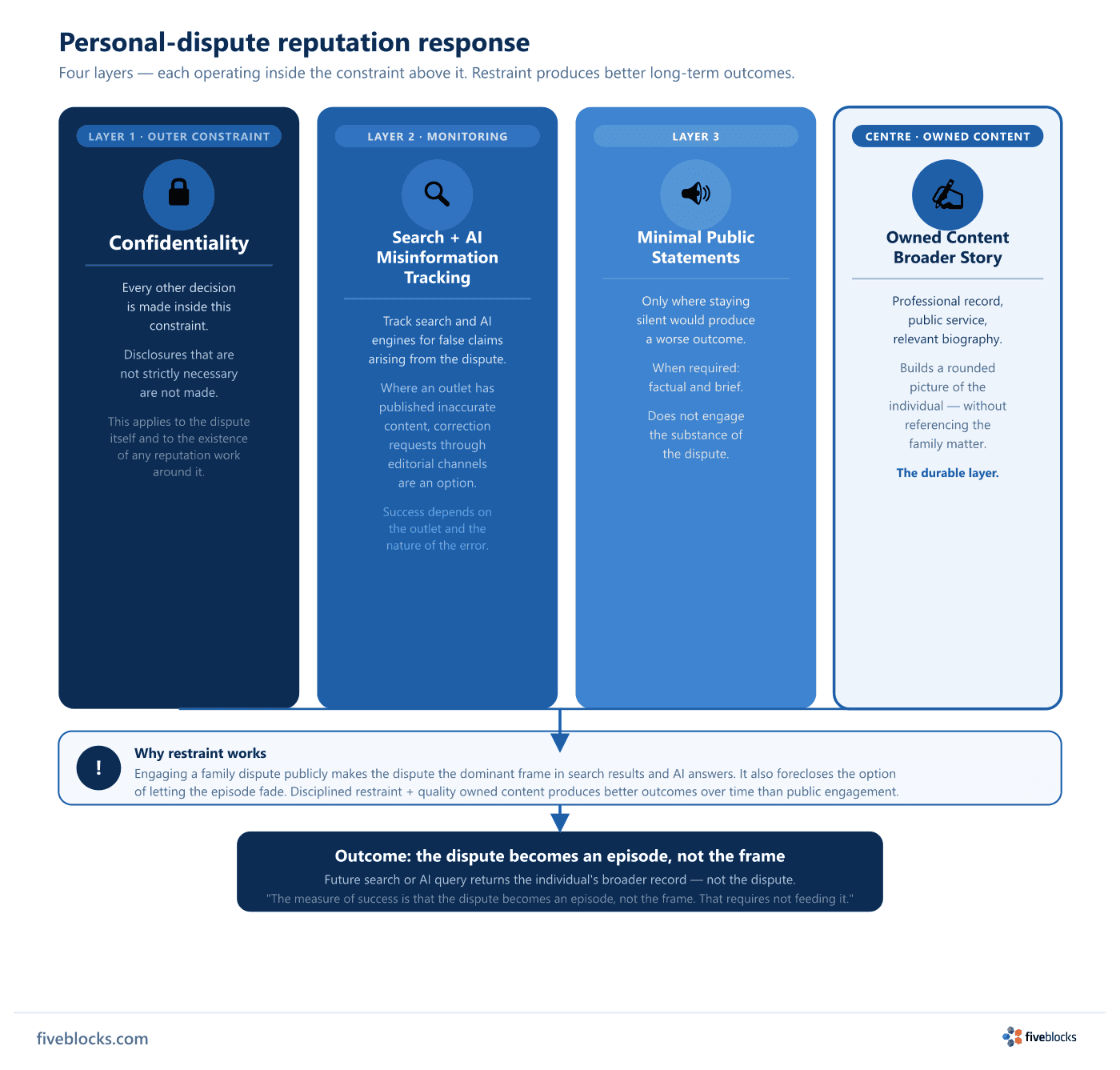
The four-layer response
- Confidentiality as the outer constraint, Every other decision is made inside it. Disclosures that are not strictly necessary are not made.
- Monitoring for misinformation, Search and AI engines are tracked for false claims that surface from the dispute. Where an outlet has published inaccurate content, a correction request through editorial channels is an option, though whether it works depends on the outlet and the nature of the error.
- Minimal, considered public statements: Where a public statement cannot be avoided, it is factual and brief. It does not engage the substance of the dispute.
- Owned content covering the broader story: Professional record, public service, relevant biography, the content that builds or maintains a rounded picture of the individual, without referencing the family matter. This is the layer that lasts.
Why restraint produces better long-term outcomes
Engaging a family dispute publicly makes the dispute the dominant frame in search results and AI engine answers. It also closes off the option of letting the episode fade. Across executives, high-net-worth individuals, and public figures, the consistent pattern is that disciplined restraint plus quality owned content produces better outcomes over time than active public engagement. The goal is for a future search or AI query to return the individual’s broader record, not the dispute.
The measure of success is that the dispute becomes an episode, not the frame. That outcome requires not feeding it.
Last reviewed: 19/05/2026
